
Beyond the Geotag: Predicting Future User Presence from Social Media Content
Predicting time-sensitive user locations from social media
The paper proposes a content-based machine learning framework to identify and categorize time-sensitive user locations from social media (Twitter). It introduces a two-stage classification process to distinguish tweets containing user-specific locations and further categorize them into "Present" or "Future" visits, achieving up to 88.2% accuracy.
TL;DR
Researchers from Xerox and University partners have developed a system that doesn't need your GPS data to know where you are—or where you're going. By analyzing the linguistic patterns of tweets, their model identifies user-specific locations with over 88% accuracy and distinguishes between where a user is now versus where they plan to be tomorrow.
Background Positioning
In the landscape of Location-Based Services (LBS), this work serves as a bridge between static "home-city" estimation and active tracking. Published at ASONAM '13, it was a pioneer in treating short-text social updates as a "social sensor" for human mobility, moving beyond the 1% of tweets that actually contain geo-coordinates.
The Problem: The Sparse Metadata Gap
Most location-aware services face a "cold start" problem: users don't geotag their posts. Only 0.87% of tweets contain coordinate metadata, and profile locations (like "New York, NY") are often static and outdated.
The challenge isn't just finding a city name in a tweet (e.g., "Earthquake in Japan!"); it's determining intent. If a user says "I want to visit Japan," that is a valuable future signal. If they say "I love Japan," it’s a sentiment. Traditional NLP often fails to distinguish these nuances in the messy, noisy world of Twitter.
Methodology: Context is King
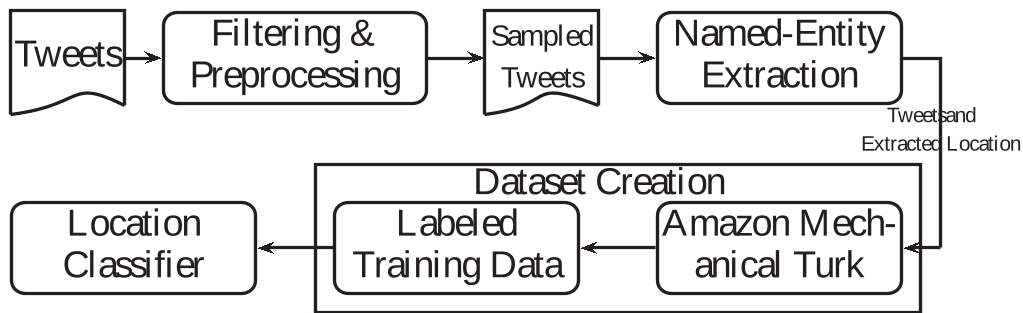
The authors developed a two-layered pipeline to extract meaning from the noise:
1. Robust Named-Entity Extraction
Standard NLP tools often break on Twitter's lack of capitalization and heavy use of slang. The authors modified the GATE (General Architecture for Text Engineering) framework to better recognize road names, airport codes, and landmarks.
2. The Two-Stage Classification
Instead of one complex model, the task is split:
- Task A (Identification): Does this tweet actually place the user at a location? (e.g., "I'm at @location" vs. "@location is beautiful").
- Task B (Categorization): Is this a "Present," "Future," or "Past" location?
Core Technical Trick: Location Masking
To avoid the model simply learning that "Vegas" is a popular destination, the authors replaced all location names with a generic @location tag. This forced the machine learning algorithms (Maximum Entropy and Naive Bayes) to learn the linguistic structure (the verbs and prepositions) rather than the names themselves.
Experimental Results & Insights
The models were tested against human-labeled data from Amazon Mechanical Turk.
- ULI (User Location Identification): MaxEnt performed best with 88.2% accuracy.
- ULC (User Location Categorization): High precision for future intent (87.7%).
One of the most compelling findings was the Temporal Analytics. By extracting time entities (e.g., "next week," "Spring Break"), the researchers could plot predicted travel volumes for Las Vegas.
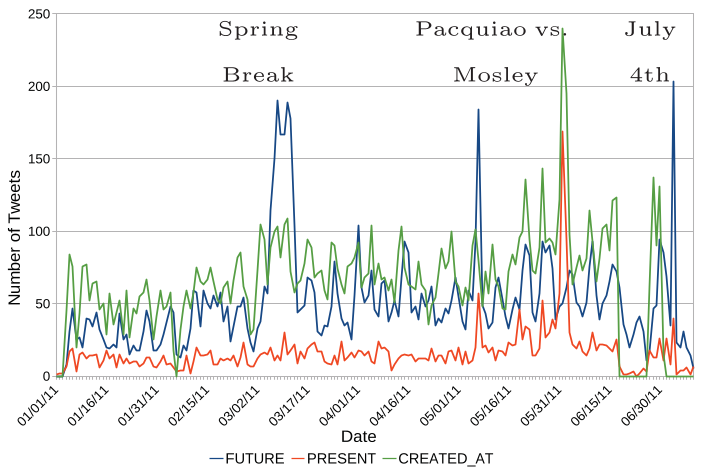
As shown in the figure above, the model successfully predicted surges in travel corresponding to "Spring Break" and the "4th of July" purely from public text data. Interestingly, people tend to tweet more about where they are going in the future than they do once they actually arrive.
Critical Analysis & Conclusion
Takeaway
This paper demonstrates that intent is often more valuable than raw coordinates. Predicting where a user will be allows businesses to offer proactive recommendations (e.g., hotel deals) rather than reactive ones.
Limitations
The system relied heavily on manually curated Gazetteers and basic ML classifiers. In today's landscape, Large Language Models (LLMs) would likely handle the "informal text" problem more robustly without custom tokenizers. Furthermore, the reliance on English-only tweets is a significant bottleneck for global applications.
Future Outlook
The authors correctly identified a growing concern: Privacy. If an algorithm can predict your future location with 90% precision from a casual sentence, it opens a Pandora's box of digital stalking and data ethics questions that the industry is still struggling to answer today.