
DA Model: Rethinking Social Trend Prediction via Dynamic Activeness
Predicting trends in social networks via dynamic activeness model
The paper introduces the Dynamic Activeness (DA) model, a novel framework for predicting dynamic social network trends by quantifying Intensity, Coverage, and Duration. Unlike traditional diffusion models, it utilizes a continuous-time "activeness" function to capture user interest and achieves superior accuracy on the DBLP co-author network dataset.
TL;DR
Predicting how a topic spreads is more than just tracing a path; it's about understanding the "fever" of the network. This paper introduces the Dynamic Activeness (DA) model, which moves away from binary infection states to a continuous-time "activeness" score. By modeling trends through Intensity, Coverage, and Duration, the authors achieve state-of-the-art accuracy in predicting academic research trends on DBLP.
Context: Why Traditional Models Fall Short
Most information diffusion models, such as the Independent Cascade (IC) or Linear Threshold (LT) models, view social networks as a series of "infections." While useful for understanding connectivity, they suffer from three major flaws when applied to real-world trends:
- Time Discretization: They often assume information moves in fixed "hops" (e.g., one step per day), missing the fluid nature of real-time interactions.
- Path Obsession: They focus on who influenced whom, whereas practitioners usually care about how many total actions (Intensity) or how many unique people (Coverage) are involved.
- Static Probabilities: They assume the chance of influence is constant across all topics, ignoring that some trends are inherently stickier or faster-decaying than others.
Methodology: The "Activeness" Intuition
The core innovation is the concept of Activeness ()—a node's momentary interest in a trend. This is treated as the "rate" parameter of a Non-homogeneous Poisson Process.
The model operates on a beautiful physical intuition:
- Propagation: When a neighbor takes an action, your "activeness" jumps. The size of this jump depends on your proximity (Shortest Path or Random Walk distance).
- Decay: Interest is a perishable resource. Without new external stimuli, a user's activeness decays exponentially over time.
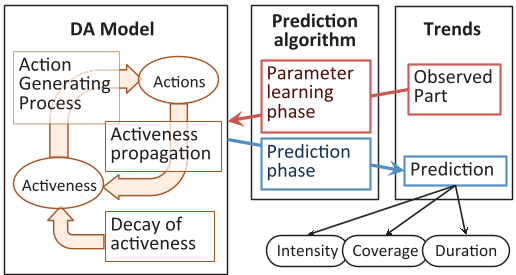 Figure 1: The DA Model Framework - Connecting action generation with latent activeness states.
The activeness of node at time is calculated by summing the decayed influence of all previous actions in the network:
Experimental Validation
The authors tested the DA model against various "Exponential Delay" versions of the IC model using 10 distinct keywords from the DBLP co-author network (e.g., "Boosting," "Privacy," "Stream").
Key Findings:
- Superior Accuracy: The DA-rw (Random Walk proximity) and DA-sp (Shortest Path) models consistently showed lower Error Ratios for both Coverage and Intensity compared to baselines.
- Stability: The "Coefficient of Variation" was markedly lower for the DA model, meaning it doesn't just predict better on average—it is more reliable across multiple simulation runs.
- Duration Prediction: The model was exceptionally good at predicting if a trend would "die out" or continue for the next 5 years, hitting 90% accuracy.
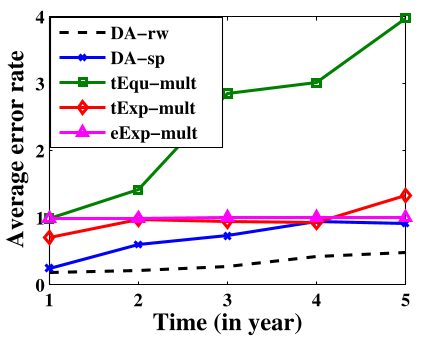 Figure 2: Performance Comparison - DA models (blue/green) show significantly lower error as time progresses.
Critical Analysis & Conclusion
The DA model succeeds because it treats social influence as a field effect rather than a simple link-by-link transmission. By allowing parameters ( for propagation and for decay) to be trend-specific, it captures the "DNA" of a particular topic.
Limitations: The model assumes the global social network is static. In fast-evolving platforms (like TikTok), the network structure itself might change as a trend progresses (e.g., people follow new accounts because of a trend), which the DA model doesn't currently account for.
Future Outlook: This work lays the groundwork for real-time trend monitoring systems. By fitting and in the early hours of a viral event, companies could predict the "Total Coverage" and "Expected Lifetime" of a meme or a product launch with high precision.
Takeaway: Trends are driven by the accumulation of interest and the inevitability of boredom. The DA model gives us the mathematical tools to measure both.