
Phillies Tweeting from Philly? Unveiling the Geography of Words
@Phillies Tweeting from Philly? Predicting Twitter User Locations with Spatial Word Usage
This paper introduces a robust framework for predicting Twitter users' home locations by analyzing the spatial usage patterns of words in their tweets. The authors propose the use of Gaussian Mixture Models (GMM) for spatial density estimation and introduce two novel unsupervised methods, Non-Localness (NL) and Geometric-Localness (GL), to identify "local words" that are highly indicative of specific geographic regions.
TL;DR
Researchers have developed a way to pinpoint where Twitter users live just by looking at the specific words they use, such as sports teams or local landmarks. By employing Gaussian Mixture Models (GMM) and new unsupervised filtering methods, they can match the accuracy of professional human-labeled systems using only 250 key "local words," significantly reducing the computational overhead and manual labor previously required.
The "Noise" Problem in Social Media Geolocation
Most of what we tweet is geographically "useless." Words like "the," "lunch," or "happy" are used everywhere. If a model tries to predict your location based on your entire vocabulary, the signal gets drowned out by this global noise.
The current SOTA (State-of-the-Art) approach solved this by having humans manually label thousands of words as "local" or "non-local." However, this is a scaling nightmare. Language on the internet changes too fast for humans to keep up. The researchers behind this paper asked: Can we find these geographic anchors automatically?
Methodology: The Geometry of Language
The paper introduces two core innovations to solve the automation problem:
1. Modeling Multi-Center Interests with GMM
Previous models struggled with "polycentric" words. For example, the word "Giants" has two massive geographic peaks: New York (NFL) and San Francisco (MLB). Simple maximum likelihood models often blur these together. By using Gaussian Mixture Models (GMM), the authors can model multiple "hotspots" for a single word, allowing the system to understand that a user might be in one of several specific cities.
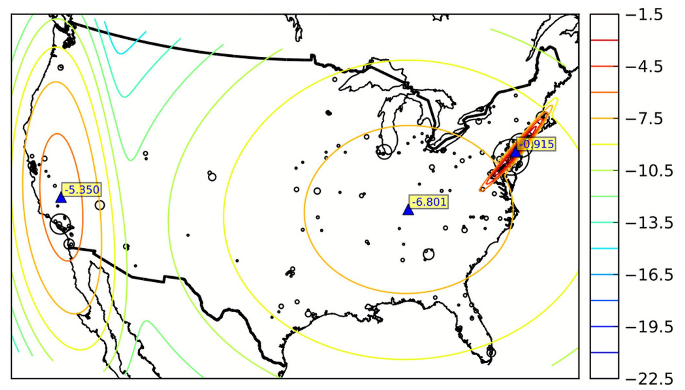 Figure 1: Comparison of word distributions. (a) shows 'phillies' centered in Philadelphia, while (b) shows 'giants' with distinct peaks in NY and SF.
2. Unsupervised Local Word Selection
To avoid manual labeling, the authors proposed two metrics:
- Non-Localness (NL): This compares the distribution of a word against "stop words" (like "and", "the"). If a word's geographic distribution looks nothing like a common stop word, it’s likely a local anchor.
- Geometric-Localness (GL): This measures "peakiness." A local word should have high probability in only a few cities that are geographically clustered together.
Experimental Results: Less is More
The results were striking. While using the entire corpus yielded poor accuracy (~10-19%), filtering for the top 2,000 to 3,000 local words boosted accuracy to over 40%.
Even more impressively, when the authors combined Localness with Frequency, they found that they could achieve an Accuracy of 0.499 using only 250 words.
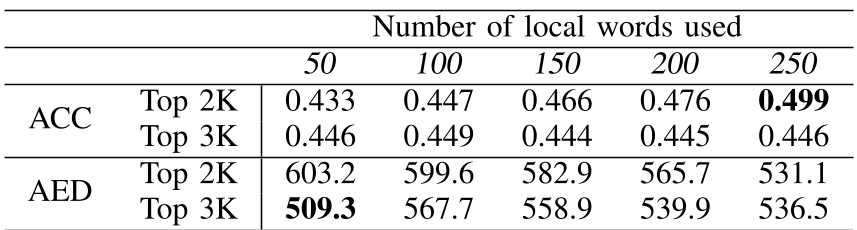 Table 5: Results showing that with a carefully selected set of just 250 words, the model achieves its peak performance, significantly outperforming broader word sets.
Critical Insight & Conclusion
The genius of this work lies in the realization that toponyms (place names) and local entities (like "Obama" or "Lakers") dominate the geographic signal. By focusing the model's "attention" on these few high-leverage terms through unsupervised spatial analysis, we gain both speed and accuracy.
Limitations: The model currently focuses on US cities with populations over 5,000. It also doesn't yet account for social network links (who you follow), which could further refine location estimates.
Future Outlook: This approach paves the way for real-time location-based marketing and disaster response tracking that can adapt to new slang and trending topics instantly, without ever needing a human to update a dictionary.