
Decoding the Digital Ballot: Machine Learning the Italian Political Landscape
Predicting Twitter Users' Political Orientation: An Application to the Italian Political Scenario
This paper presents a large-scale supervised learning approach to classify the political orientation of Italian Twitter users. Utilizing a manually-labeled dataset of 6,685 users and nearly 9.6 million tweets, the authors implement various NLP classifiers to achieve SOTA-level accuracy in binary (Left vs. Right) orientation prediction.
TL;DR
Researchers from the University of Padova have developed a highly accurate framework for predicting political orientation on Twitter. By moving beyond simple hashtag counting into deep NLP-based content analysis, they achieved 93% accuracy in distinguishing between the Italian Left and Right. Usefully, they also cracked the code on the "identity crisis" of the Movimento 5 Stelle (M5S), proving that data can reveal party leanings even when the party's own platform remains ambiguous.
Background: The Italian Complexity
Unlike the US two-party system, Italian politics is a multi-dimensional chess game. With the rise of the Movimento 5 Stelle (M5S)—a party that resists traditional "Left" or "Right" labels—scholars have struggled to categorize the electorate. This paper establishes a new benchmark by creating a massive, human-labeled dataset of Italian political discourse, providing a ground truth that is far more reliable than automated "follower-based" labeling.
Methodology: High-Fidelity Labels & NLP
The core strength of this research lies in its Data Pipeline. Instead of assuming "you are who you follow," the authors used a pool of 5 human judges to manually categorize users based on their actual tweet content and commentary.
The Engine
- Preprocessing: Removing URLs, emojis, and stop words while normalizing Italian/English text.
- Vectorization: Using TF-IDF (Term Frequency-Inverse Document Frequency) to highlight unique political vocabulary.
- Dimensionality Reduction: Applying Truncated SVD to handle the sparse nature of tweet data.
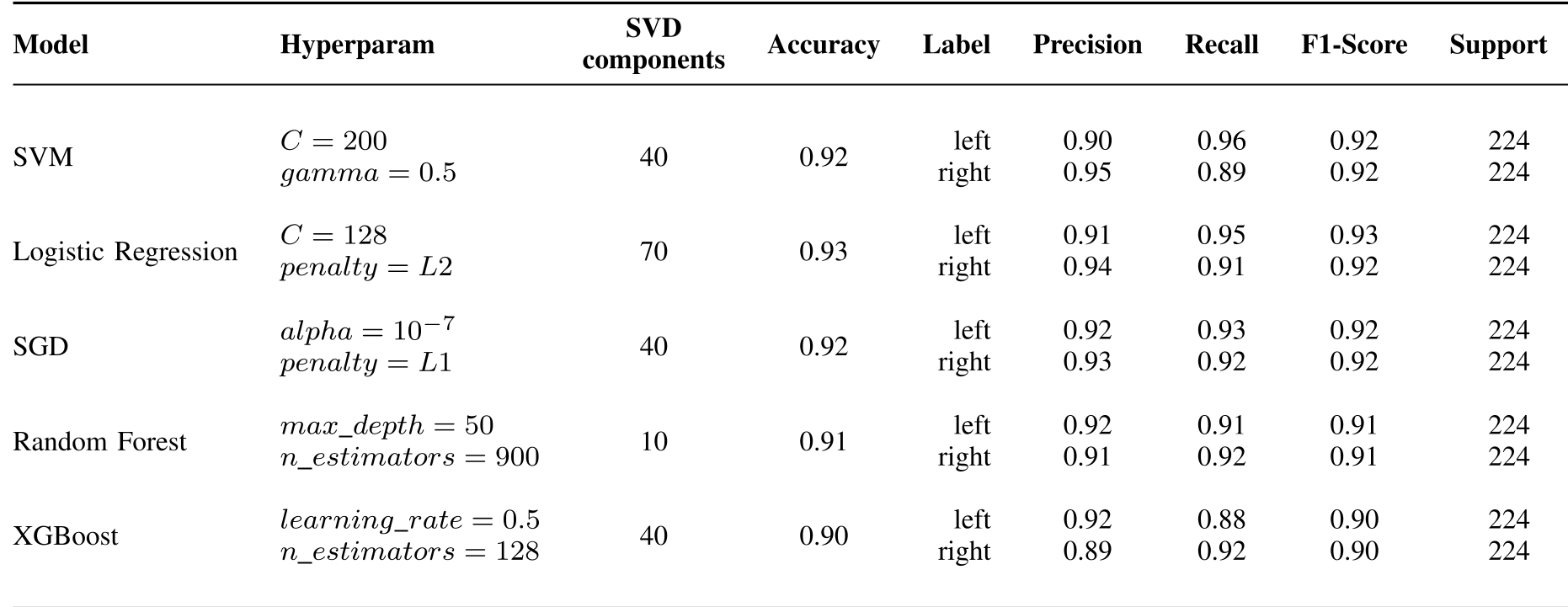
- Classification: Testing five heavy-hitters including SVM, Logistic Regression, and XGBoost.
Key Insights: The "Out-Party" Obsession
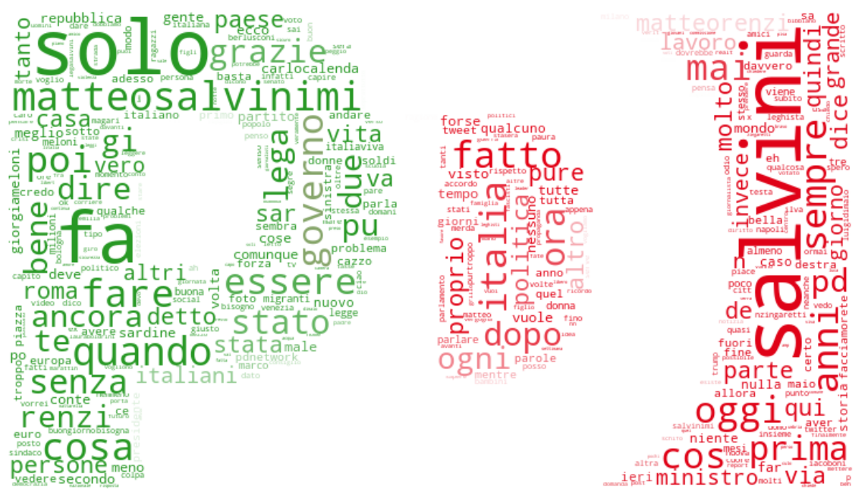
One of the most fascinating findings (as seen in the Word Cloud analysis below) is the phenomenon of Affective Polarization.
- Left-wing supporters mentioned "Salvini" (the Right-wing leader) more frequently (32 times/user) than Right-wing supporters did (30 times/user).
- Right-wing supporters mentioned the "PD" (the main Left-wing party) as their 6th most frequent word.
This confirms a chilling reality of social media: users are more defined by who they hate than who they follow.
Resolving the M5S Ambiguity
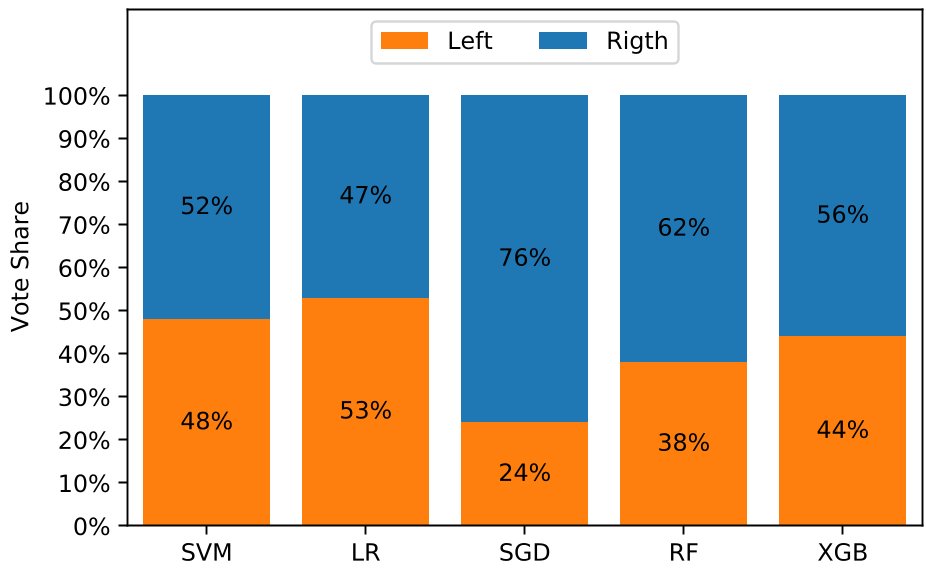
The researchers used their trained "Left/Right" classifiers to view the elusive M5S supporters through a binary lens. The results provide a data-driven answer to a long-standing political question: Where does M5S actually sit?
By analyzing 801 M5S supporters, the models (specifically Logistic Regression and SGD) showed a clear trend towards the Right. At a 75% agreement threshold among models, 51% of M5S supporters were classified as Right-leaning, compared to just 32% for the Left.
Critical Perspective & Future Outlook
While the 93% accuracy is impressive, the study acknowledges significant limitations. The removal of emojis—often the primary transporters of sentiment and sarcasm in Italian culture—is a notable loss of potential signal. Furthermore, while the models are excellent at predicting current orientation, they do not yet account for the temporal shift of voters over time.
Takeaway: This work represents a massive leap for European computational social science. As digital advertising expenditures for online campaigns continue to skyrocket, the ability to decode the "silent signals" in voter text will become the most valuable tool in a political strategist's arsenal.
Conclusion
The study proves that our digital footprints are more than just noise; they are highly structured indicators of our deepest ideological commitments. Whether we like it or not, our tweets say exactly where we stand on the political spectrum, even when we think we're just criticizing the "other side."