
Predicting Personal Unemployment: A Markovian Machine Learning Approach
Predicting Unemployment with Machine Learning Based on Registry Data
The paper introduces a Markov chain-based framework using machine learning and administrative registry data to predict individual labor market states. By modeling persons with specific transition rates (entry/exit), the study achieves a high predictive accuracy for long-term unemployment (AUC 0.80) and short-term status (AUC 0.90+).
TL;DR
Researchers from the University of Turku have developed a predictive framework that treats a person's employment history as a stochastic process. By leveraging a five-year administrative registry from Finland, they built a Markov chain model with person-specific transition rates that can predict lifetime unemployment risks with an AUC of 0.80 and short-term job status with over 90% accuracy.
Background & Positioning
Reliably predicting who will become unemployed—and for how long—is a "holy grail" for social policy. Historically, this has been split into two camps: Macroeconometrics (predicting national rates) and Microeconometrics (analyzing how specific factors like education affect duration). This paper bridges the gap by using Machine Learning to handle individual heterogeneity at scale, positioning itself as a transition from descriptive statistics to proactive personal-level risk assessment.
The Problem: The Heterogeneity Gap
Standard models often fail because people aren't economic averages. Two individuals with the same degree might have vastly different career trajectories due to unobserved factors like motivation, networking, or health. Existing methods typically treat unemployment as a single event, whereas the reality is a series of recurrent spells. The challenge is modeling these transitions dynamically over time while accounting for both observed covariates and hidden personal traits.
Methodology: The Markov Chain Intuition
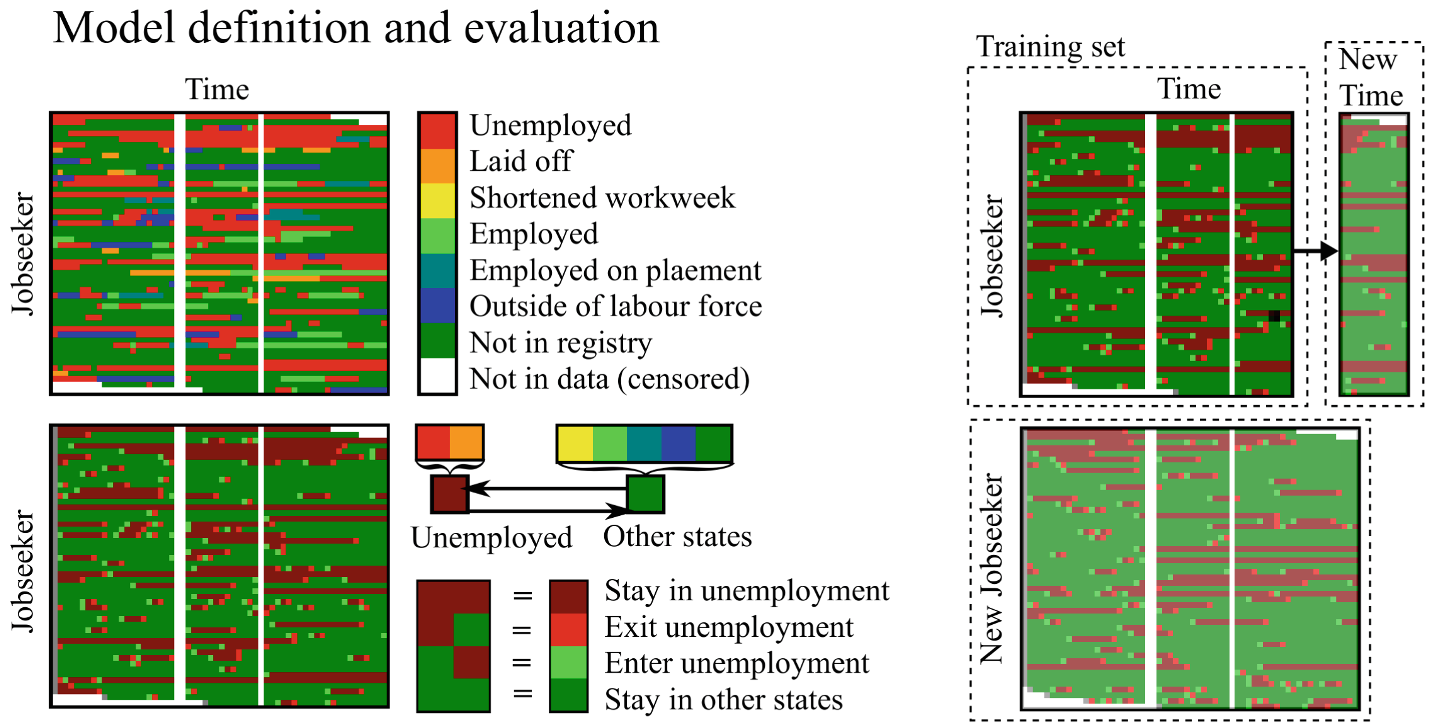
The core innovation lies in treating each citizen as a two-state Markov chain.
1. The Rate Matrix
The model calculates two vital rates:
- : The rate of exiting unemployment (finding a job).
- : The rate of entering unemployment (losing a job).
2. Person-Specific Intercepts
The researchers used a Linear Machine Learning (LML) approach with regularization to estimate person-specific intercepts (). These intercepts act as "latent profiles" that capture the inherent risk of a person beyond what their age or education suggests.
Experiments and Results
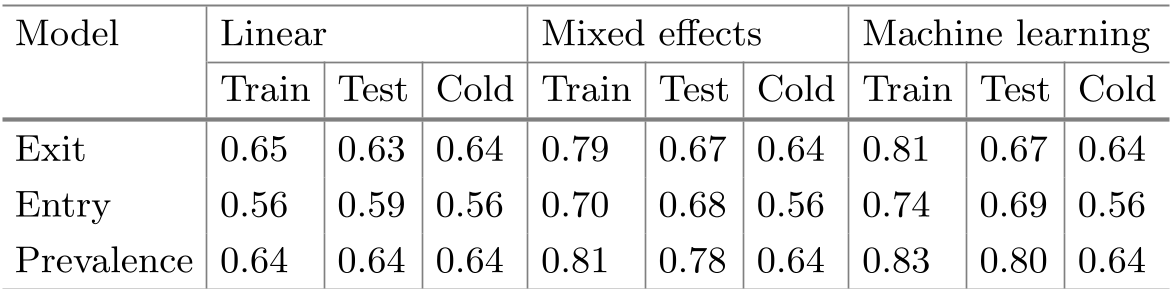
The model was tested on three tasks: Exit Risk, Entry Risk, and Prevalence (the total time spent unemployed).
Key Findings:
- Predictive Power: The model excels at "Prevalence" (AUC 0.80), proving that labor market history is a better predictor of the future than static snapshots.
- Near-Term Accuracy: When the recent state is known, the AUC for 1-month-forward prediction hits 0.95, though this decays to 0.80 over a 12-month horizon as the "memory" of the Markov chain fades.
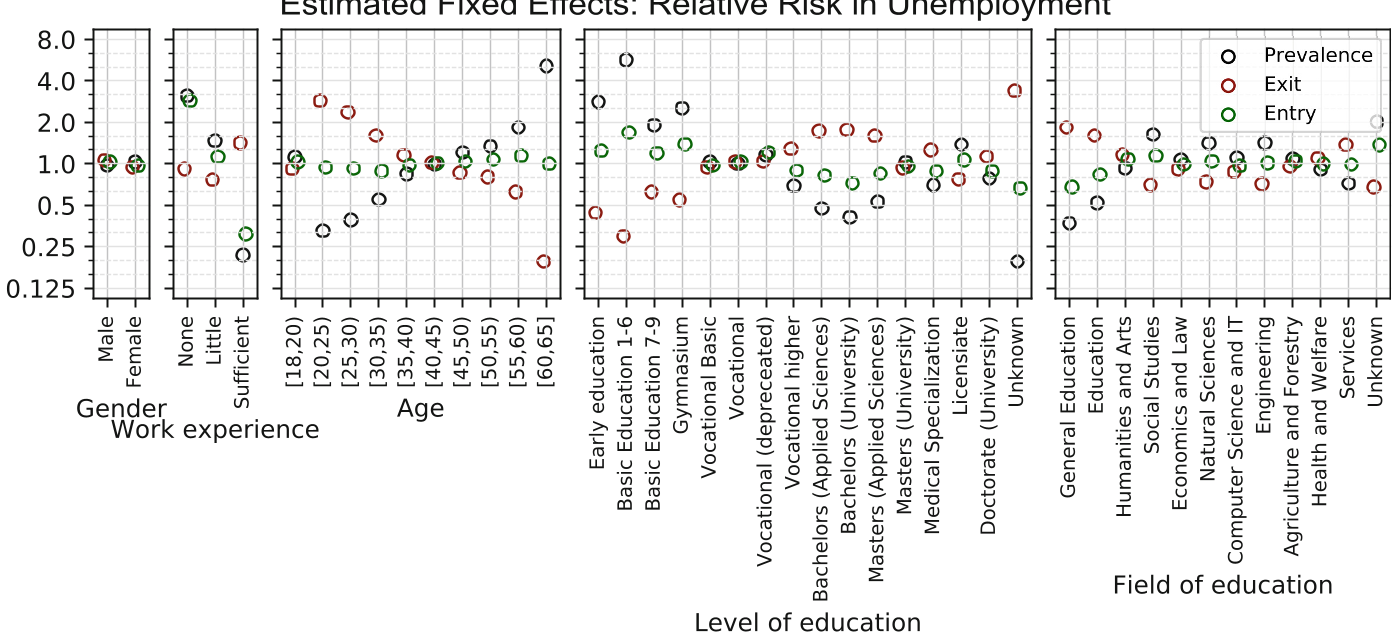
- Covariate Impact: Being over 55 or having no prior work experience increases expected unemployment prevalence by nearly 400%.
Visualizing the Correlation
The study found a significant negative correlation (-0.71) between entry and exit rates. This mathematically confirms the "double-whammy" effect: individuals who struggle to find jobs are also more likely to lose them quickly.
Critical Analysis & Conclusion
This work demonstrates that simple linear models, when framed correctly within a stochastic process (Markov chains), can outperform complex black-box models that ignore temporal dynamics.
Limitations:
- Registry Bias: The model only "sees" people who have been unemployed at least once. It may overestimate risk for the general population.
- Data Granularity: Monthly sampling misses "micro-spells" (jobs lasting only weeks).
Future Outlook: Integrating this with Non-linear models (Boosted Trees) and richer feature sets (industry-specific trends) could create a real-time "early warning system" for social services, allowing for intervention before a worker enters a cycle of long-term unemployment.