
Trust is the Gatekeeper: Predicting Technology Uptake in Family Dispute Resolution
Predicting uptake of technology innovations in online family dispute resolution services: An application and extension of the UTAUT
This study evaluates an extended Unified Theory of Acceptance and Use of Technology (UTAUT) to predict staff uptake of an Online Family Dispute Resolution (OFDR) system. By integrating Trust and Personal Web Innovativeness, the research achieves a variance explanation of 55% for behavioral intention using Partial Least Squares (PLS) modeling.
TL;DR
As family law moves online, the success of technological shifts depends less on "social pressure" and more on "technical trust." This study extends the UTAUT framework to show that for professional staff, the belief that a system is reliable (Trust) directly lowers the perceived barrier to entry (Effort Expectancy), ultimately determining whether they will use the innovation.
Background: The High-Stakes Shift to OFDR
In Australia, mandatory mediation for parental separation has flooded family dispute resolution (FDR) services. To cope, organizations are pivoting to Online Family Dispute Resolution (OFDR). However, implementing tech in a field defined by high emotional distress and legal sensitivity isn't just a IT hurdle—it's a psychological one. This work analyzes the "pre-contemplation" phase: what do staff think before the system even goes live?
Motivation: Why Standard Models Aren't Enough
While the Unified Theory of Acceptance and Use of Technology (UTAUT) is the gold standard for predicting IT uptake, it often treats users as passive recipients of corporate tools. The authors argue that in specialized fields like family mediation, two factors are ignored:
- Trust: If the Internet is perceived as risky or the internal IT infrastructure is buggy, staff won't touch new tools.
- Innovativeness: Individual personality traits regarding technology exploration (Web Innovativeness) shape how valuable a person thinks a tool is.
Methodology: The Extended UTAUT Framework
The researchers surveyed 127 staff members at Relationships Australia Queensland (RAQ) and used Partial Least Squares (PLS) path modeling. They didn't just look at "What" staff intended to do, but "How" their underlying beliefs influenced that choice.
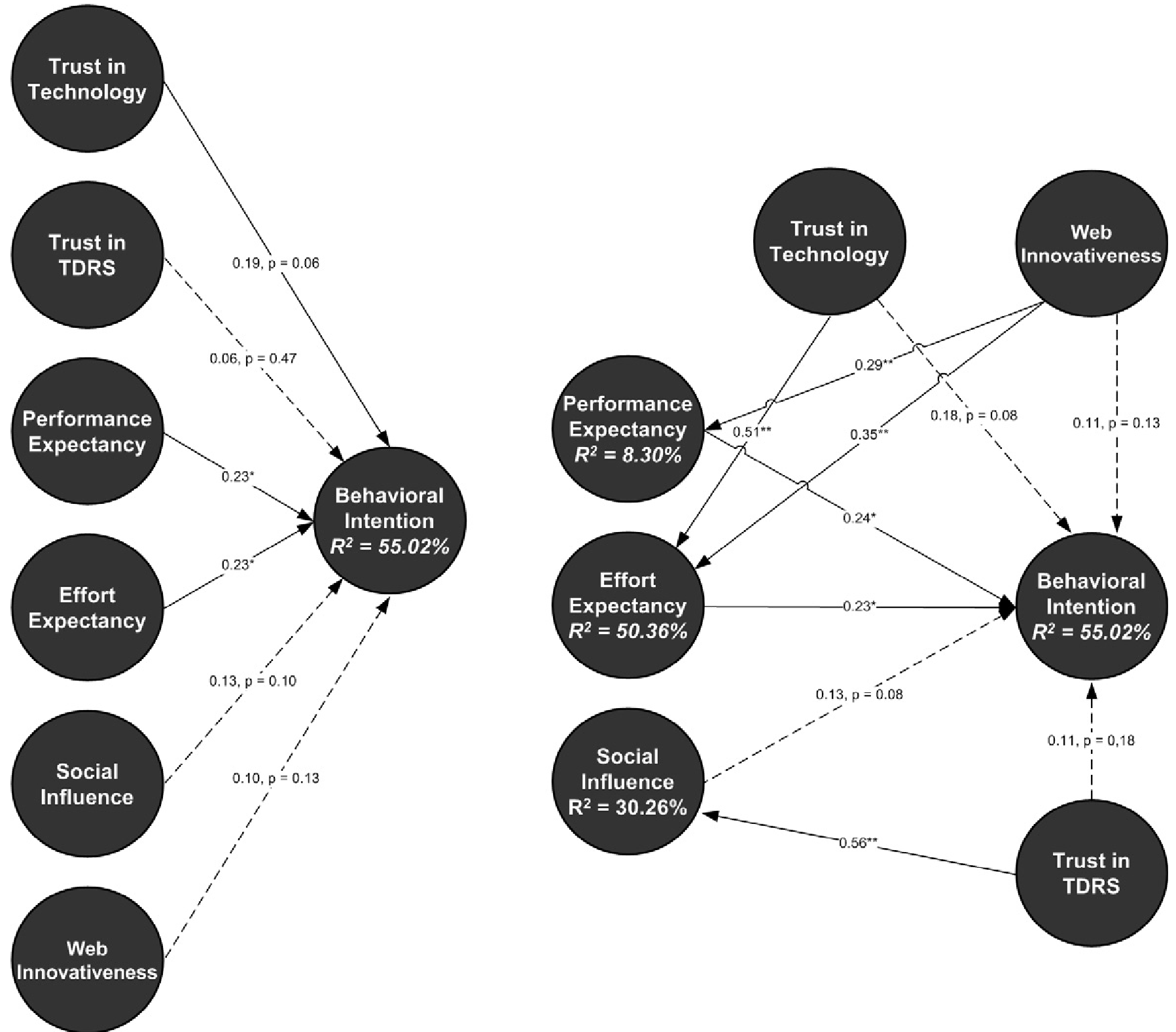 Figure 1: The structural model showing direct effects and mediated pathways from Trust and Innovativeness to Behavioral Intention.
Core Insights: The "Effort" Filter
One of the most striking findings was the role of Effort Expectancy.
- Trust as a Mediator: The study found that Trust in Technology does not necessarily make a tool feel "more useful" (Performance Expectancy), but it significantly makes it feel "easier to use" (Effort Expectancy). If staff trust that the system won't crash, they perceive the mental effort of learning it as lower.
- The Social Influence Paradox: Surprisingly, Social Influence (what colleagues and bosses think) did not directly drive the intention to use the tool. This suggests that for professionals in FDR, individual professional judgment and technical reliability outweigh peer pressure.
Experimental Results & Data Validations
The measurement model was rigorous, utilizing Multiple Imputation (MI) to handle missing data and ensuring high Average Variance Extracted (AVE) across all constructs.
 Table 1: Reliability indices and Inter-construct correlations confirming the validity of the scales used.
The results showed that Performance Expectancy and Effort Expectancy remained the strongest direct predictors of Behavioral Intention. Interestingly, "Web Innovators" were much more likely to see the tool as beneficial, suggesting that change management should target "Early Adopters" to champion the system.
Critical Analysis & Conclusion
Takeaway for Change Managers
- Fix the Foundation: You cannot successfully launch a new OFDR platform if your current office IT is unreliable. Staff generalize their distrust.
- Highlight Utility: Since Performance Expectancy is a top driver, internal marketing should focus on how the tool helps settle disputes faster, not just that "it's new."
- Trust Cues: Use security logos and rigorous pre-launch testing to signal reliability.
Limitations
The study is cross-sectional and "pre-contemplation." Actual usage behavior might differ once the staff faces the reality of "screen fatigue" or technical bugs in real-time mediation. Future research must bridge the gap between "Intention" and "Long-term Usage."
In conclusion, the successful digitization of social services rests on the human element of Trust. By addressing technical anxiety early, organizations can ensure that technological innovation actually translates into better outcomes for families in crisis.