
Deciphering the Dialogue: Predicting User Intents and Satisfaction in Conversational Recommendations
Predicting User Intents and Satisfaction with Dialogue-based Conversational Recommendations
This paper introduces two hierarchical taxonomies for classifying user intents and recommender actions in multi-turn Dialogue-based Conversational Recommender Systems (DCRSs). By employing machine learning models like XGBoost and MLP on the ReDial dataset, the authors achieve high-performance results in predicting user intents and satisfaction, demonstrating the critical role of context and dialogue behavior features.
TL;DR
Building a truly conversational recommender requires more than just item matching—it requires "social intelligence." This paper tackles the challenge of multi-turn DCRSs by creating a structured roadmap of user intents and recommender actions. By analyzing human-to-human dialogues, the researchers developed models that can predict what a user wants next and whether they are ultimately happy with a recommendation, achieving high precision by focusing on the context of the conversation.
Background: Beyond the One-Shot Recommendation
Most current AI assistants act like vending machines: you ask, they provide, and the interaction ends. However, real-world shopping or movie-seeking is a journey. Users critique, change their minds, and ask for clarifications. This paper identifies a major gap: we don't have a standardized way to categorize these multi-turn interactions, making it hard to train models that "understand" the flow of a recommendation dialogue.
The Core Insight: Two New Taxonomies
The researchers didn't just throw data at a neural network; they used Grounded Theory to build two hierarchical taxonomies:
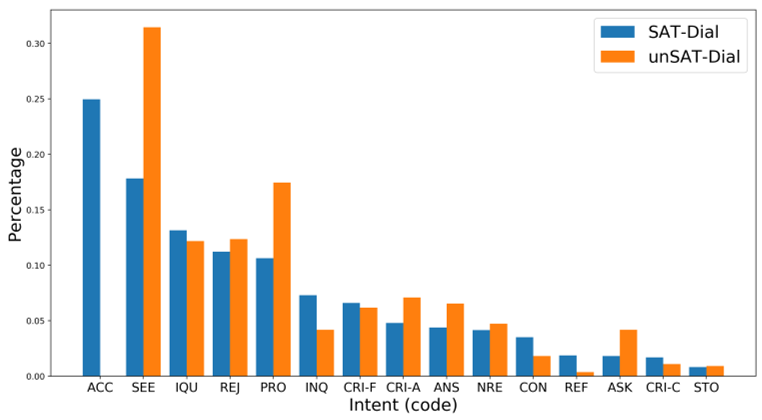
- User Intents: 15 categories such as Critique-Feature, Provide Preference, and Inquire.
- Recommender Actions: 9 categories including Recommend-Explore and Explain-Preference.
This structured approach allows the system to treat a dialogue as a sequence of high-level "behaviors" rather than just a bag of words.
Methodology: The Power of Context
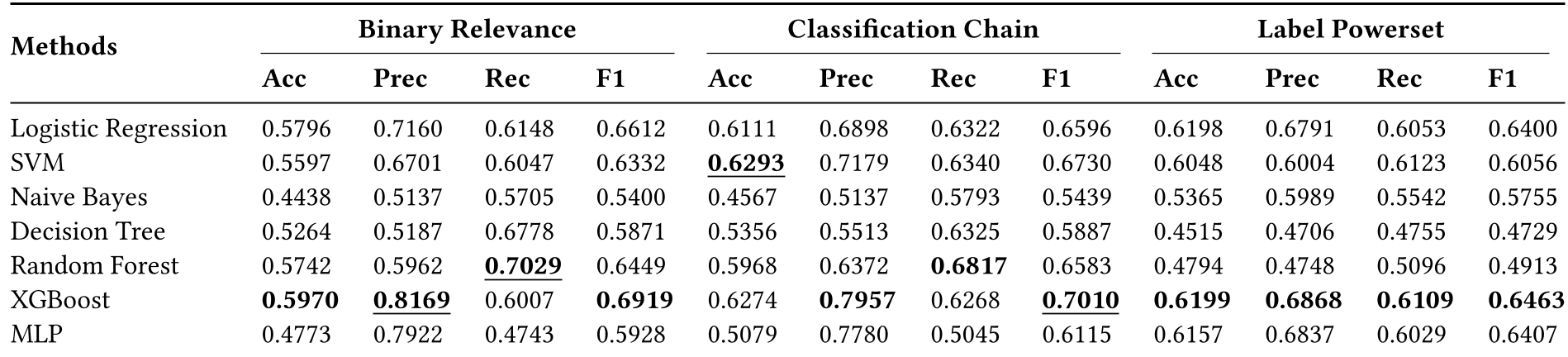
The study compared classical Machine Learning (XGBoost, SVM, MLP) with Deep Learning (CNN, Bi-LSTM). Surprisingly, XGBoost paired with Context Features (like the previous action taken by the recommender) performed best.
The methodology split features into four tiers:
- Content: What was said (TF-IDF, entities).
- Discourse: How it was said (Sentence length, POS tags).
- Sentiment: The emotional tone.
- Context: The "Where" and "When" (Position in dialogue, similarity to previous turns).
Architecture Highlight: Feature Importance
The experiment proved that Context is king. Knowing that the recommender just asked a question significantly boosts the probability of correctly identifying a user's Answer intent.
Experimental Results: Predicting "Success"
The paper defines "Satisfaction" as whether the user eventually accepts a recommendation.
- Intent Prediction: Achieving an F1-score of ~0.70 with XGBoost.
- Satisfaction Prediction: The MLP model reached a precision of 0.8990.
Interestingly, the researchers found that explanations matter. Satisfactory dialogues (SAT-Dial) had a higher frequency of Explain-Introduction and Explain-Preference actions compared to failed dialogues.
Critical Analysis & Future Outlook
While the results are robust, the paper notes a few hurdles:
- Data Scarcity: Deep learning models underperformed classical ones, likely due to the limited size of the annotated ReDial subset.
- Domain Specificity: The taxonomy was built on movie data. Whether "I want something more recent" translates well to the fashion or electronics domain remains to be seen.
The Takeaway: For developers building the next generation of Shopping or Entertainment bots, the message is clear: Model the behavior, not just the text. Understanding the intent behind a critique is the secret sauce to turning a frustrated user into a satisfied customer.
Conclusion
This work provides a foundational framework for making conversational AI more "human-like" in its reasoning. By bridgeing the gap between linguistics and recommendation logic, Cai and Chen have mapped out the "dance" between seekers and recommenders.