
Predicting Political Affiliation: Why Your Stance on Issues Matters More Than Who You Follow
Predicting User’s Political Party using Ideological Stances
This paper introduces a novel political party prediction framework that leverages users' ideological stances on controversial sociopolitical issues. By formulating the problem as a recommendation task, the authors employ Probabilistic Matrix Factorization (PMF) to address data sparsity, achieving a state-of-the-art accuracy of 88.9% on the debate.org dataset.
TL;DR
In the digital age, your "digital breadcrumbs" often reveal your politics. This paper demonstrates that ideological stances—your positions on controversial topics like gun rights or healthcare—are powerful predictors of your political party. By applying Probabilistic Matrix Factorization (PMF) to fill in the gaps of missing user opinions, researchers achieved nearly 89% accuracy in classifying Democrats and Republicans, even when users only voiced opinions on a fraction of topics.
Background: The Limits of Social Networks
Most existing political prediction models look at who you follow or what hashtags you use. However, social networks are messy: political opponents often follow each other to argue, and hashtags can be ambiguous. This research shifts the focus to Ideology. The core insight is simple: an individual leans toward a party that mirrors their personal belief system. If we know your stance on abortion and the death penalty, we can predict your party with high confidence.
The Sparsity Challenge
The "Catch-22" of using stances is Data Sparsity. Most users on platforms like debate.org don't comment on every single issue. They might argue about "National Healthcare" but stay silent on "Flat Taxes."
In the study's dataset, the initial sparsity was around 23%, but it can go much higher in real-world applications. Standard clustering fails here because the "distance" between two users cannot be calculated if they haven't commented on the same issues.
Methodology: Collaborative Filtering for Beliefs
The authors treat political stances like movie ratings in a recommender system (e.g., Netflix).
- Users: The individuals in the forum.
- Items: Controversial sociopolitical issues.
- Ratings: Support (Pro) or Oppose (Con).
The Model: Probabilistic Matrix Factorization (PMF)
While they tested many methods (Memory-based, SVD, Slope-One), PMF emerged as the winner. PMF models the user-issue matrix by uncovering "latent factors"—hidden dimensions that explain why a user holds certain beliefs.
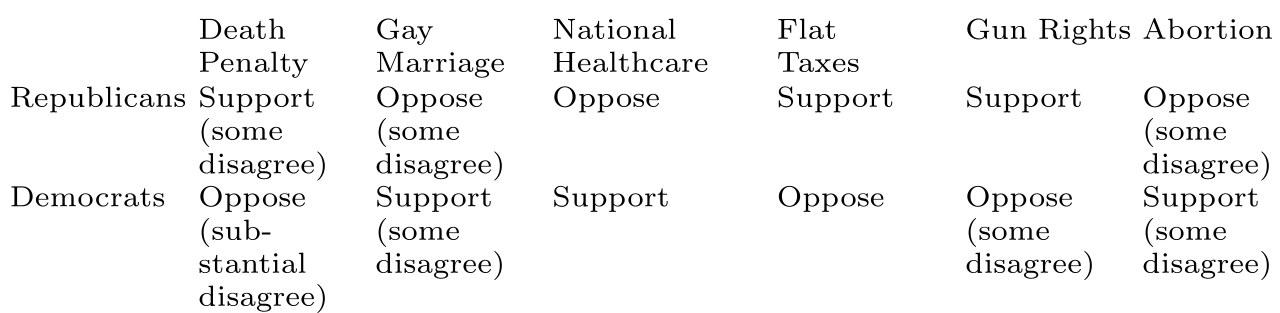 Table 1: The ground truth ideological platforms used to label the final clusters.
The Two-Step Process
- Stance Prediction: Use PMF to predict how a user would feel about an issue they haven't discussed yet.
- Clustering & Labeling: Use K-means to group users with similar (now complete) ideological profiles and match these groups to the Democratic or Republican platforms using Hamming distance.
Experiments and Breakthrough Results
The researchers compared their PMF approach against the Discussant Attribute Profile (DAP) and a basic Hamming Distance baseline.
- High Fidelity: At the original sparsity of 22.95%, PMF reached 88.9% accuracy.
- Robustness under Pressure: When 70% of the data was hidden (extreme sparsity), PMF still maintained 80.5% accuracy, whereas other methods like DAP plummeted to 67%.
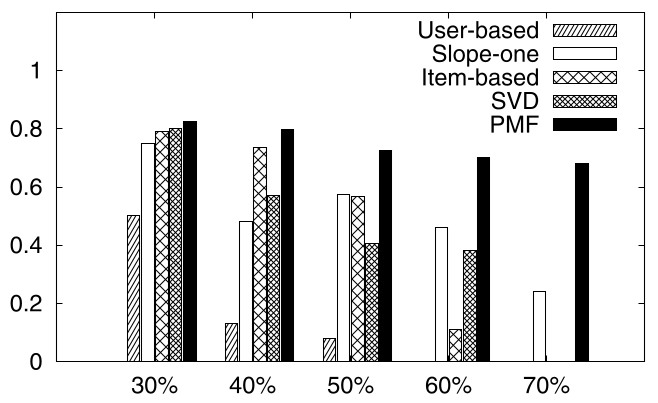 (a) Accuracy of five methods at various matrix Sparsity rates
The study also found that just 6 core issues (Death Penalty, Gay Marriage, Healthcare, Flat Taxes, Gun Rights, and Abortion) were sufficient to predict a party as effectively as a set of 46 issues. This suggests that political identity is tied to a few "load-bearing" ideological pillars.
Critical Insight & Conclusion
This work proves that our specific beliefs are far more indicative of our political identity than broad demographics like religion or age. The application of Probabilistic Matrix Factorization is particularly clever here; it recognizes that political beliefs are not random but governed by underlying latent structures.
Limitations & Future Work
- Binary Limitation: The study focuses only on the US two-party system. Multi-party systems (common in Europe or Asia) would require a more complex latent factor space.
- Temporal Shift: Ideologies evolve. A Republican stance in 2026 might look different than in 2010.
- Future Path: Combining these ideological "latent factors" with real-time text sentiment analysis could create the most powerful political prediction engine to date.
Takeaway: Your silence on a political topic doesn't mean your stance is invisible; the "logic" of your other beliefs allows AI to fill in the blanks with startling accuracy.