
LSSVR & Sentiment Analysis: Precision Vehicle Sales Forecasting via Twitter and Stock Markets
Predicting Vehicle Sales by Sentiment Analysis of Twitter Data and Stock Market Values
This paper presents a hybrid forecasting framework for predicting monthly vehicle sales in the USA by integrating Twitter sentiment analysis and stock market indices (DJIA and S&P 500). The authors utilize Least Squares Support Vector Regression (LSSVR) and a deseasonalization procedure to achieve a Mean Absolute Percentage Error (MAPE) of 3.96%, outperforming traditional time series models.
Executive Summary
TL;DR: This research pioneers a high-precision forecasting framework for the US automotive market by fusing social media "chatter" with stock market indices. By applying a specialized deseasonalization procedure to Least Squares Support Vector Regression (LSSVR), the authors achieved an impressive MAPE of 3.96%, proving that what we say on Twitter and how our portfolios perform are leading indicators of car purchases.
Context: This work transitions vehicle sales forecasting from "reactive" (historical trends) to "proactive" (intent-based), positioning itself as a benchmark for hybrid architectural forecasting in the high-involvement product sector.
Problem & Motivation: Beyond Historical Trends
Why is predicting car sales so difficult? Unlike fast-moving consumer goods, vehicles are high-cost, "high-involvement" products. Purchase decisions are influenced by:
- Consumer Sentiment: The emotional readiness to commit to a long-term loan.
- Purchasing Power: Real-time wealth fluctuations, often reflected in stock market performance.
- Seasonality: Monthly fluctuations (e.g., year-end clearances) that mask true demand signals.
Previous works utilized Google Trends or simple time-series models (ARIMA), but often missed the synergistic effect between social sentiment and economic ability.
Methodology: The Hybrid LSSVR Framework
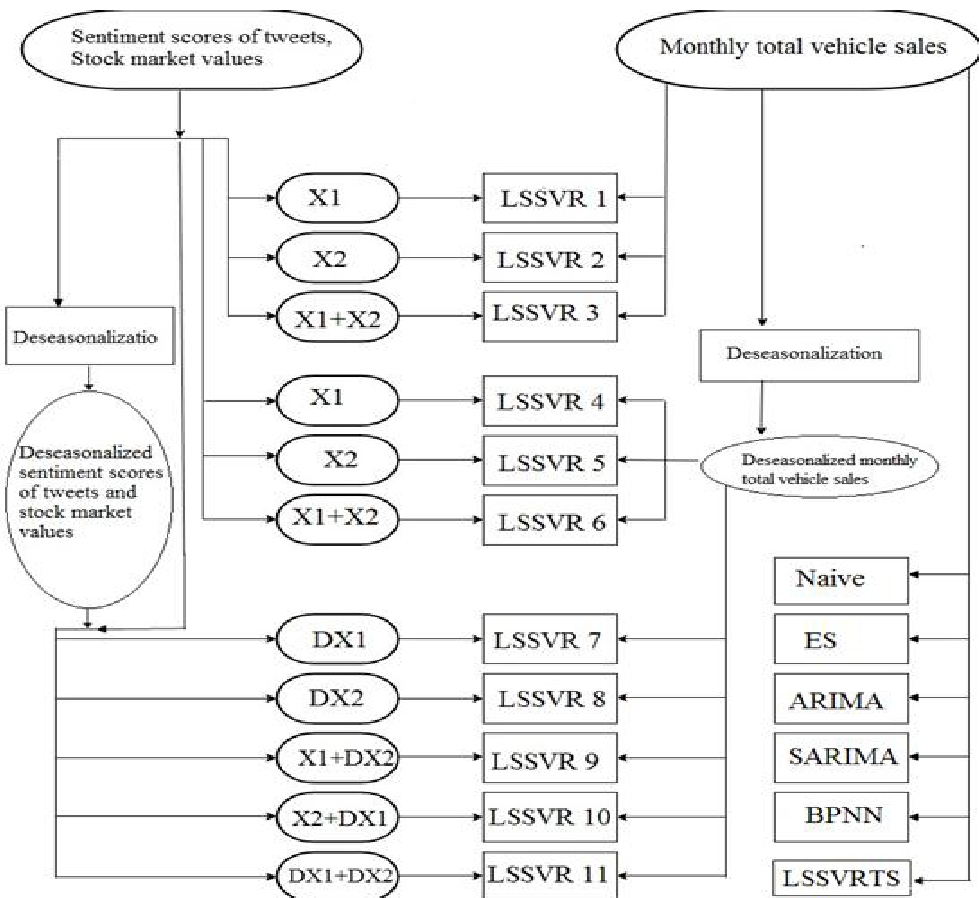
The core innovation lies in the Proposed Monthly Total Vehicle Sales Forecasting Framework. The authors didn't just dump data into a model; they processed it through a rigorous pipeline:
1. Sentiment Engine (Twitter)
Over 6 million tweets containing keywords like "buy car" and "buy truck" were filtered and analyzed using SentiStrength. This tool assigns scores from -5 (negativity) to +5 (positivity), capturing the "Electronic Word of Mouth" (eWOM).
2. Economic Proxy (Stock Market)
The Dow Jones (DJIA) and S&P 500 were integrated to represent the "Wealth Effect"—the phenomenon where consumers spend more as their asset values increase.
3. The LSSVR Engine
Instead of standard SVR, which is computationally heavy (quadratic programming), the authors used LSSVR, which solves linear equations. They optimized the parameters ( and ) using Genetic Algorithms (GA) to ensure the model didn't get stuck in local optima.
Experiments & Results: The Power of Hybrid Data
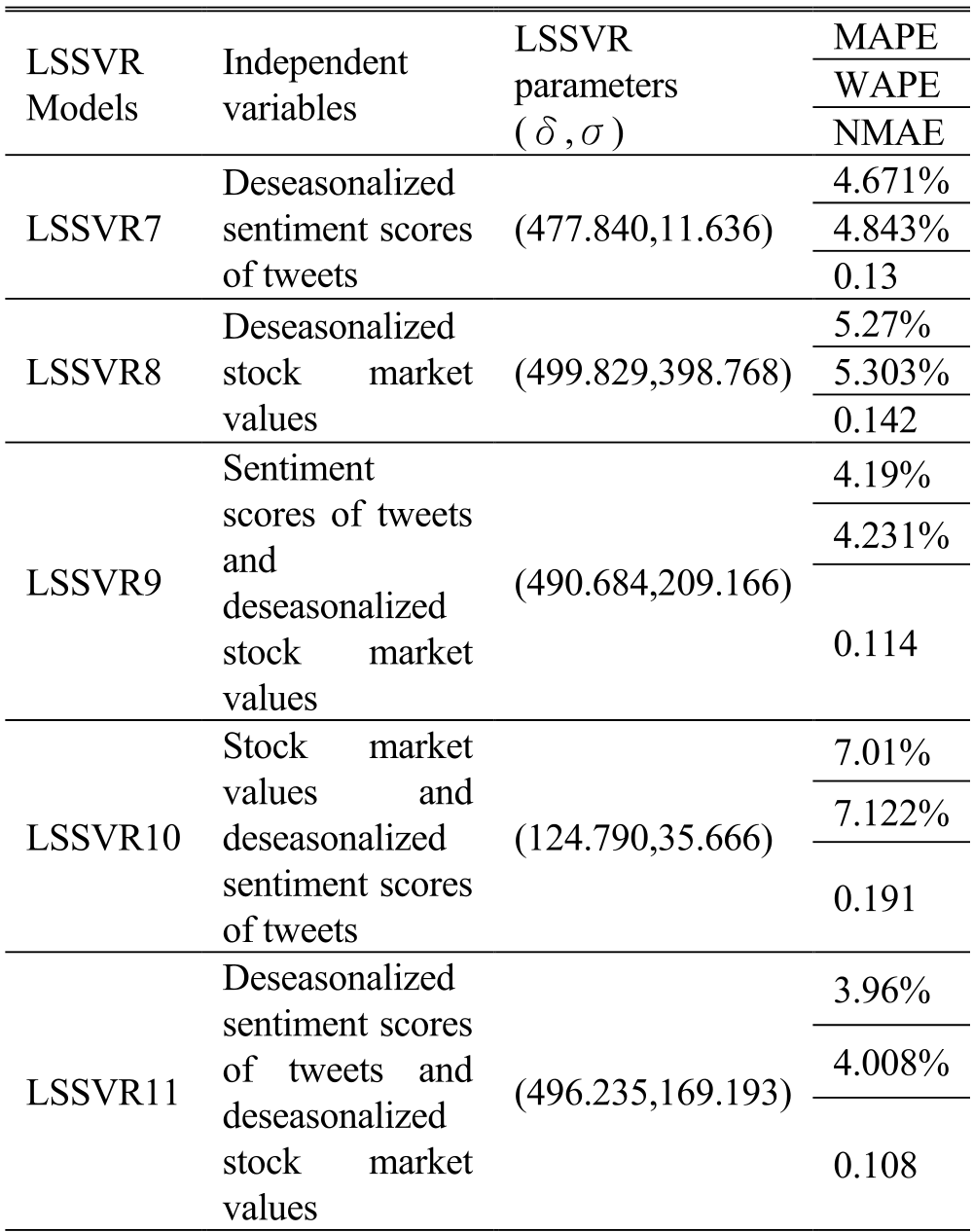
The study compared seven time-series models against eleven LSSVR variations. The results were clear: Deseasonalization is the "Secret Sauce."
- Baseline SARIMA: Achieved a respectable 7.076% MAPE.
- LSSVR with Hybrid Data (Raw): Achieved 6.635% MAPE.
- LSSVR with Hybrid Data (Deseasonalized): Smashed the competition with 3.96% MAPE.
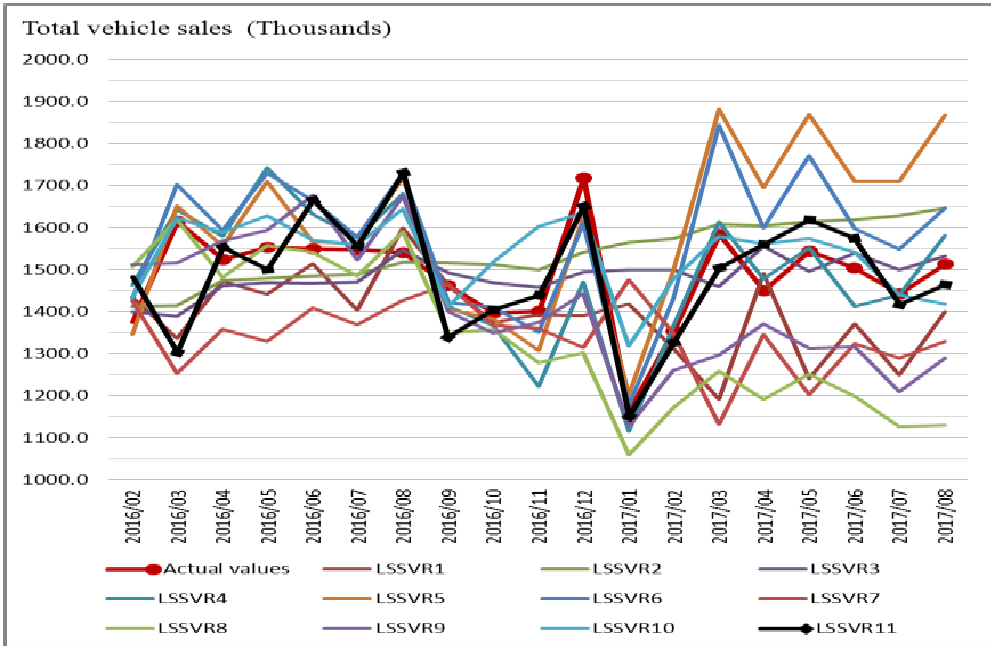
The point-to-point comparison graphs show that LSSVR11 (the hybrid deseasonalized model) tracks the actual sales "peaks and valleys" much more closely than traditional models, which tend to lag behind sudden market shifts.
Critical Analysis & Conclusion
Takeaways
The research confirms that multivariate models outperform univariate time-series because they look at the "Why" (sentiment and wealth) rather than just the "What" (past sales). Specifically, the deseasonalizing of input features (Twitter scores) is a novel step that likely removed the noise of holiday-related chatter, leaving behind the pure "intent" signal.
Limitations
- Keyword Sensitivity: The reliance on "buy car" as a keyword is narrow. Language is evolving, and sarcasm or slang in Tweets could still confuse SentiStrength.
- Data Lag: The study uses one-step-ahead rolling forecasting; real-world supply chain issues might require longer-range projections.
Future Outlook
The authors suggest that future researchers incorporate Facebook and YouTube or utilize Geographical Information to understand localized demand—a critical factor for the automotive industry's distribution logistics.