
Predicting Webpage Credibility: Moving Beyond Popularity to Linguistic Intuition
Predicting webpage credibility using linguistic features
The paper presents a machine learning approach to automate webpage credibility prediction using advanced linguistic features. By integrating psychosocial dimensions from the General Inquirer and high-dimensional Bag-of-Words (BoW) models, the authors significantly improve over previous state-of-the-art baselines in both classification and regression tasks.
TL;DR
In an era of information overload, determining what to trust online is a critical challenge. This paper demonstrates that linguistic features—specifically psycholinguistic categories and high-dimensional word patterns—can predict webpage credibility more accurately than traditional popularity metrics like social shares or search engine rankings. By analyzing how something is written rather than just how many people clicked it, the authors achieved a 10% boost in precision for credibility classification.
Background: The Subjectivity of Trust
Credibility is not an objective truth; it is a "perceived quality." Early web users assessed trust through social circles, but the modern web requires heuristics. While previous SOTA methods (like Olteanu et al.) used a mix of popularity and simple text features, they were often dependent on external APIs (Facebook, Twitter, PageRank). These external signals are "noisy" and easily gamed by actors seeking to manipulate algorithms.
The Problem & Motivation
The authors identified two major gaps in existing credibility research:
- Dependency on External APIs: Relying on Google or Facebook for features makes the system a "black box" that can break if the API changes.
- Under-utilization of Psycholinguistic Cues: Purely structural features (like count of exclamation marks) miss the deeper psychological signals that humans subconsciously use to detect reliability.
Methodology: The Core
The research introduces two specific enhancements to the feature set:
1. The General Inquirer (GI)
The GI is a content analysis tool that maps words to 183 psychosocial and psycholinguistic categories (e.g., "Politics," "Positive/Negative sentiment," "Arousal"). This allows the model to "understand" the tone and intent of the page content.
2. High-Dimensional Bag-of-Words (BoW)
Instead of selecting specific features, the authors used a supervised unigram approach, creating a vector space of over 70,000 features. This captures specific "trust-words" and "distrust-words" that humans might miss.
Note: The paper focuses on the feature engineering pipeline, comparing 37 structural features against the 183 GI features and the high-dimensional BoW space.
Experiments & Results: What Signals Trust?
The results were conclusive: linguistic features outperform metadata.
- 3-Class Task: The weighted precision jumped from 0.63 to 0.70.
- Binary Task: Significant improvements were seen in F-measure for both "Low" and "High" trust categories.
The "Dictionary of Trust"
One of the most insightul parts of the study is the analysis of model coefficients—identifying which words carry the most "weight" for trust:
| Trust Level | Associated Keywords |
|---|---|
| High Trust | retirement, energy, research, safety, gov, clinic |
| Low Trust | debt, invest, posts, blog, forums, loans, facebook |
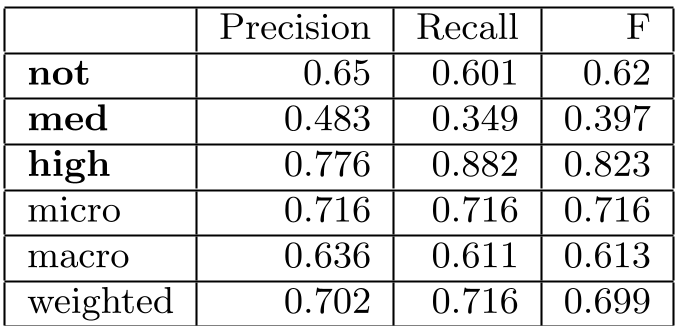 Table showing performance metrics for the high-dimensional BoW model, which outperformed structural baselines.
Critical Analysis & Conclusion
Takeaway
The study proves that internal content analysis is more resilient and potentially more accurate than contextual metadata. High-trust content often utilizes formal, institutional, and research-oriented language. Conversely, words associated with user-generated content (UGC) and specific predatory financial services (e.g., "refinancing," "debt") are strong signals of low credibility.
Limitations
- Topic Bias: The dataset was relatively small (1,000 URLs). Some word weights might reflect the specific topics in the dataset rather than universal trust signals.
- Static Lexicon: The BoW approach is vulnerable to new vocabulary and doesn't handle context as well as modern Transformer models would.
Future Outlook
This work lays the foundation for "self-contained" credibility filters that don't need to ping external servers to decide if a site is sketchy. In the future, combining these psycholinguistic features with Transformer-based embeddings could create a virtually un-gamable "Trust Score" for the open web.