
Decoding Social Success: A Multimodal Approach to Assessing Communication Skills
Prediction/Assessment of communication skill using multimodal cues in social interactions
This paper presents a multimodal framework for the automatic prediction of communication skills in social interactions, including synchronous/asynchronous interviews and group discussions. Leveraging audio, visual, and lexical cues, the system achieves up to 92% accuracy in predicting communication ratings, marking the first comprehensive study to compare human perception and machine prediction across diverse social settings.
TL;DR
Is it possible for a machine to judge how well you communicate? This research proves it is. By analyzing speech patterns, facial expressions, and word choice across various social scenarios—ranging from Skype-style interviews to group debates—the author developed a framework that predicts communication skill ratings with up to 92% accuracy, matching human perception.
The Perception Gap: Why This Research Matters
In the world of Social Computing, we have spent years teaching machines to recognize "Big Five" personality traits or identify who the "boss" is in a meeting. However, Communication Skill—the actual ability to convey thoughts convincingly—has remained a "black box" for automation.
The primary challenge lies in the contextual shift. We communicate differently when talking to a webcam (Asynchronous) than we do when sitting across from a human (Synchronous). This paper addresses the fundamental question: Can a machine find a universal signature for a "good communicator" regardless of the setting?
Methodology: The Multimodal Lens
The author breaks down communication into three core channels, extracting features that reflect both "what" you say and "how" you say it:
- Lexical (The "What"): Using both manual transcripts and Automatic Speech Recognition (ASR).
- Prosodic & Audio (The "How"): Capturing pitch, loudness, energy, and rhythm (Rate of Speech).
- Visual (The "Expression"): Tracking facial expressions, head pose, and "unmotivated movements" through tools like iMotions.
The Framework Architecture
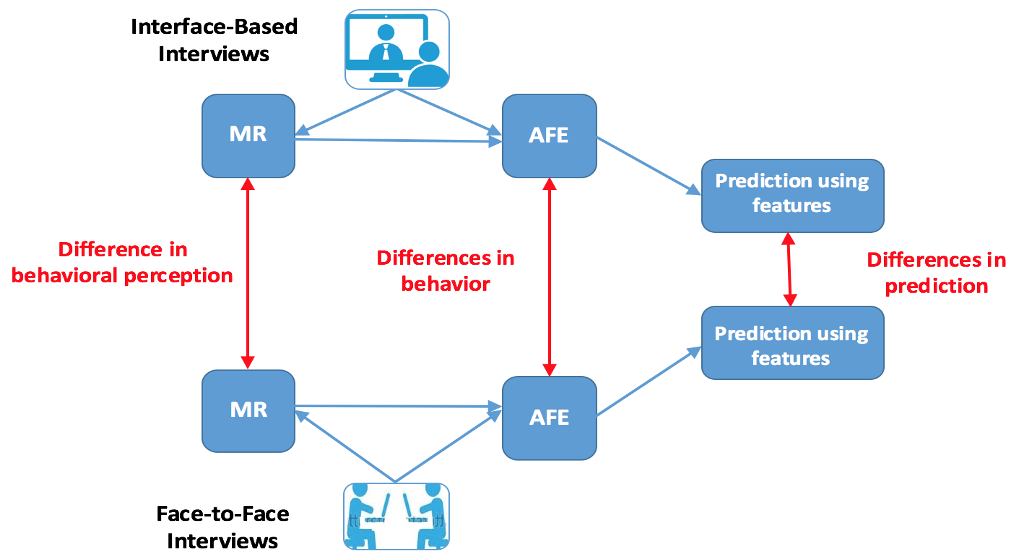 Figure 1: The dual-setup methodology comparing Interface-Based and Face-to-Face interactions.
Key Insights and Experimental Results
The findings challenge some traditional assumptions about human-computer interaction:
- The Power of ASR: One of the most significant findings is that Automatic Speech Recognition (ASR) transcriptions are sufficient for prediction. You don't need a human to transcribe the interview to get an accurate skill rating.
- Context Matters: In Face-to-Face (FF) settings, Content-based features (vocabulary richness, "big words") were more predictive. In Interface-Based (IB) settings, Prosodic features (tone and tempo) took the lead.
- Performance Parity: The machine was nearly as accurate in judging online "interface-based" interviews as it was for traditional face-to-face ones.
Performance Benchmarks
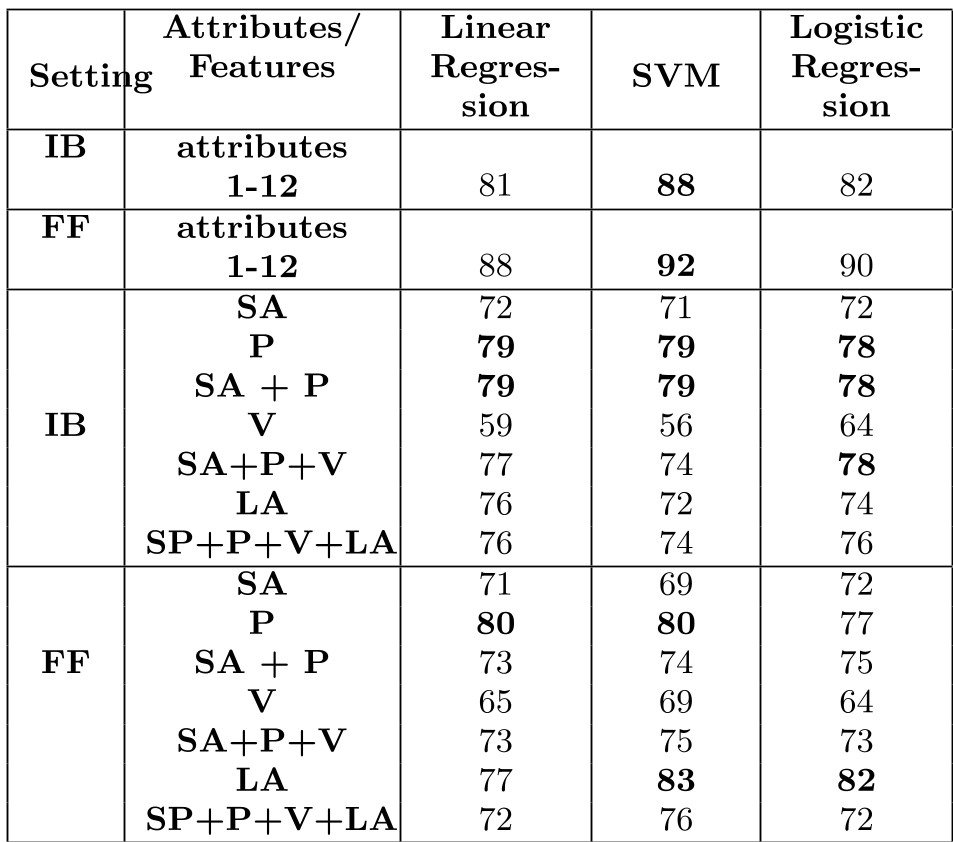 Table: Comparison of prediction accuracy across different feature sets and classifiers. Note the high performance of SVM in FF settings (92%).
Critical Analysis: Reflections from the Tech Editor
The brilliance of this work lies in its comparative nature. By testing the same individuals in different social "pressures," the author reveals that a "good communicator" is someone who can maintain their rate of speech and lexical diversity even when the social cues (a human face) are removed.
Limitations to Consider:
- Thin Slices vs. Holistic Views: While the paper mentions "thin slice" analysis (using only 30-120 seconds of video), communication is often a marathon, not a sprint. Long-form persuasive ability might still require deeper temporal modeling.
- Cultural Bias: Communication "skills" are highly culturally dependent. The dataset used here (IIIT Bangalore) likely reflects specific professional norms that might not translate globally.
Future Outlook: Beyond the Interview
The roadmap for this technology extends into Group Dynamics. The next frontier is predicting leadership and dominance in "triads" (groups of three). Imagine a collaboration tool that provides real-time feedback on whether you are being too dominant or if your communication style is helping or hindering group cohesion.
As AI moves from being a tool to a "social agent," understanding the nuances of human communication is no longer optional—it is the prerequisite for the next generation of social computing.
Final Takeaway: Your next job interview score might be determined not just by what you say, but by the prosodic melody of your voice and the stability of your head pose—and the machine is getting very good at listening.