
Linking Social Identities: A Game-Theoretic Approach to Predicting E-Commerce Behavior
Prediction of purchase behaviors across heterogeneous social networks
The paper proposes a novel framework for predicting purchase behaviors by linking heterogeneous networks, specifically Facebook (social) and eBay (e-commerce). It introduces a game-theoretic "Stable Matching" algorithm to align user accounts and a fusion-based prediction model called FHSOP that outperforms Matrix Factorization (MF) by 5% in accuracy.
TL;DR
Predicting what a user will buy is difficult when their shopping history is sparse (the "Cold Start" problem). This paper bridges the gap by linking Facebook social profiles with eBay purchase data. By implementing an adapted Stable Matching algorithm for account identification and a tripartite fusion model (FHSOP) for prediction, the researchers achieved 70% matching accuracy and a 5% performance boost over traditional Matrix Factorization.
The Challenge: Heterogeneous Data Gaps
In the digital ecosystem, we exist in silos. Our social personas (Facebook) are rich and expressive, while our commercial personas (eBay) are often "heavy-tailed"—meaning most users have very few transactions.
The authors identify two critical pain points:
- Identity Fragmentation: How do you know "User_A" on Facebook is "Buyer_7" on eBay when domains are completely different?
- Domain Divergence: Features in a social network (likes, statuses) don't naturally map to product categories (electronics, clothing).
Methodology: Stable Matching & Interest Vectors
The core innovation lies in treating account matching as a Stable Marriage Problem. In a standard matching scenario, you have two sets (Men and Women) with preference lists. Here, the "preferences" are calculated via similarity scores.
1. Account Matching via Algorithm 1
The authors use an extended version of the Stable Matching model. Unlike previous unsupervised methods that might map multiple social accounts to one buyer, this model enforces a strict one-to-one mapping, ensuring logical consistency.
- Features used: Levenshtein distance for usernames, demographic overlap (gender/location), and Interest Vectors.
- Interest Extraction: They use both corpus-based (LDA/LSA) and knowledge-based (Freebase/Wikipedia) approaches to turn messy status updates into a structured vector of 36 product categories.

2. The FHSOP Prediction Model
Once accounts are linked, the prediction uses a weighted fusion (learned via SGD):
- : Purchase History (Time-weighted using a Gaussian kernel).
- : Demographic Characteristics (Age, Gender, Location).
- : Social Media Mentions (Probabilistic Matrix Factorization on statuses).
Experimental Insights
The researchers tested this on a real-world dataset of 507 matched accounts with over 239k Facebook messages and ~32k eBay purchases.
Performance Results
The "AMbSM" (Account Matching based on Stable Matching) method consistently outperformed baseline supervised and unsupervised methods. Specifically, using a knowledge-based interest vector provided more stability as the dataset size increased.
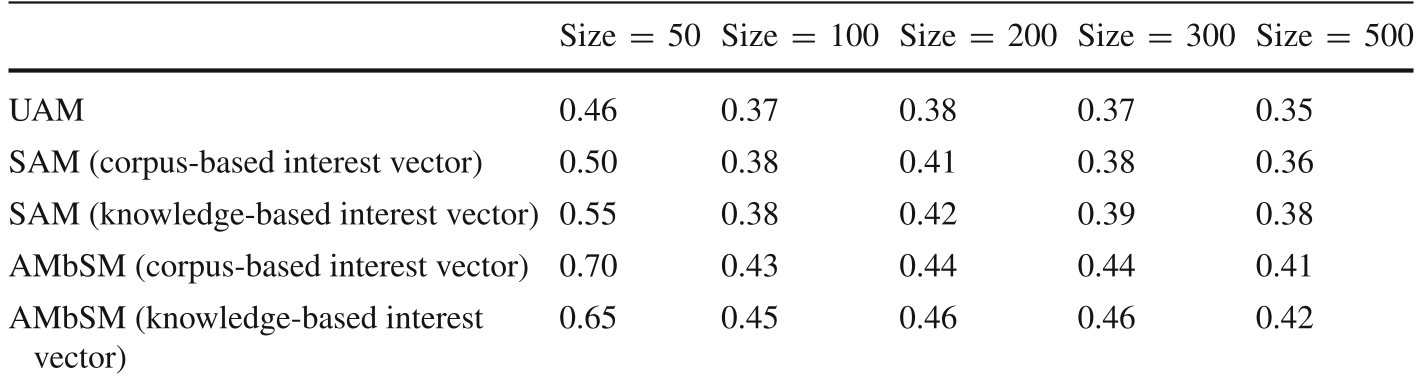
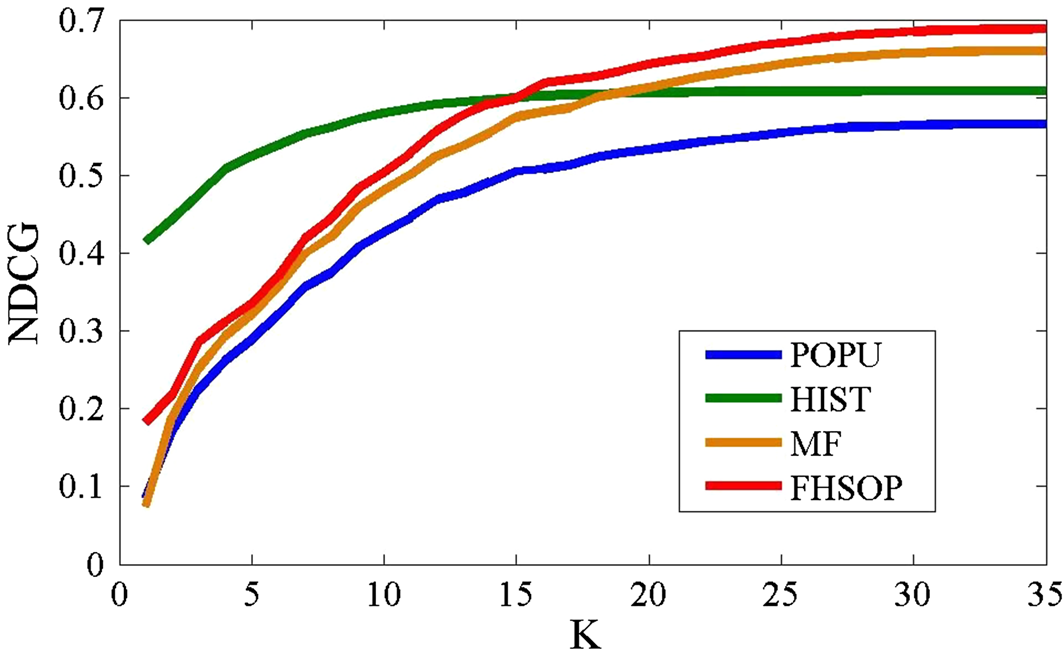
In terms of purchase prediction, the FHSOP model showed:
- Superiority in the "Middle-K" range (Precision at Position K), proving it suggests relevant "new" items better than models relying solely on purchase history.
- A 5% improvement in NDCG (Normalized Discounted Cumulative Gain) over the widely used Matrix Factorization.
Critical Analysis & Takeaways
The brilliance of this work is the application of Game Theory to a high-dimensional data problem. By viewing account linkage through the lens of stability rather than just similarity, the authors mitigate the noise inherent in heterogeneous networks.
Limitations: The study relies on a relatively small set of manually verified accounts (507). In a production environment with millions of users, the computational complexity of Gale-Shapley matching and the noise of username collisions might require more aggressive pruning or heuristic approximations.
Future Outlook: Leveraging external knowledge bases (like Freebase) to bridge the semantic gap is a precursor to modern Graph Embedding techniques. Future iterations could likely replace the linear fusion with a Deep Neural Network to capture non-linear interactions between social interests and commercial intent.