
Deciphering the Temporal Flow: Predicting Web User Behavior via Relational Intervals
Prediction of Web User Behavior by Discovering Temporal Relational Rules from Web Log Data
This paper introduces a temporal interval relational rule mining approach specifically for Web Log Analysis to predict user behavior. By transforming raw web logs into temporal intervals and applying constraints based on Allen’s interval relations (e.g., before, overlaps, during), the method successfully extracts complex navigational patterns that traditional association rule mining often overlooks.
TL;DR
Web mining is no longer just about transition probabilities; it's about time. This paper proposes a Temporal Interval Relational Rule Mining framework that moves beyond simple sequences. By treating web page visits as time intervals, the authors extract sophisticated rules (like "overlaps" or "during") that allow web designers to optimize layouts based on how and when users navigate, achieving more granular behavioral insights than standard association rules.
Problem & Motivation: The Missing Dimension of Time
While existing web mining focuses on "Association Rules" (if a user visits Page A, they might visit Page B), they often treat timestamps as mere order markers. However, in the real world, a user might open multiple tabs (overlapping intervals) or stay on a reference page while browsing others (containing intervals).
The authors argue that by ignoring the Temporal Interval, we lose the "time series characteristics" of human behavior. Their goal was to build a system that can say not just "A then B," but "A overlaps with B" or "B happens during the period of A."
Methodology: From Raw Logs to Temporal Logic
The proposed workflow transforms chaotic web logs into structured relational knowledge through four major stages:
1. Preprocessing and Event Filtering
Raw logs (IP, Time, URL) are cleaned. Crucially, the authors filter for a Large Event Set (LES). This reduces "noise" by focusing only on pages that meet a Minimum Support threshold for Large Event (MSLE).
2. Identifying Uniformity
Not every click is a new event. Users often refresh or click back and forth. The Uniform Event Set (UES) step merges these continuous occurrences into a single "Generalized Event" with a defined Start (VS) and End (VE) time.
3. Relational Mapping
This is where the magic happens. Instead of simple "Next-page" links, the system evaluates the relationship between any two intervals using logic derived from Allen’s interval algebra:
- Before/Meets: Sequential navigation.
- Overlaps/During/Equals: Parallel or nested navigation.
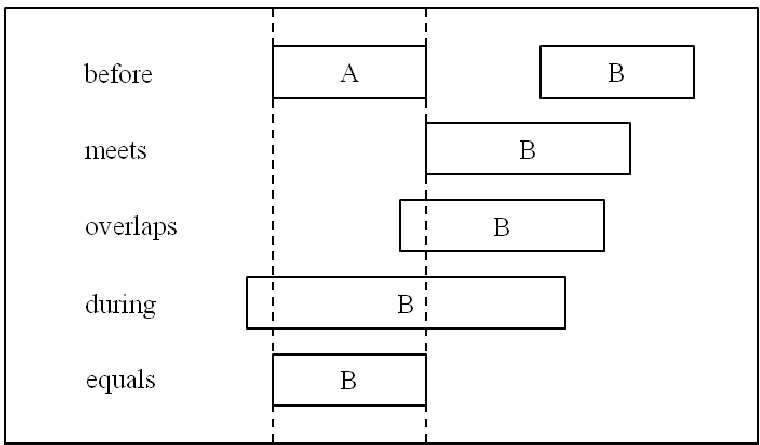 Fig 1: The core temporal relations considered: before, meets, overlaps, during, and equals.
Experiments & Results: Turning Data into Design
The authors tested their approach on NASA web logs and university institutional data.
Hidden Knowledge Discovery
Table 4 in the paper reveals striking patterns. For example, the rule 6 [before] 18 with 55.6% support suggests that users visiting "oglasna.php" almost always start at "ispit_raspored_god.php".
- Actionable Insight: The web designer should immediately place a direct hyperlink from Page 6 to Page 18 to streamline the user journey.
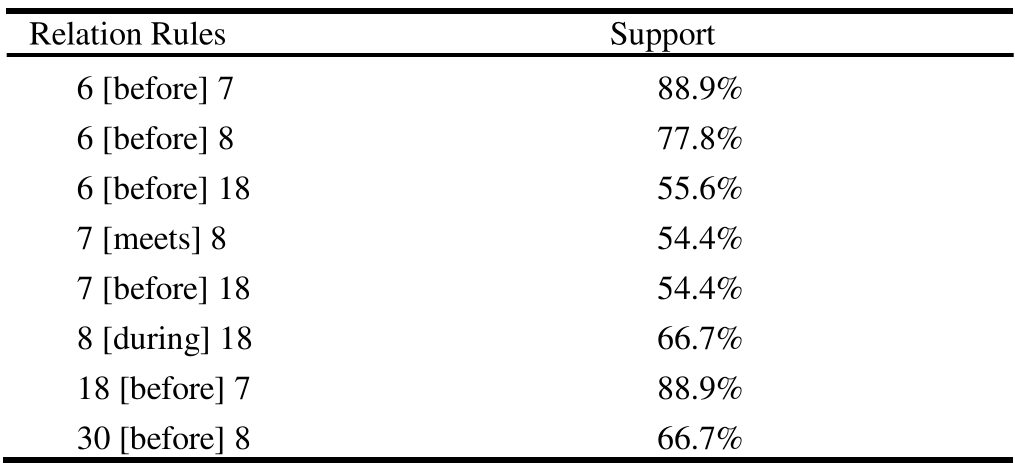 Fig 2: Extracted Temporal Relation Rules and their corresponding Support values.
The Power of Parameters
The research highlights that the sensitivity of the model is controlled by three knobs:
- MSLE: Controls the level of generalization (higher = only very popular pages).
- MSUE: Ensures events are "continuous" enough to be meaningful.
- MSRR: Determines the "strictness" of the final rules.
As shown in their parameter analysis (Fig 3-5), lowering these thresholds increases the discovery of "niche" patterns but risks including noise.
Critical Analysis & Conclusion
Takeaways
The paper successfully demonstrates that Temporal Relational Rules provide a much richer vocabulary for describing web usage than traditional methods. In an era of multi-tab browsing and complex web apps, this interval-based approach is theoretically more sound than point-based sequence mining.
Limitations
- Computational Complexity: Comparing every pair of intervals in a Large Event Set can become expensive as the number of "Uniform Events" grows.
- Window Size Sensitivity: The results are highly dependent on the
Window Size (WS)andSession Timedefinitions, which in this study were kept relatively simple (e.g., 1 hour).
Future Outlook
The move toward "Interval-based" mining is a precursor to modern session-based recommendation systems. Integrating this logic into deep learning models—where the "Interval Relation" becomes an embedding feature—could significantly sharpen the accuracy of real-time e-commerce predictions.
Senior Editor's Note: This work serves as a foundational bridge between classical data mining and modern temporal logic applications in UX research.