
Predictive Maintenance in Healthcare: Bridging IoT and Big Data for Patient Safety
Predictive Maintenance in Healthcare Services with Big Data Technologies
This paper proposes a scalable, distributed big data architecture specifically designed for the predictive maintenance of biomedical devices in healthcare settings. By integrating IoT, cloud computing, and stream processing tools like Apache Kafka and Flink, the system enables real-time monitoring and failure prediction for critical medical equipment like MRI and X-ray machines.
TL;DR
Biomedical devices are more than just tools; in a hospital, they are life-support systems. This paper introduces a specialized Big Data architecture for Predictive Maintenance (PdM). By leveraging IoT sensors and distributed processing frameworks (Kafka, Flink, Storm), the system moves beyond rigid maintenance schedules to a real-time, "live" monitoring model that identifies potential failures before they jeopardize patient health.
The Critical Gap: Why Traditional Maintenance Fails
In many industries, a machine failure means a secondary financial loss. In healthcare, it is a matter of life and death. The authors identify two major shortcomings in current hospital operations:
- The Rigid Schedule Trap: Preventive maintenance is often done too early (wasting resources) or too late (after a failure has begun).
- The Data Silo Problem: Most medical devices generate massive amounts of telemetry data (voltage, temperature, error codes), but this data is either discarded or stuck in proprietary, non-standardized formats that cannot be processed at scale.
The research's core intuition is that by treating every biomedical device as an IoT entity, we can apply "self-awareness" to the hardware, allowing it to predict its own "wear-out" phase based on real-time stressors.
Methodology: A Scalable Architecture for Real-Time Insights
The proposed architecture is designed to handle the 3 Vs of Big Data: Volume, Velocity, and Variety.
1. Data Ingestion & Messaging
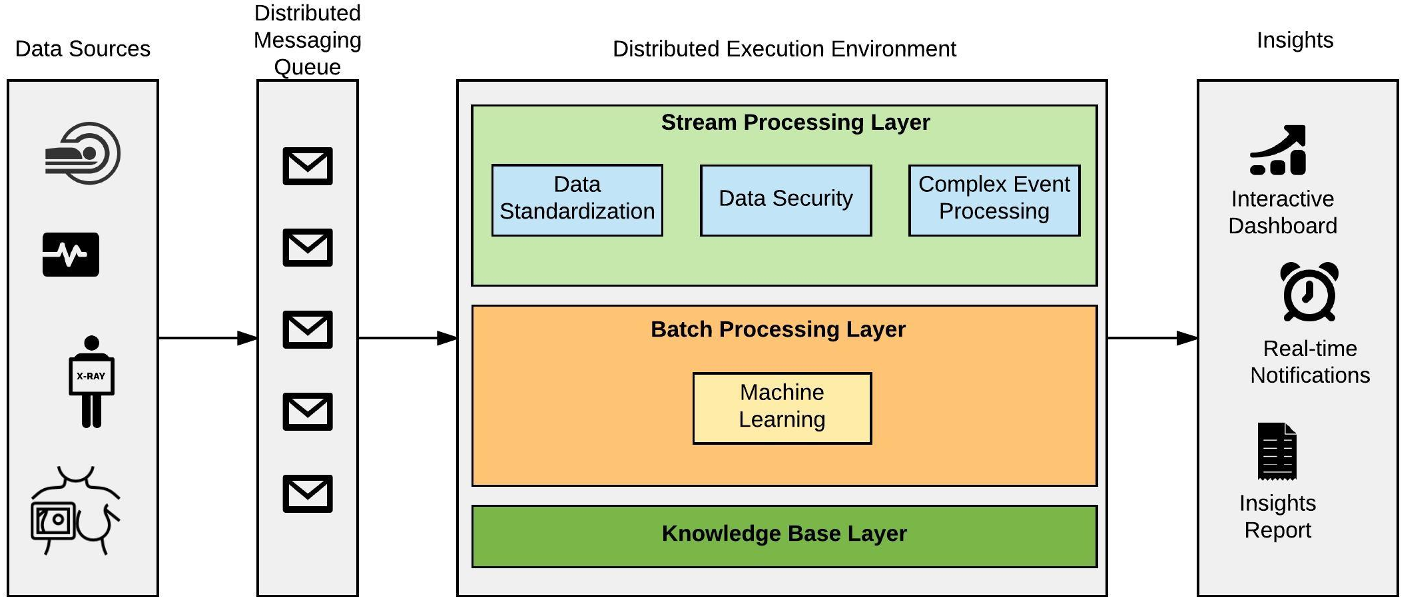
The system uses Apache Kafka as a buffer. Because medical devices produce heterogeneous data types (structured error codes vs. unstructured sensor streams), Kafka provides a fault-tolerant "pipeline" that ensures no critical health alert is lost during peak hospital hours.
2. Distributed Execution Environment
This is the "brain" of the system, split into three layers:
- Stream Processing (Storm/Flink): Handles data standardization and security. It anonymizes patient data to comply with regulations while identifying "Complex Events" (e.g., a sudden spike in X-ray tube temperature).
- Batch Processing (Spark): Trains Machine Learning models (SVM, Naïve Bayes, or Decision Trees) on historical failure data to recognize the digital signatures of an impending breakdown.
- Knowledge Base: A HDFS-backed NoSQL storage (HBase/Cassandra) that archives every "heartbeat" of the devices for future audit and longitudinal study.
Analyzing the "Bathtub Curve" in Healthcare
The authors ground their methodology in the Bathtub Curve theory of reliability:
- Infant Mortality (Early Failure): Detected via real-time stress monitoring.
- Constant Failure Rate (Random Failure): Managed via anomaly detection.
- Wear-out Phase: Predicted by ML models to trigger maintenance just before the curve spikes.
By visualizing these stages on a Live Dashboard, biomedical engineers can prioritize repairs based on actual risk rather than just the date on a calendar.
Experimental Insight & Strategic Value
The paper argues that the transition to PdM offers a "Globalization Opportunity." Manufacturers could remotely monitor their fleet of devices across different countries, identifying global patterns in hardware fatigue under different environmental conditions.
However, they realistically note the Challenges:
- Expertise Gap: Implementing Flink/Kafka requires high-level data science skills rarely found in traditional hospital IT departments.
- Legacy Hardware: Many devices are not "born digital" and require retrofitting with external sensors.
Conclusion & Future Outlook
The shift toward a big-data-driven maintenance model is inevitable for the "Smart Hospital." The authors conclude that the next frontier is the integration of Blockchain, which would ensure that maintenance logs are immutable and transparent across manufacturers, hospitals, and regulatory bodies.
Takeaway: Effective predictive maintenance isn't just about saving costs—it's about ensuring that when a surgeon reaches for a tool or a technician runs an MRI, the system works with 100% reliability, every single time.