
Predictive Partitioning: Leveraging Graph Structure for Efficient BFS Traversal
Predictive Partitioning for Efficient BFS Traversal in Social Networks
The paper introduces a predictive graph partitioning method designed for parallel Breadth-First Search (BFS) in social networks. By leveraging the skewed degree distribution of frontier vertices at different iterations, the proposed method utilizes the METIS algorithm on weighted graphs to reduce inter-processor message overhead, achieving up to 20% average reduction in communication costs.
TL;DR
Breadth-First Search (BFS) is the backbone of graph analytics, yet in parallel environments, it suffers from massive communication overhead during peak iterations. This paper proposes a predictive partitioning strategy that anticipates which edges will be traversed based on the graph’s structural properties (power-law distribution and assortativity). By weighting the graph before partitioning, the author reduces inter-processor messages by up to 20% on average and 50% in best-case scenarios.
Problem & Motivation: The Peak Iteration Bottleneck
In large-scale social networks, BFS doesn't explore the graph uniformly. The process follows a "wave" that starts small, explodes during a middle "peak" iteration, and then rapidly decays.
Current parallel implementations usually partition the graph into processors to balance the workload. However, the communication cost—the messages sent between processors when an edge crosses a partition—becomes the dominant bottleneck. Specifically, ~70% of the total communication occurs during the peak iteration. Traditional partitioning tools like METIS treat all edges as equally likely to be traversed, which fails to account for the fact that certain nodes (hubs) are much more likely to be part of the frontier at specific times than others.
Methodology: The Physics of the Frontier
The author’s core insight is that the "frontier" (the set of nodes being explored at step ) has a degree distribution that is highly skewed and changes over time.
1. Predicting the Frontier
Using a configuration model, the author derives an expression for , the fraction of vertices of degree touched by time . Early in the BFS, high-degree nodes (hubs) are swallowed up quickly. Later iterations are forced to explore the "residue" of lower-degree nodes.

2. Weighted Graph Construction
The author defines a weighting function , which represents the probability that an edge between a node of degree and will be used in a specific iteration. By calculating the Joint Degree Distribution (), the model accounts for assortativity—the tendency of similar nodes to connect.
Instead of partitioning the raw graph , the system partitions a weighted graph . This forces the partitioning algorithm (METIS) to prioritize keeping "high-probability traversal edges" within the same processor.
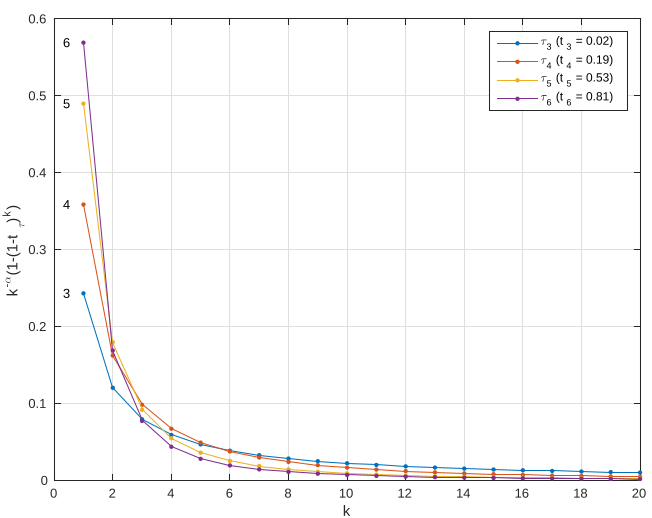 Fig: The bias shifts from high-degree nodes to low-degree nodes as iterations progress.
Experiments & Results
The author tested the approach across 8 different types of graphs, including social networks (YouTube, Epinions), co-authorship (DBLP), and synthetic generators (ER).
Key Findings:
- Social Networks: The method shines here. In the YouTube friendship graph, the average message count dropped from 790K to 681K (a ~14% improvement).
- Core vs. Periphery: The performance is highly sensitive to the root node's location. For vertices that reach the peak iteration later (non-core), the reduction in messages can reach 17% to 35%.
- Structural Dependence: On purely random graphs (Erdos-Renyi), the method provides zero gain because there is no skewed structure to exploit. On the Google Hyperlink graph, performance slightly degraded because the degree distribution did not follow a strict power law at the lower end.
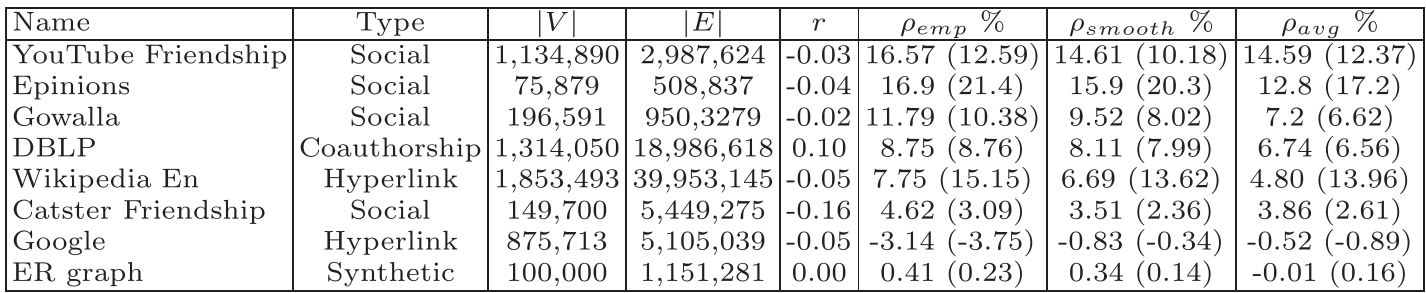 Table: Comparison of message reduction across different graph types ( represents the proposed method).
Critical Analysis & Takeaways
The brilliance of this paper lies in its movement away from "general-purpose" graph partitioning toward "algorithmic-aware" partitioning.
Takeaways:
- Exploit the Skew: In social networks, the standard "unweighted edge-cut" is an inefficient metric because BFS traversal is inherently biased by degree.
- Low Overhead: The statistics needed for this method (, ) can be estimated via a small "burn-in" period of a few BFS runs, making it practical for dynamic systems.
Limitations: The current model assumes an undirected, unweighted graph. Furthermore, for graphs that don't follow a clear power-law distribution (like certain web crawls), the predictive model may mislead the partitioner.
Future Outlook: As we move toward massive-scale GNN training and streaming graph analytics, "predictive" placement of data based on anticipated traversal patterns will likely become a standard optimization.