
DPSTA: Bridging the Gap Between Prediction and Task Assignment in Spatial Crowdsourcing
Predictive Task Assignment in Spatial Crowdsourcing: A Data-driven Approach
This paper introduces the Data-driven Predictive Spatial Task Assignment (DPSTA) framework, a novel approach for maximizing task completion in spatial crowdsourcing by predicting both current and future worker and task distributions. It utilizes a hybrid prediction phase (ST-RNN and PC-DeepWalk) and an assignment phase (Greedy and Optimal) to outperform existing static and strictly online models.
TL;DR
The "Predictive Task Assignment in Spatial Crowdsourcing" paper proposes the DPSTA framework. Unlike previous works that only look at the "now," DPSTA uses deep learning (ST-RNN) and network embeddings (PC-DeepWalk) to peek into the future, predicting where workers will be and where tasks will pop up. By optimizing task sequences over multiple time instances using a graph-partitioning approach, it achieves higher task completion rates than current SOTA online methods.
Background: The Myopia of Current Systems
Most Spatial Crowdsourcing (SC) platforms like Uber, Meituan, or specialized sensing apps treat task assignment as a series of isolated snapshots. This leads to two major issues:
- Worker Dynamics: We don't know where a worker will be in 30 minutes.
- Emergent Tasks: We don't know where a new task will appear.
If a system ignores these factors, it might assign a worker to a nearby task now, only to find that the worker is now too far away to handle a high-priority cluster of tasks that appears ten minutes later.
Methodology: The DPSTA Framework
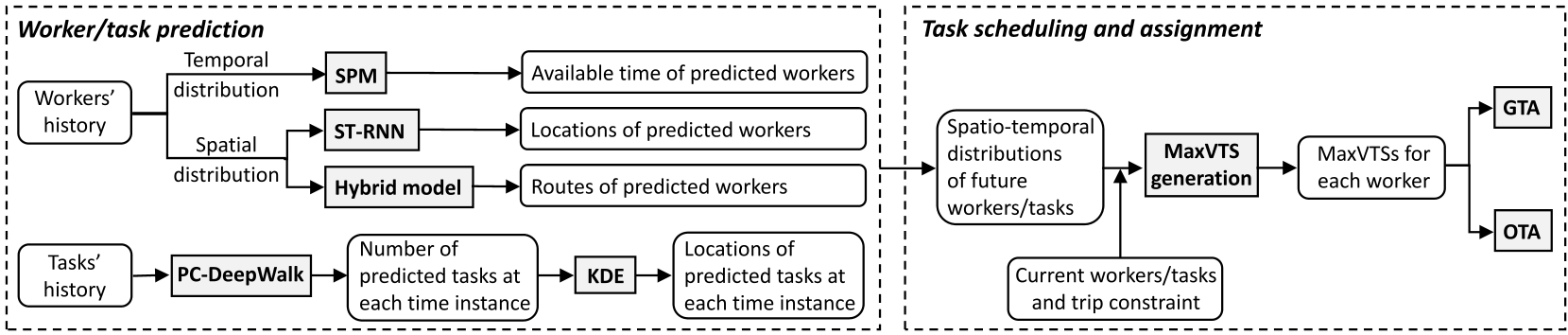
The authors break the problem into two distinct phases: Prediction and Assignment.
1. Multi-Modal Prediction
The system doesn't just predict a point; it predicts behavior.
- Worker Prediction: Uses ST-RNN (Spatial Temporal Recurrent Neural Network) to capture sequential correlations in movement. For workers following specific paths, it uses a hybrid of Pattern Matching and ST-RNN to handle data sparsity.
- Task Prediction: This is treated as a Heterogeneous Information Network (HIN) problem. The PC-DeepWalk algorithm embeds spatial cells and task types into a latent space to predict task density, followed by Kernel Density Estimation (KDE) to pinpoint precise locations.
2. Global Task Assignment
Once the future is "mapped," the assignment problem becomes one of finding the Maximal Valid Task Set (MaxVTS).
- The Challenge: The search space is exponential relative to the number of workers.
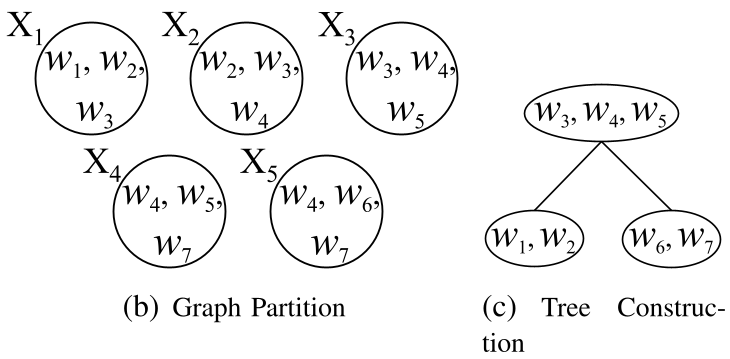
- The Solution: The authors use Graph Partitioning. They build a Worker Dependency Graph (WDG) where edges represent shared reachable tasks. By decomposing this graph into a tree structure, they can solve independent sub-problems efficiently using a Depth-First Search (DFS) or a faster Greedy approach.
Experiments and Results
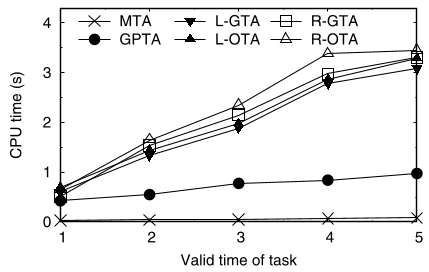
The researchers tested DPSTA against several baselines, including static maximum assignment (MTA) and existing predictive models (GPTA).
- Effectiveness: The Route-specific Optimal Task Assignment (R-OTA) consistently outperformed all other methods. By following a predicted route and picking up tasks along the way, workers could complete significantly more tasks than by simply moving from point A to B.
- Scalability: While the Optimal algorithm (OTA) is more computationally intensive, the Greedy version (GTA) provides a high-performance alternative that still beats non-predictive Baselines.
Critical Insight: Why Does This Work?
The core "Aha!" moment of this paper is the Route-specific vs. Location-specific distinction. By recognizing that human movement is constrained by road networks and habits, the model reduces the uncertainty of "anywhere" to the probability of "along the path." This constraint actually makes the prediction more robust and the assignment more efficient.
Conclusion & Future Outlook
The DPSTA framework proves that data-driven prediction is not just a "nice-to-have" but a fundamental requirement for the next generation of spatial crowdsourcing.
Limitations: The model assumes a travel time processing of 0 for tasks, which isn't realistic for complex physical tasks (like repairing a meter). Future Work: Integrating heterogeneous task weights (priority levels) and more complex worker incentive models would be natural extensions for this robust framework.