
Beyond Citations: What Really Drives the Impact of Orthodontic Research?
Predictors of societal and professional impact of orthodontic research. A multivariate, scientometric approach
This study employs a multivariate scientometric approach to identify predictors of societal impact (measured by Altmetric Attention Score, AAS) and professional impact (measured by citation counts) in orthodontic research published in 2019. It reveals that grant funding and article type are universal predictors for both impact types, while Open Access specifically boosts societal reach.
Executive Summary
TL;DR: In the digital age, a paper's success isn't just about how many peers cite it, but how many people tweet, blog, and read it. This study analyzes 825 orthodontic articles to discover that while grant funding and systematic reviews are the gold standards for all impact, Open Access is the secret sauce for reaching the public.
Background: This work moves beyond simple citation counting to define the "dual-track" impact of modern science: Professional (academic) and Societal (public). It positions itself as a methodological upgrade in dental scientometrics by using multivariate regression rather than simple correlations.
The Problem: The Ivory Tower Blind Spot
For decades, the "Impact Factor" was the only currency in academia. However, this metric ignores the stakeholders who often fund the research: patients and the general public. The problem is that academic citations take years to accumulate and only reflect the interests of other researchers. We need a way to measure the "societal pulse" of a study—and understand what features make a study transcend the lab to reach the clinical chair and the newsroom.
Methodology: A Multivariate Lens
The authors didn't just look at what was cited; they looked at why. By analyzing every orthodontic research article from 2019 indexed in Medline, they captured a snapshot of the field's health.
Key Variables Analyzed:
- Origin: Which continents produce the most "viral" research?
- Access: Does the "Paywall" kill societal impact?
- Type: Do Case Reports stand a chance against Systematic Reviews?
- Funding: Does money actually buy better visibility?
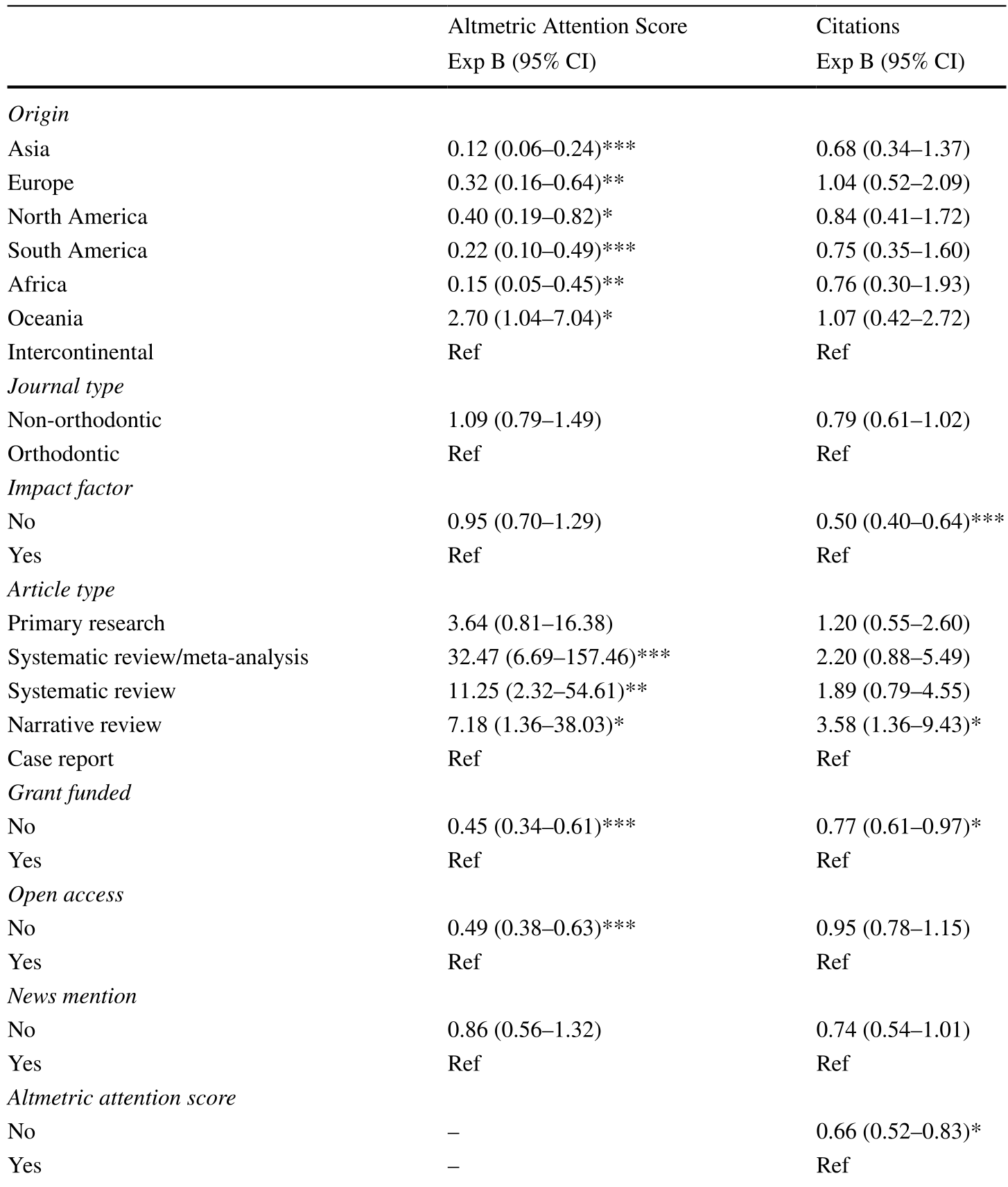 Table 4: Multivariate regression results showing the "Exponentiated B" (Exp B) values for AAS and Citations.
Detailed Insights: Why It Works
The study reveals a fascinating divergence in what drives influence:
1. The Systematic Review Powerhouse
Systematic reviews and meta-analyses are the titans of societal impact. With an Exp B of 32.47, they are over 30 times more likely to gain high Altmetric scores than case reports. Why? Because they provide "distilled" truth that is easily shareable and highly relevant to clinical guidelines.
2. The Open Access Advantage
Research published behind a paywall saw significantly lower societal engagement. The data suggests that making research Open Access is essentially a prerequisite for societal impact. If the news media or the public can’t read the full text, they don’t talk about it.
3. Funding as a Proxy for Quality
Grant funding was a "common denominator." Funded research typically undergoes rigorous peer review before it even begins, leading to higher quality outputs that naturally attract more citations and social media attention.
 Figure 5: Distribution of mentions across Twitter, Facebook, News, and Blogs for top-performing articles.
Results & SOTA Comparison
Compared to previous studies (e.g., Livas & Delli, 2018), which found no significant correlation between research type and AAS, this multivariate approach proves that when you control for other factors, the article type is actually a massive predictor.
- Professional Impact: Heavily influenced by the Journal Impact Factor and AAS. Interestingly, the presence of an AAS (social buzz) was a significant predictor of academic citations—proving that "trending" on Twitter today often leads to being cited in a journal tomorrow.
- Geography Matters: Research from Oceania (Australia/NZ) showed unique success in news mentions, potentially due to strong institutional PR or the "novelty" of clinical topics covered in that region.
Critical Analysis & Conclusion
Takeaway
If you want your research to matter, fund it, review it, and free it. Systematic reviews that are grant-funded and published Open Access are the "triple threat" of the orthodontic world.
Limitations
The study only looked at a one-year window (2019). While this provides a controlled "age" for the papers, bibliometrics usually require 3-5 years to fully mature. Furthermore, Altmetrics can be "gamed" through self-promotion on social media, which doesn't always equate to true scientific value.
Future Outlook
As AI and "Deepfake" research (cited in the discussion) begin to dominate the Altmetric Top 100, dental research must find new ways to stay "emotionally engaging" and timely to maintain its presence in the public discourse.