
PrefCast: Maximizing Global Satisfaction in Mobile Social Networks through Preference-Aware Forwarding
Preference-aware content dissemination in opportunistic mobile social networks
This paper introduces PrefCast, a preference-aware content dissemination protocol for Opportunistic Mobile Social Networks (MSNs). By formulating content forwarding as a maximum-utility scheduling problem, it optimizes the distribution of multimedia objects to satisfy heterogeneous user interests in intermittently connected environments.
TL;DR
PrefCast is a novel dissemination protocol designed for Mobile Social Networks (MSNs) that prioritizes content based on specific user preferences rather than just delivery speed. By predicting the "Future Utility" of a contact and solving the forwarding sequence as a bipartite matching problem, it outperforms existing frequency-based protocols by up to 25%.
Context: The Shift from Connectivity to Content
Most research in Delay Tolerant Networks (DTNs) treats all data packets as equally important, focusing on maximizing the delivery ratio. However, in the age of YouTube and Pandora, users have distinct tastes. A sports fan derives zero utility from a news clip. PrefCast shifts the paradigm from quantity (how many people get the file) to quality (how satisfied are the users who get it).
The Core Insight: Local vs. Global Utility
The fundamental challenge in opportunistic networks is the "Short Contact Paradox." When two users meet, they only have enough time to exchange a few files.
- Local Strategy: Send what the current neighbor wants most.
- PrefCast Strategy: Send what will benefit the system most after the neighbor moves on to their next set of contacts.

As shown in the figure above, broadcasting a popular object (m2) might yield lower immediate utility but results in a massive "future utility" gain as the receiving nodes move into new social circles.
Methodology: Math Behind the Intuition
1. Predicting Future Utility ()
PrefCast requires nodes to estimate how much "value" they can add to the network if they receive an object. This estimation considers:
- Contact Probability: Modeled as a Poisson process ().
- Preference Decay: The probability that a future contact already has the object.
- Buffer Dynamics: The risk of dropping the object due to limited space before the next meeting.
2. Optimal Forwarding via Bipartite Matching
A forwarder often meets multiple neighbors with varying contact durations. Some neighbors stay for 5 minutes; others for 30 seconds. PrefCast maps this onto a Maximum Weight Bipartite Matching (MWBM) problem.
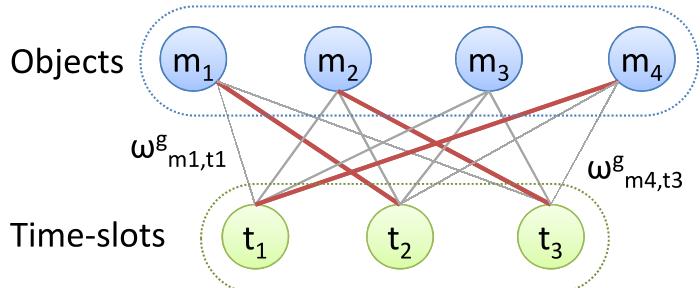
The forwarder builds a graph where one set of nodes represents available Time-Slots and the other represents Content Objects. The edges are weighted by the predicted global utility. By applying the Hungarian Algorithm, the node finds the mathematically optimal sequence to broadcast content.
Experimental Results
The authors tested PrefCast against "Epidemic" and "PROPHET" protocols using real-world mobility traces.
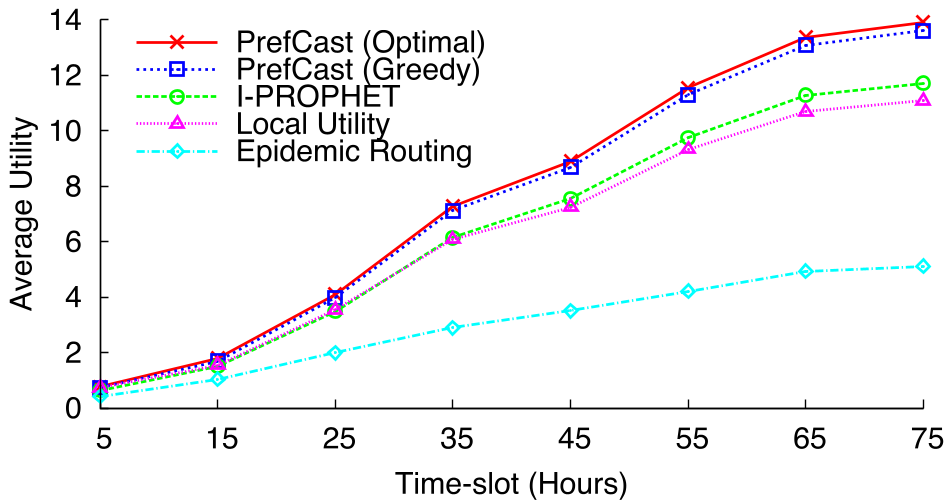
- Superior Utility: PrefCast consistently yielded the highest average satisfaction across NUS student traces and INFOCOM conference traces.
- Efficiency: Even the "Greedy" version of PrefCast performed remarkably close to the "Optimal" version, suggesting that the protocol is practical for low-power mobile devices.
Critical Analysis & Conclusion
PrefCast successfully addresses the "greedy local optimum" trap in MSN routing. However, its performance relies on nodes accurately reporting their preferences—a potential privacy concern.
Takeaway: In edge computing and opportunistic offloading, knowing who is likely to meet whom next is just as important as knowing the current connection. PrefCast provides a rigorous framework for making these "look-ahead" decisions.