
GAUP: Why Subjective Preference is the Key to Finding True Social Influencers
Preference-Based Top-K Influential Nodes Mining in Social Networks
The paper introduces GAUP, a two-stage mining algorithm designed to identify the top-K influential nodes in social networks for specific topics. It uniquely combines SVD-based Latent Semantic Indexing (LSI) with a Greedy approach to incorporate user preferences into the Independent Cascade (IC) model.
TL;DR
Social influence isn't one-size-fits-all. A world-class chef influence recipes, not rocket trajectories. This paper presents GAUP (Greedy Algorithm with User Preferences), a framework that moves beyond the "uniform probability" myth of social propagation by merging Collaborative Filtering with Influence Maximization. In tests on academic networks, it improved topic-specific influence capture by over 30% compared to standard Greed Algorithms.
The Problem: The "Uniform Probability" Fallacy
Since the seminal work of Kempe et al. (2003), the Influence Maximization (IM) problem has been treated as a structural optimization task. We assume if Author A follows Author B, there is a fixed probability that an idea will pass between them.
However, this ignores the Topic-Influence Gap. You might follow a colleague because they are a genius at Machine Learning, but you ignore their posts about Macroeconomics. Standard algorithms like the basic Greedy Algorithm (GA) tend to pick "global celebrities" who have high degrees but potentially zero influence on a niche, specific topic.
Methodology: Bridging LSI and Diffusion
The authors propose a two-stage pipeline called GAUP.
Stage 1: Latent Semantic Indexing (LSI) for Preference
The team leverages Singular Value Decomposition (SVD) to map users and topics into a shared latent space. By decomposing a user-conference matrix , they can predict how much an author (node) cares about a specific conference (topic).
Stage 2: The Extended Independent Cascade (EIC) Model
Instead of a fixed for every edge, the authors introduce the EIC Model. The probability of node activating node for topic is now a function of both their preferences:
This ensures that influence "flows" more easily through clusters of users who share a mutual interest in the subject matter.
 (Formula: Redefining activation probability based on latent user preferences)
Experiments: Hunting for Networking Experts
The authors tested GAUP on the DBLP dataset (8,627 nodes, 91,574 edges). They aimed to find influencers for SIGCOMM (a top-tier networking conference).
Key Findings:
- Superior Topic Accuracy: When , GAUP’s influence spread on the specific topic (ISST) was significantly higher than the traditional GA and standard Collaborative Filtering (CF).
- Expert Discovery: While the standard GA picked general Computer Science "giants" (e.g., Philip Yu, who is influential but focuses on Data Mining), GAUP correctly identified networking legends like James Kurose and Jennifer Rexford.
- Efficiency: By utilizing CELF optimization, the authors maintained the submodularity benefits of the greedy approach, making the NP-hard problem computationally tractable.
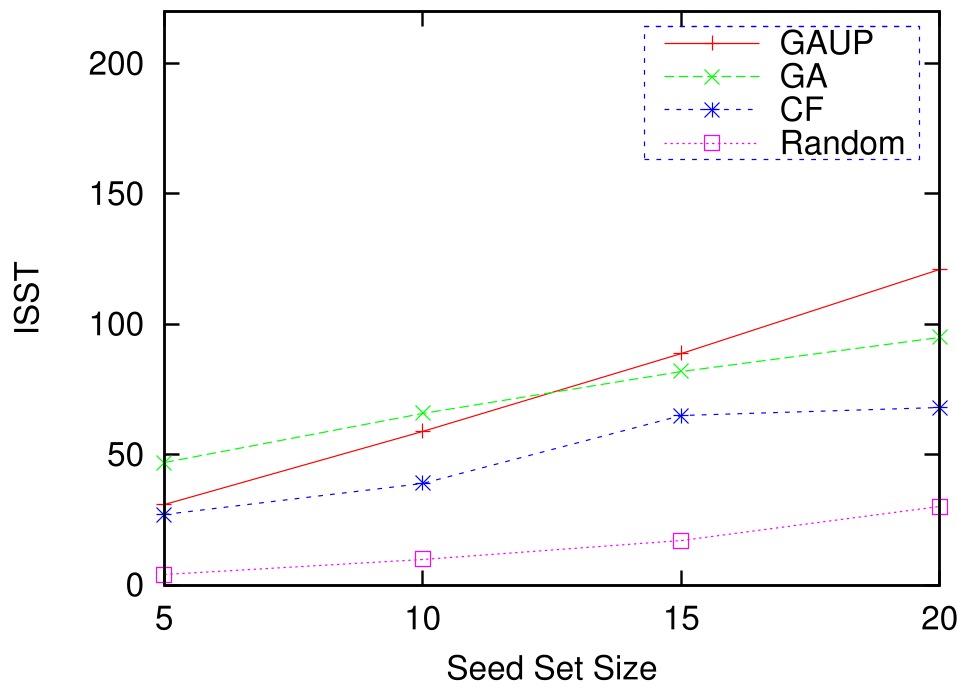 (Figure 1: Influence Spread of different algorithms over topic-specific metrics)
Critical Insight: Why GAUP Wins
The brilliance of GAUP lies in its recognition that Influence = Connectivity Interest.
- GA only sees Connectivity.
- CF only sees Interest.
- GAUP fuses them, allowing the algorithm to navigate "interest-based sub-graphs" within a larger social structure.
Conclusion & Future Outlook
The GAUP algorithm proves that for social networks to be useful in viral marketing or expert recommendation, they must be "weighted" by the topic at hand.
Limitations: The current model relies on Monte Carlo simulations, which are notoriously slow. The authors suggest that future work should focus on parallelization and potentially scaling to dynamic networks where preferences change over time. As we move toward more personalized AI, algorithms like GAUP provide the necessary bridge between structural graph theory and behavioral psychology.