
Deciphering Social Influence: How Local Connections Shape Global Power in OSNs
Preferential attachment and the spreading influence of users in online social networks
This paper investigates the relationship between local preferential attachment (assortativity) and the global spreading influence of users in Online Social Networks (OSNs). Utilizing k-shell decomposition, the authors reveal how network growth and user connection preferences dictate influence distribution, achieving a theoretical proof for power-law coreness distribution across multiple real-world datasets.
TL;DR
Not all social networks are built equal. This paper reveals that the "local preference" of how you choose your friends—whether you seek peers with similar popularity (assortative) or link to "stars" (disassortative)—fundamentally changes the global hierarchy of influence. Using k-shell analysis, the authors prove that influence follows a power-law distribution and that your path to becoming an "influencer" is much more predictable in networks like Facebook than in platforms like Twitter.
The "Who You Know" Dilemma: Problems & Motivation
In the world of Online Social Networks (OSNs), we often focus on Degree Centrality (how many followers you have). However, true "spreading influence" is a global property. The core problem is that we don't fully understand the interplay between Local Preferential Attachment and Global Spreading Influence.
Why does a message go viral on one platform but die on another? The authors argue the secret lies in the Assortative Coefficient ():
- Assortative (): Popular people hang out with popular people (e.g., Facebook).
- Disassortative (): Popular hubs connect to many "ordinary" users (e.g., Epinions, Twitter).
Methodology: Pruning the Network Tree
To measure global influence, the authors use k-shell decomposition. This process involves iteratively "pruning" nodes with low connections to find the innermost "core" of the network. A higher shell index () represents higher global influence.
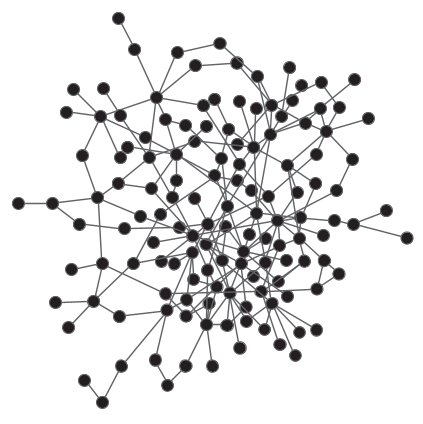 (Visualizing Assortative vs. Disassortative clusters)
By applying this to the Reaction-Diffusion-like Coevolving (RDC) model, the authors could simulate network growth from 10 to 100,000 nodes, observing how influence patterns emerge as the population scales.
Key Insights and Mathematical Proof
The authors provide a theoretical breakthrough by proving that the proportion of users on a specific shell follows a power-law:
1. Influence Variation
In Disassortative networks, there is a massive gap between the "elite" and the "masses." These networks have a high number of shells (), meaning the "core" users are exponentially more powerful than the periphery. In Assortative networks, the number of shells is lower and remains steady as the network grows, meaning ordinary users are actually quite influential.
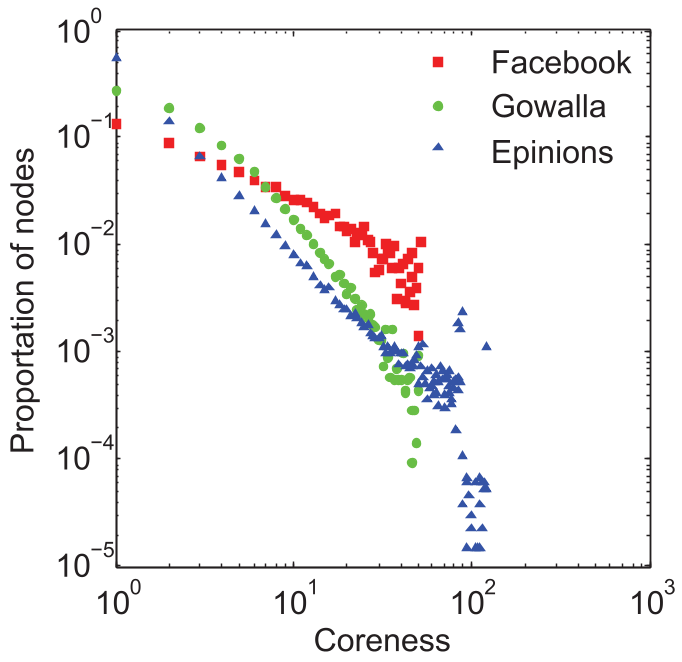 (The number of shells explodes in disassortative networks as they scale)
2. The Density of the Core
In Facebook (Assortative), the core is "crowded" (about 1% of users). In Epinions (Disassortative), the core is a "lonely peak" (<0.01% of users). This makes disassortative networks highly vulnerable: remove a few core hubs, and the whole network collapses.
Evolution: How to Become an Influencer
The study tracks "freshman" users over time.
- In Assortative OSNs, there is a "definitive growing progress." If you stay in the network, you naturally upgrade to the core members over time. It’s a predictable ladder of influence.
- In Disassortative OSNs, growth is chaotic. While the "super-stars" get even stronger (rich-get-richer), ordinary users scatter across all levels of hierarchy with no guarantee of rising to the top.
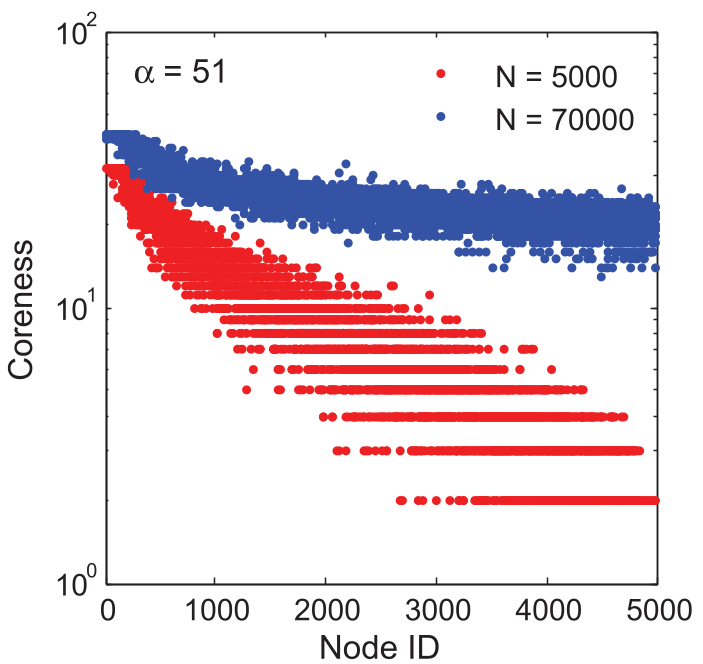 (Tracking nodes from N=5,000 to N=70,000 shows steady upward migration in assortative models)
Critical Analysis & Conclusion
Takeaway
For marketers and epidemic researchers, this paper highlights that network topology dictates strategy. On an assortative platform, you can initiate a cascade starting with "ordinary" users. On a disassortative platform, you must hit the few, highly-exclusive core hubs.
Limitations & Future Work
The study primarily uses degree-based attachment. The authors acknowledge that real human behavior is deeper—people join "communities" or "cliques" (local rich-get-richer effects). Future research needs to integrate community detection into this influence hierarchy to see if "local stars" in small niches carry the same weight as global influencers.
Reference: Jiang, J., et al. "Preferential Attachment and the Spreading Influence of Users in Online Social Networks."