
Deep Emotion: Decoding Human Feelings through Neural Architectures
A Preliminary Investigation of Deep Emotion-based Classification from Natural Language Text
This paper presents a preliminary investigation into emotion-based text classification using Deep Learning (MLP, CNN, and LSTM). The authors propose a custom NLP preprocessing pipeline involving chunking and weighted emotion-lexicons to transform raw text into term-document matrices for multi-class emotion recognition.
TL;DR
This study investigates the transition from binary Sentiment Analysis to multi-class Emotion Classification. By leveraging various Deep Learning architectures (MLP, CNN, LSTM) and specialized NLP preprocessing (weighted emotion features), the researchers compare how well machines can "feel" the intent behind text across different datasets. While explicit reviews (IMDB) are easily classified, implicit emotional episodes (ISEAR) remain a grand challenge for current lexicon-driven deep learning.
Problem & Motivation: Beyond "Positive" and "Negative"
Most commercial sentiment tools act as a simple toggle: Is this review good or bad? However, human psychology is far more complex. A "negative" review could be fueled by Anger, Sadness, or Disgust—each requiring a different corporate or social response.
The authors identify two main bottlenecks in current research:
- Implicit vs. Explicit: Words like "happy" are easy to flag, but a sentence like "I got the job I applied for" contains joy without using a single "emotion word."
- Linguistic Modifiers: An adjective's weight changes drastically when preceded by "very" (intensifier) or "hardly" (diminisher).
Methodology: The Weighted Feature Pipeline
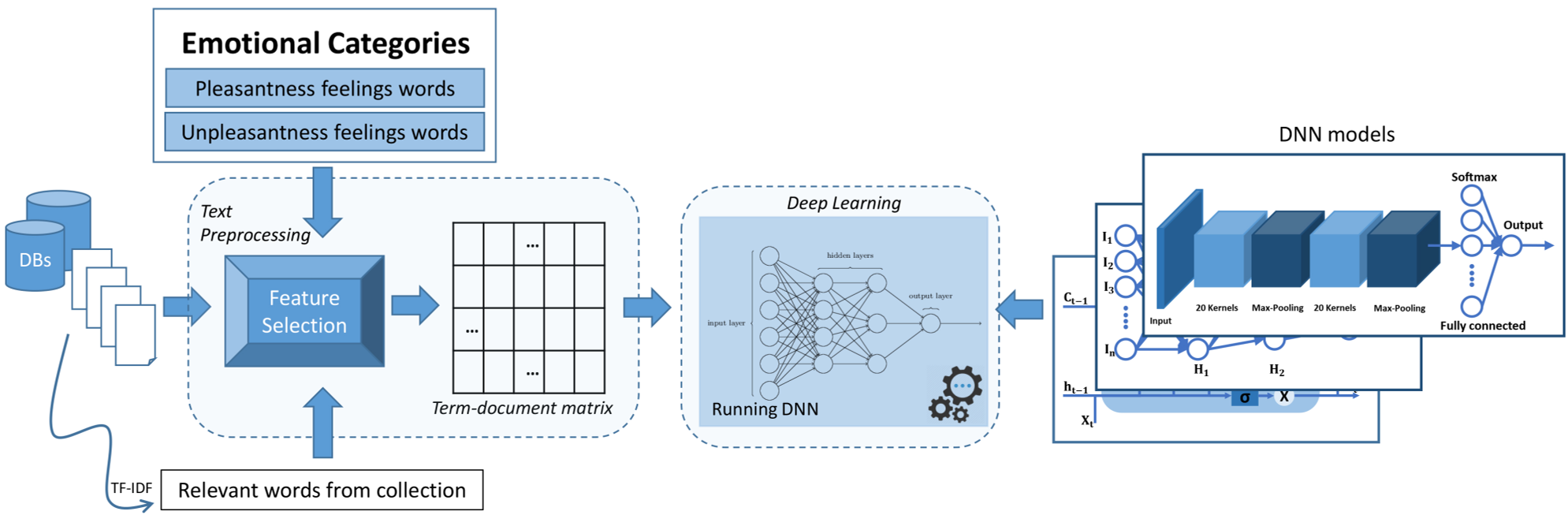
The core innovation lies in the Preprocessing Phase, which bridges the gap between raw natural language and the numerical matrices required by Deep Neural Networks (DNNs).
1. Feature Engineering
The authors defined three distinct ways to build the input matrix:
- Compressed Features: Grouping synonyms into 16 core emotional categories (e.g., Alive, Happy, Angry, Afraid).
- Expanded Features: Using all 267 synonym words as individual features.
- Expanded Word-Emotion: Combining the 16 emotional categories with the top 100 most relevant words derived via TF-IDF.
2. The Weighting Mechanism
To handle linguistic nuances, the authors use a grammar chunker to identify patterns like Adv + Adj. They apply a formula:
Where acts as a modifier (+1 for intensifiers, -1 for diminishers). This ensures that "very good" scores higher (+3) than "good" (+2), while "not good" triggers an antonym swap.
Experiments: A Tale of Two Datasets
The researchers tested their pipeline on IMDB (explicit movie reviews) and ISEAR (descriptions of emotional events).
Key Result: The "Implicit" Wall
The results were polarized. On the IMDB dataset, the models performed exceptionally well:
- CNN Accuracy: 96.65%
- MLP Accuracy: 93.00%
- LSTM Accuracy: 96.25%
However, on the ISEAR dataset, accuracy plummeted to the 36% - 44% range.
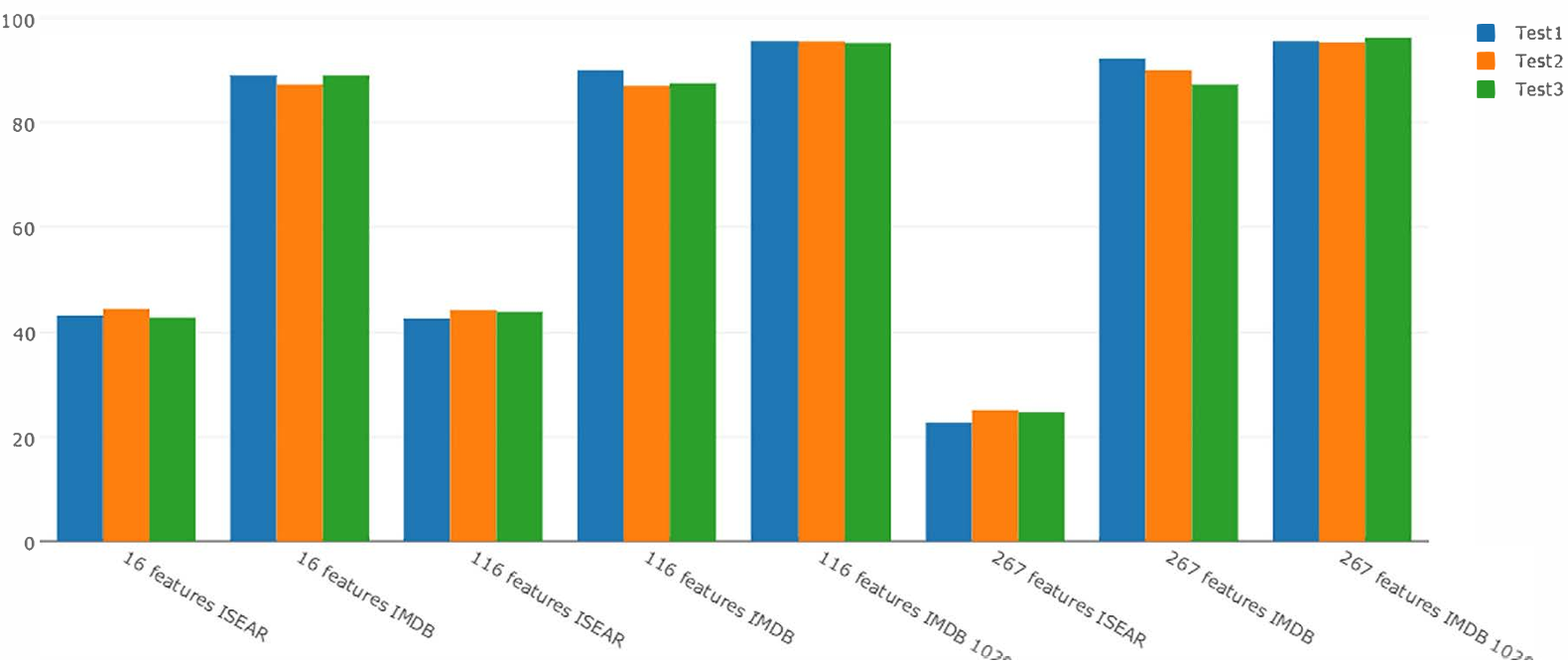
Why the discrepancy? The authors argue that ISEAR is composed of "emotional episodes" where the feeling is hidden in the situation. A description of a funeral might not use the word "sad," but the context implies it. The current preprocessing, which relies heavily on a lexicon (word-matching), simply returns a zero-vector for such sentences.
Critical Analysis & Conclusion
Takeaway
The study proves that for explicit emotion detection (where users want to be heard, like reviews), simple NN architectures combined with weighted lexicons are highly effective and production-ready.
Limitations & Future Work
The reliance on Feature Selection act as a double-edged sword. While it reduces noise, it also removes the contextual "connective tissue" that modern Transformer models (like BERT or GPT) use to understand implicit meaning. The author's investigation suggests that the next step in this field isn't just "deeper" networks, but networks that can interpret Common Sense Reasoning to decode the emotions behind neutral-looking descriptions.
In the battle of architectures:
- MLP: Best for efficiency (15 min training).
- CNN/LSTM: High accuracy but computationally expensive (2+ hours).