
Beyond the Code: Scaffolding Intercultural Competence in Computer Science
Preparing Undergraduate Computer Science Students to Face Intercultural and Multidisciplinary Scenarios
This teaching case introduces a semester-long undergraduate course designed for Computer Science students to develop soft skills for multicultural and transdisciplinary environments. By integrating Vygotsky’s Social Formation of the Mind and Hofstede’s Cultural Theory, the curriculum successfully shifted student focus from technical "algorithms" to effective communication across diverse audiences.
TL;DR
Modern engineering isn't just about human-computer interaction; it's about human-human interaction mediated by computers. This paper details a successful curricular intervention that uses social science giants like Vygotsky and Hofstede to teach Computer Science students how to navigate the "messy" reality of multicultural and multidisciplinary workplaces. The result? A measurable shift from dogmatic technical thinking to flexible, empathetic professional communication.
The "Algorithm" Trap: Why Technical Excellence Isn't Enough
For decades, Computer Science (CS) education has operated on a hidden assumption: if you teach a student the logic of machines, they will intuitively figure out the logic of people. However, as the authors point out, graduates often enter the workforce with a "mental algorithm" that is excellent for debugging code but terrible for navigating cultural nuances.
The core problem is cognitive isolation. CS students are taught to value "absolute truths" and "efficient solutions," which often leads to a dismissive attitude toward non-technical stakeholders—a phenomenon the authors describe as "over-crediting" oneself and underestimating diverse opinions.
Methodology: Theoretically Grounded Soft Skills
The researchers didn't just host "chat sessions." They built a rigorous theoretical bridge between psychology, sociology, and technology.
The Theoretical Backbone
The course relies on two primary pillars:
- Vygotsky’s Social Formation of the Mind: The idea that our internal thought process (inner speech) is shaped by our social interactions and the tools (language, IT) we use.
- Hofstede’s Cultural Theory: Understanding culture as "collective programming" that dictates how we perceive authority, uncertainty, and community.
Practical Architecture
The course structure follows Bloom’s Revised Taxonomy, moving from lower-order thinking (remembering definitions) to higher-order thinking (creating intervention strategies for real-life organizations).
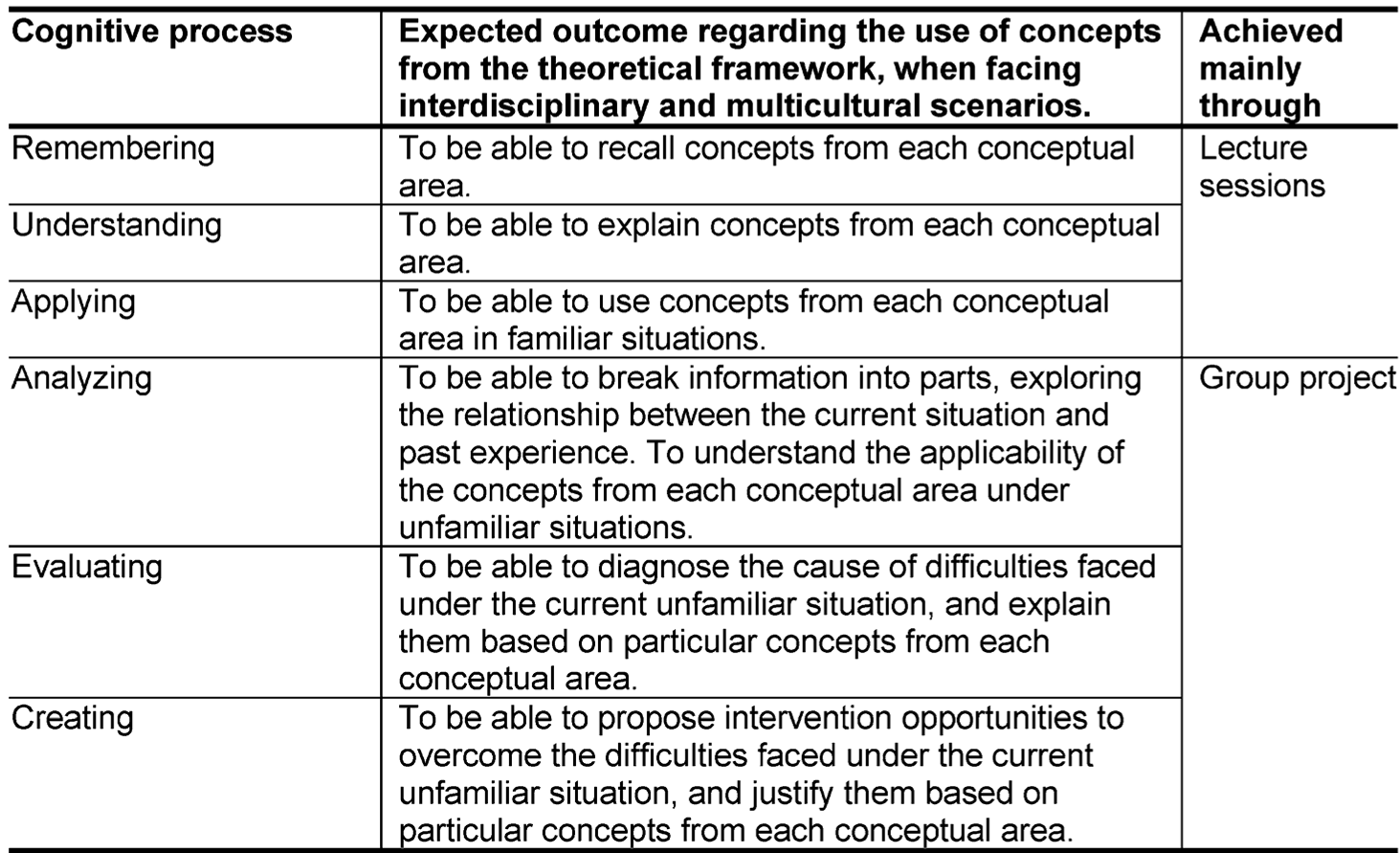
Students were tasked with a semester-long project: analyzing a "human organization" (any group of 2+ people) going through IT adoption. By using varied media—podcasts, wikis, and Facebook groups—students were forced to "translate" their technical findings for different audiences, directly practicing the ABET requirement of "communicating effectively with a range of audiences."
Measuring the Shift: From Judgmental to Flexible
The study utilized a pretest/posttest design involving open-ended questions about polysemic videos (e.g., watching a performance of John Cage’s silent 4’33”).
Quantitative Growth
The growth factors in the students' ability to apply theoretical concepts were remarkable:
- Representation & Modeling: +230% increase in conceptual application.
- Partial Observation: +217% increase.

Qualitative Evolution
Perhaps more striking than the numbers was the change in tone. In pretests, students were often judgmental (e.g., "The silent music is a waste of time"). In posttests, students frequently prefaced their answers with "In my opinion" or "From my perspective," acknowledging that their view is only a partial observation of reality.
Critical Insight: The "Tagline" of Professionalism
A year after the course, students were asked for a "tagline." The responses highlight the profound identity shift:
"We don't see the world how it is, but rather how we are." "The only truth is that there is no absolute truth."
While a small minority (approx. 8%) found the course "a waste of time," the overwhelming majority recognized that these "soft" skills are actually "hard" to master and essential for professional survival.
Conclusion & Future Outlook
This teaching case proves that soft skills can—and should—be taught as a primary subject in CS curricula. By providing a "bibliographical backbone," educators can give students the tools to categorize and organize the social complexities they will face.
Future Directions: The authors suggest exploring why a small group remains resistant to these concepts. For the rest of the field, the takeaway is clear: to build better systems, we must first learn to understand the people who use them and the diverse teams that build them.