
The Preprocessing Paradox: Why Your Choice of Data Encoding Matters More Than Your Algorithm
The impact of preprocessing on data mining: An evaluation of classifier sensitivity in direct marketing
This paper presents a comprehensive empirical evaluation of Data Preprocessing (DPP) impact on classifier performance in direct marketing. It compares Decision Trees (DT), Neural Networks (NN), and Support Vector Machines (SVM) using multifactorial ANOVA to reveal how attribute scaling, sampling, and coding schemes influence predictive accuracy (Lift).
TL;DR
In the race to achieve SOTA (State-of-the-Art) performance, we often obsess over model architectures (NN vs. SVM vs. XGBoost) and hyperparameter tuning. However, this seminal study by Crone et al. proves that Data Preprocessing (DPP)—the "unglamorous" work of scaling and coding—can influence your results more than the model itself. By analyzing direct marketing response models, the authors demonstrate that arbitrary preprocessing choices can bias scientific comparisons and lead to significant monetary losses in real-world applications.
Problem & Motivation: The Overlooked Stage of KDD
The Knowledge Discovery in Databases (KDD) process is a pipeline: Selection → Preprocessing → Transformation → Data Mining → Evaluation.
The authors' literature review revealed a startling trend: while 84% of papers detail hyperparameter tuning, almost none justify their choice of categorical encoding or scaling. Most researchers apply a single, arbitrary DPP scheme and then declare a "winning" algorithm. This leads to a reproducibility crisis where Algorithm A beats B in one study, but the reverse happens in another—simply because the data was "scaled to [0,1]" instead of "standardized."
Methodology: A Multifactorial Attack
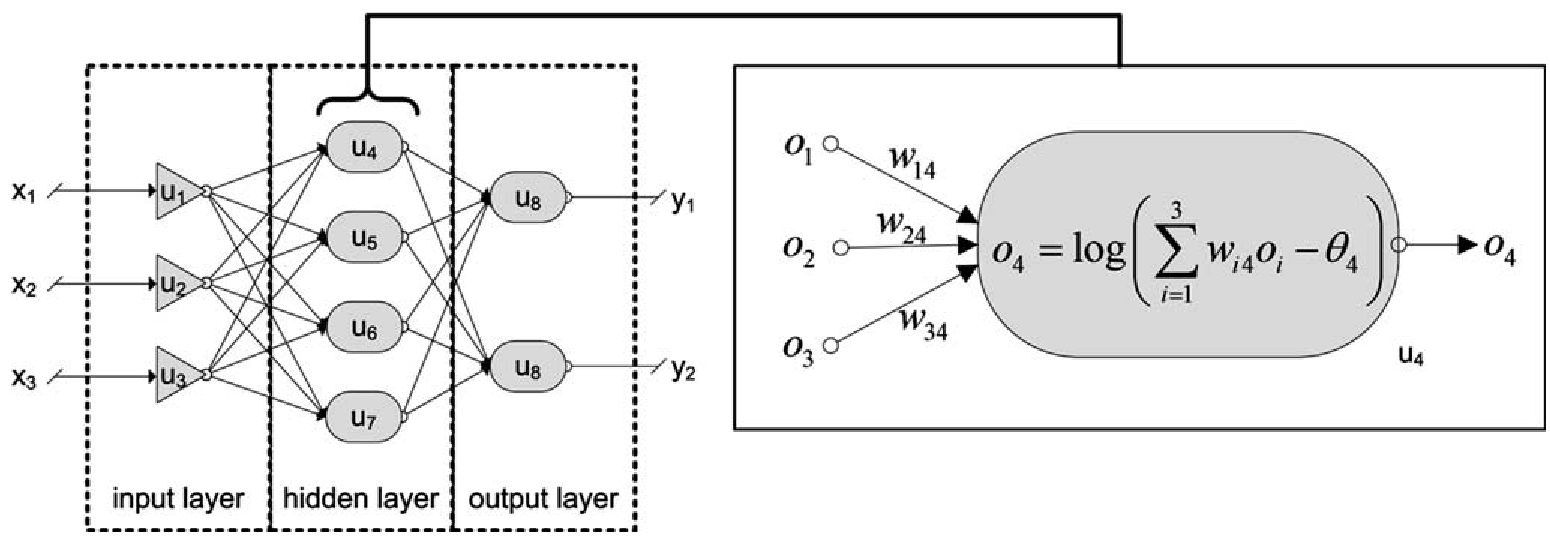
The study used a real-world direct marketing dataset (300,000 customers, 1.4% response rate) and tested the sensitivity of Neural Networks (MLP), Support Vector Machines (SVM), and C4.5 Decision Trees (DT).
The Controlled Variables
- Sampling: Undersampling vs. Oversampling (to handle the 1.4% imbalance).
- Continuous Coding: Discretization (binning) vs. Standardization (Z-score).
- Categorical Coding: N (One-hot), N-1 (Dummy), Thermometer, and Ordinal encoding.
- Scaling Range: [0, 1] vs. [-1, 1].
Key Insights: Why "Best Practices" Aren't Universal
1. The Sampling Trap
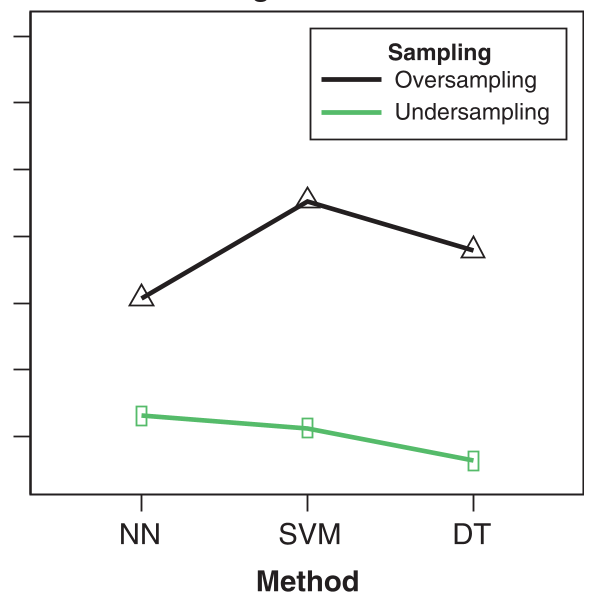
While undersampling the majority class (non-responders) is computationally faster, it was found to be consistently inferior. For SVMs and DTs, it led to a massive drop in out-of-sample performance (Lift accuracy dropped by over 6%). More dangerously, undersampling caused a negative correlation between training and test performance, meaning you cannot trust your validation metrics to select the best model.
2. Classifier Sensitivity
The study proved that algorithms have unique "preprocessing personalities":
- Neural Networks: Extremely sensitive to encoding. They perform best with discretized continuous features and N-coding. Standardizing data containing outliers significantly hurts NN training.
- SVMs: More robust than NNs to coding but favor standardization and [0, 1] scaling.
- Decision Trees: Naturally robust to scaling but were negatively affected by the interaction of N-1 encoding and discretization.
3. The Variance Revelation
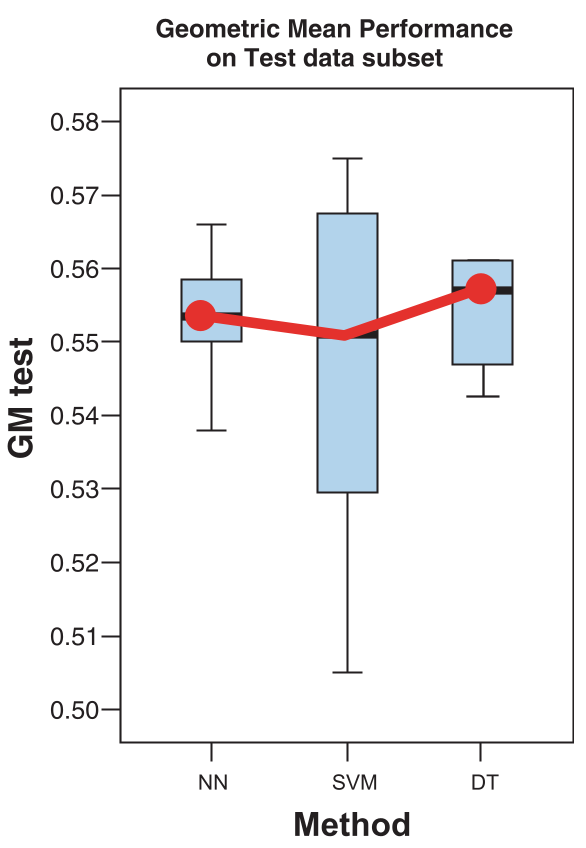
Perhaps the most critical finding is visualized in the boxplots below. The variance in performance (Lift) induced by different DPP choices within a single method was often larger than the difference between the mean performance of different methods.
Critical Analysis & Conclusion
Takeaway
If you scale your data for an SVM and then run a Neural Network on that same data, you are likely handicapping the NN. The "superiority" of an algorithm in many benchmark papers might actually be the superiority of the preprocessing scheme used for that specific algorithm.
Limitations
The study focuses on a specific imbalanced classification task (Direct Marketing). While the results for sampling and coding are likely generalizable to other tabular data tasks, high-dimensional data (like image or text) might exhibit different sensitivities.
Future Outlook
This work highlights the necessity of End-to-End Pipeline Optimization. In modern ML, we should stop treating preprocessing as a "pre-step" and start including it in our cross-validation and grid-search loops. The future of robust ML lies in finding the best Data-Processor-Model triplet, not just the best model.