
Beyond the Smileyometer: Automating Preschooler Satisfaction Assessment via AI
A Step Towards Preschoolers' Satisfaction Assessment Support by Facial Expression Emotions Identification
The paper proposes an automated framework for assessing preschoolers' satisfaction with "edutainment" applications using Machine Learning-based facial expression recognition. It demonstrates that integrating CNN-based emotion identification provides an objective metric for usability evaluation in early childhood education.
TL;DR
Evaluating software for children under six is notoriously difficult because they can't accurately report their feelings. This paper introduces a Machine Learning pipeline that uses facial expression recognition to objectively measure a child's "satisfaction" during edutainment. By leveraging CNNs and transfer learning, the researchers achieved up to 81% accuracy, providing a roadmap for data-driven UI/UX improvements in early childhood education.
The Problem: The "Please-the-Adult" Bias
In adult UX research, we use interviews and Likert scales. For children, researchers often use "Smileyometers" (visual scales). However, preschoolers (ages 3-5) are in the preoperational stage of cognitive development. They struggle with self-reflection and often provide positive feedback just to satisfy the researcher.
The core challenge is that manual observation by experts is both subjective and non-scalable. If an expert misses a micro-expression of frustration during a specific game level, a critical design flaw might go unfixed.
Methodology: Bridging the Adult-Child Data Gap
The researchers faced a common "Cold Start" problem in AI: there isn't enough labeled data of children's faces. To solve this, they used Transfer Learning.
The Pipeline:
- Face Detection: Utilizing Haar Cascades and HOG features to locate the face in a video frame.
- Feature Extraction: Comparing traditional handcrafted features (Action Units/SVM) against Deep Learning (CNN).
- Training Scenarios: They tested three paths:
- Training on adults, testing on children (Result: Low accuracy, ~52%).
- Training only on children (Result: Moderate accuracy, ~68%).
- Mixed Training: Combining adult and child datasets (Result: High accuracy, 81%).

Experiments & Results: The Value of Time-Stamps
The study proved that children's facial expressions are less "distinct" than adults', leading to higher classification errors when using adult-only models. However, when the model was trained on the BBU Dataset (recorded in actual kindergartens), it successfully identified periods of anger and frustration.
The real breakthrough wasn't just the accuracy number, but the Dynamic Output. The system produces a timeline of emotions, allowing developers to see exactly when a child got frustrated.
| Approach | ML Algorithm | Dataset | Accuracy |
|---|---|---|---|
| P1 (Mixed) | CNN | FER + CK+ + CAFE | 81% |
| P4 (Child-only) | CNN | CAFE | 68% |
| P5 (Traditional) | SVM + AUs | CAFE | 50% |
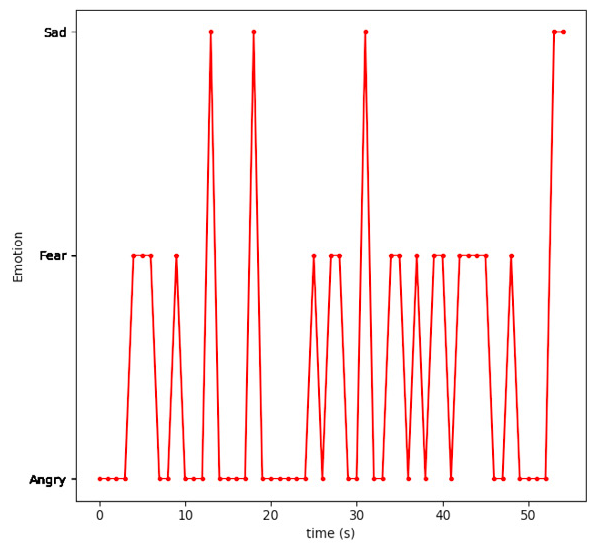 Figure (a): A dynamic pie chart and polar graph showing the frequency and timing of identified emotions.
Critical Insight & Future Outlook
This work signals a shift from Inquiry-based (asking the child) to Observation-based (analyzing the child) usability.
Limitations:
- Single-label bias: The current model assumes a child feels only one emotion at a time. In reality, "frustrated-interest" is a common state in learning.
- Demographics: Small datasets may not capture the full diversity of facial mimics across different cultures.
Future Directions: The authors suggest a future where "Adaptive Edutainment" exists—applications that detect a child’s frustration in real-time and automatically lower the difficulty level to prevent the child from giving up. This moves AI emotion recognition from a "reporting tool" to a "real-time intervention tool."
Conclusion
By converting raw video frames into structured emotional data, we can finally look past the "I like it!" responses of preschoolers to see the objective truth of their digital experiences.