
k-Subgraph: Shielding Social Networks from Structural Background Knowledge Attacks
Preservation of Privacy in Publishing Social Network Data
The paper proposes the "k-subgraph" framework, a novel anonymization method for social network data publishing. It combines label generalization with structural perturbation via k-subgraph partition, perturbation, and connectivity to achieve a re-identification probability of at most 1/k.
TL;DR
This paper addresses a critical vulnerability in social network publishing: even if you hide names, an attacker knowing "Alice has 3 friends, and those friends have 2, 3, and 4 friends respectively" can still find Alice in a public graph. The authors propose the k-subgraph framework, which uses partition, perturbation, and a connectivity table to ensure that every node is structurally identical to at least others, keeping re-identification risk below while maintaining high query accuracy.
Background & Motivation: The Identity-Structure Paradox
In the era of big data, "Anonymization" is often misunderstood as simply removing names (label generalization). However, social networks are mathematical graphs where topology is identity.
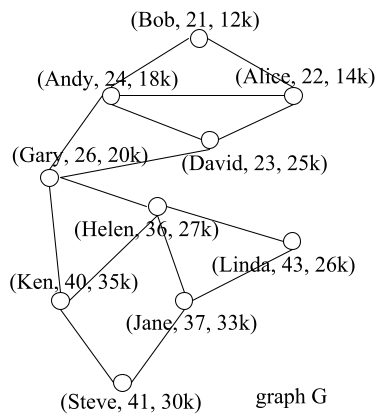
The authors point out that if an adversary knows the degree of a target and their immediate neighbors, "Basic Anonymization" (shown below) is useless. If Alice’s structural profile is unique, she is exposed. The challenge is: How do we distort the graph enough to hide individuals but not so much that the data becomes useless for researchers?
Methodology: The Three Pillars of k-Subgraph
The author's solution, the k-subgraph method, moves beyond simple label masking to "Structural Isomorphism" within local groups.
1. k-subgraph Partition
Nodes are grouped into subgraphs of size . Nodes within a group are selected based on label similarity and proximity. All labels within a group are then generalized to be identical.
2. k-subgraph Perturbation
This is the core "cloaking" step. Within each k-subgraph, the algorithm adds or deletes edges until every vertex has the exact same degree. This makes them indistinguishable to an adversary looking at local structural properties.
3. k-subgraph Connectivity
To prevent the network from becoming a collection of isolated islands, the authors introduce a connectivity table. This table stores the count of edges that existed between different subgraphs before they were "severed" during perturbation. This allows researchers to perform aggregate queries (like average path length) by reconstructing the global density.
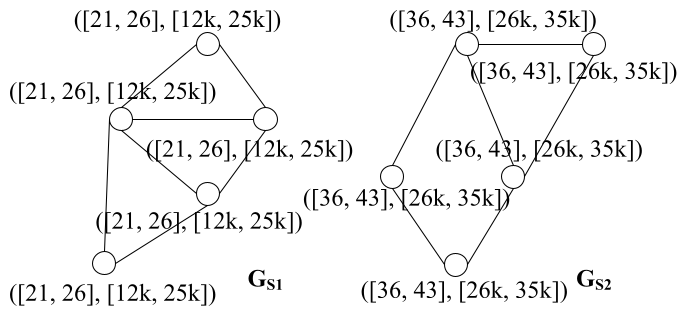 Figure: The transition from generalized subgraphs (a) to perturbed, isomorphic subgraphs (b) and the resulting connectivity table (c).
Experiments & Performance
The researchers evaluated their method using R-MAT models (which simulate real-world "small-world" properties) and the KDD Cup 2003 co-authorship dataset.
- Anonymization Cost: As the number of vertices () increases, the number of modified edges grows sublinearly. This suggests the method scales well to ultra-large networks.
- Utility (Query Accuracy): The team tested "Aggregate Network Queries" (e.g., "What is the average distance between PhD students and Professors?").
- Result: Even with (high privacy), the error rate remained remarkably low. Because the connectivity table preserves the macro-structure of the graph, the "loss" of specific edges doesn't destroy the "statistical truth" of the network.
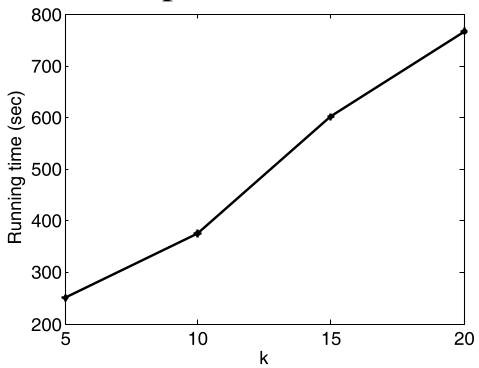 Figure: Error rate for aggregate queries vs. privacy level k. Note how the utility remains stable even as k increases.
Critical Insight: Why This Works
The "magic" of this paper lies in the Connectivity Table. Most graph anonymization works either:
- Drop edges randomly (destroying connectivity).
- Add noise everywhere (Differential Privacy), which can ruin small-community analysis.
By partitioning the graph into k-subgraphs and then documenting the "missing links" between those subgraphs, the authors provide a "map" that allows analysts to estimate distances without ever knowing exactly which node connected to which node.
Conclusion & Limitations
The k-subgraph approach is a robust defense against background knowledge attacks. It provides a formal safety guarantee ( re-identification probability) while keeping the graph "useful" for social science research.
Limitations: The current method focuses on undirected graphs. In directed graphs (like Twitter/X followers), the attack surface is much larger because "in-degree" and "out-degree" must both be balanced, which would significantly increase the "perturbation cost" (the number of edges you have to change). Future work should explore how to apply this to dynamic graphs where the structure changes over time.