
Preserving the Pulse of Social Data: Privacy-Preserving Mining of Sharing Patterns
1789_Preserving privacy and frequent sharing patterns for social network data publishing.
The paper introduces a novel anonymization algorithm designed to achieve k-anonymity in social networks while preserving "frequent sharing patterns" (spatterns). It combines structural graph anonymization with set-valued data utility, specifically targeting marketing and consumer behavior analysis.
TL;DR
Sharing social network data is a double-edged sword: it is gold for market researchers but a minefield for user privacy. This paper presents a specialized k-anonymity algorithm that prevents "neighborhood attacks" while ensuring that frequent sharing patterns—the common traits shared within connected communities—remain intact for data mining.
Background: The Privacy-Utility Tug-of-War
In social network data publishing, simply removing names is insufficient. An attacker knowing Toby's connection count and his friends' mutual relationships can uniquely identify him. While previous methods focused on masking these structural "fingerprints," they often inadvertently deleted the very patterns that make the data useful—such as the fact that "Students who use Laptops" tend to form specific clusters. This paper is the first to bridge the gap between structural k-anonymity and set-valued frequent pattern mining.
The Core Motivating Insight
The authors argue that when we add edges to a graph to hide someone's identity, we shouldn't just pick nodes at random. If we connect two nodes that share many identical attributes, we might create "fake" frequent patterns that didn't exist in the original data. Their insight is to use a minimal overlap cost function to select where to add edges, ensuring the "knowledge" extracted by the end-user stays as close to the truth as possible.
Methodology: The Two-Step Dance
The algorithm processes nodes from highest to lowest degree (following the power-law distribution characteristic of social networks) through two main phases:
Phase 1: Degree Smoothing
To make nodes "look alike," they must first have the same degree. The algorithm selects target nodes with the lowest degrees and calculates a cost based on label intersections: By minimizing this, they prevent the artificial inflation of support for specific attribute sets.
Phase 2: BFS Isomorphism
Once degrees match, the 1-neighborhood structures are made isomorphic using BFS Coding. This technique encodes the graph structure into a string, allowing the algorithm to identify exactly where edges need to be added to make a group of nodes structurally indistinguishable.
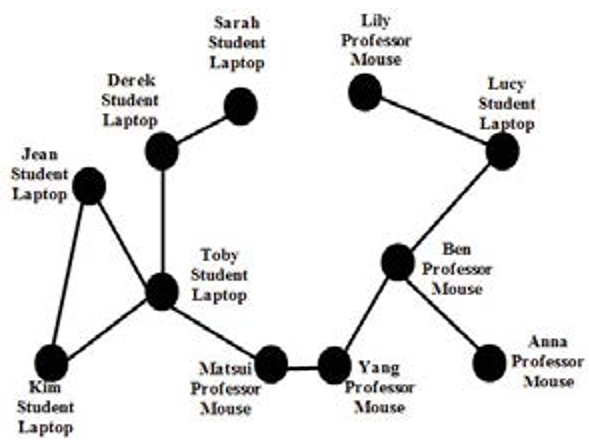 Figure: The transition from a raw social network (a) to an anonymized version (b) where structural identities are hidden.
Experimental Evidence
The authors tested their approach using Gnutella P2P network structures combined with the "Adult" dataset for vertex attributes. They measured FS Loss (Frequent Spattern Loss)—the discrepancy in discovered patterns before and after anonymization.
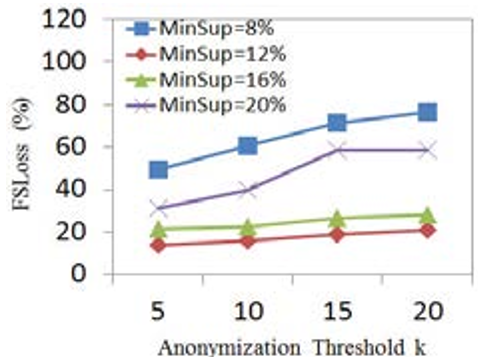 Figure: The impact of increasing privacy (k-value) on the utility of Gnutella data.
The results indicate that while increasing (higher privacy) naturally leads to higher utility loss, the rise is gradual. Even at , the data remains highly useful for identifying community-wide behaviors.
Critical Analysis & Future Outlook
Takeaway
The true value of this paper lies in its scalability. By targeting nodes with high degrees first and using BFS codes for structural matching, the method handles large-scale graphs better than previous combinatorial approaches.
Limitations
- 1-Neighborhood Constraint: The method only protects against attackers knowing a target's immediate neighbors. If an attacker knows the relationships two or three hops away, the privacy model may fail.
- Label Disclosure: It focuses on identity privacy but doesn't strictly prevent "Attribute Disclosure" (knowing someone's specific sensitive traits if all nodes in a k-group share them).
Future Work
As social networks become multi-modal (containing photos, text, and timestamps), extending this frequent pattern preservation to attributed graphs with continuous variables will be the next major frontier in privacy-preserving data publishing.