
Preserving Privacy in Weighted Social Networks: Moving Beyond Strict Isomorphism
Preserving Privacy with Probabilistic Indistinguishability in Weighted Social Networks
This paper introduces a novel privacy framework for weighted social networks to prevent identity disclosure. It proposes the "Probabilistic Indistinguishability" property and the Heuristic Indistinguishable Group Anonymization (HIGA) scheme, which utilizes random-walk-based structural similarity and weight generalization to protect against weighted 1*-neighborhood attacks.
TL;DR
Social networks are increasingly weighted (representing affinity, frequency, or trust), and these weights are a goldmine for attackers. This paper presents HIGA (Heuristic Indistinguishable Group Anonymization), a scheme that replaces the rigid requirement of graph isomorphism with a more flexible Probabilistic Indistinguishability. By combining random-walk structural analysis with weight generalization, it protects users while keeping the data useful for complex graph mining.
The Problem: The "Weighted 1*-Neighborhood" Attack
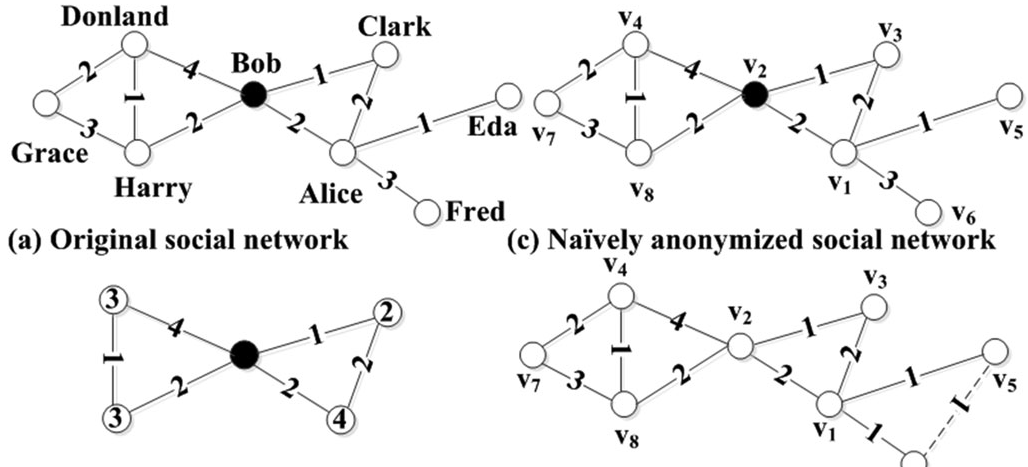
Most researchers previously assumed that removing names or masking degrees was enough. However, the authors identify a potent threat: the Weighted 1-Neighborhood Attack*.
In this scenario, an attacker knows:
- A target's one-hop neighbors.
- The connections between those neighbors (the 1-neighborhood graph).
- The absolute degrees of those neighbors and the weights on the edges.
Even if a graph is k-neighbor anonymous (meaning people have the same neighbor structure), the specific weights (e.g., "Bob talks to Alice 50 times a day") can act as a unique fingerprint, allowing for nearly 100% accurate re-identification.
Methodology: The HIGA Framework
The core innovation lies in the HIGA scheme, which treats privacy as a grouping problem rather than a total obfuscation problem.
1. Structural Similarity via Random Walks
Instead of checking if two subgraphs are perfectly identical (isomorphic), which is computationally expensive and data-destructive, the authors use Random Walks (RW). By performing a random walk on neighbor structures, they generate a "topological signature." If the Hellinger distance between two signatures is below a threshold, the structures are deemed "similar enough."
2. Weight Generalization
To handle edge weights, HIGA doesn't just delete them. It generalizes them into ranges (e.g., a weight of 4 and 2 become the range [2, 4]). This ensures that an attacker cannot distinguish between nodes based on precise affinity values.
3. Probabilistic Indistinguishability
The final touch is a randomization step. By slightly perturbing the graph with a probability after anonymization, the authors ensure that even if an attacker finds a match, they can never be certain if that match was original or a result of the noise, keeping re-identification confidence below .
Experimental Performance
The authors tested HIGA on major datasets: Facebook, CA-CondMat, Enron, and Douban.
- Utility Preservation: Unlike methods that scrub weights entirely, HIGA maintains the "small-world" characteristics and power-law distributions of the original networks.
- Efficiency: While large datasets like Douban (154k nodes) take significant time, the paper proposes a parallel graph partition strategy to scale the process.
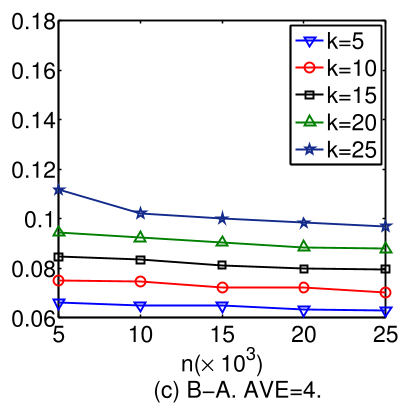 Fig: As the group size increases, the number of modified edges rises, but remains lower than traditional isomorphism-based methods.
Critical Insight & Conclusion
The true value of this work is the shift from deterministic privacy (it must look exactly like others) to probabilistic privacy (it probably looks like others, and there's enough noise to mask the truth).
Takeaway: If you are publishing graph data, stop trying to make every neighborhood identical. Use structural signatures and weight ranges. It provides the same protection against real-world attackers while keeping the "social" signal in your social network data alive.
Limitations: The computational cost for massive graphs (millions of edges) remains high, and the current model handles static graphs; dynamic, evolving social networks would require a more temporal-aware approach.