
LP k2-Anonymity: Neutralizing Privacy Leaks from Friendship Label Pairs
Preserving Privacy in Social Networks Against Label Pair Attacks
The paper introduces a novel "Label Pair Attack" model for social networks and proposes the LP k2-anonymity framework to counter it. By combining vertex label generalization (LGA) with edge manipulation (LGAN), the method ensures that any re-identification attempt based on a pair of friends' labels has a success probability of no more than 1/k.
TL;DR
Researchers have identified a new vulnerability called the Label Pair Attack, where an attacker identifies you and your friends by matching your public profiles (labels) with your known relationships. To combat this, this paper introduces LP k2-anonymity, a framework that generalizes user labels and adjusts network edges so that every "friendship signature" is shared by at least users, effectively hiding individuals in a crowd of peers.
Problem & Motivation: The Danger of "Knowing Your Friends"
While social networks often strip away names (de-identification), they frequently leave behind labels (e.g., Job: Doctor, City: London). Previous research focused on "Neighborhood Attacks" (knowing who your neighbors are) or "Structural Attacks" (knowing the shape of your local graph).
However, the authors point out a more subtle threat: the Label Pair Attack. If an adversary knows that "Alice (Doctor) is friends with Bob (Teacher)," they can search the anonymized graph for an edge connecting a "Doctor" label to a "Teacher" label. If that pair is unique, Alice and Bob are exposed. Existing -anonymity methods that only look at degrees or single labels cannot stop this specific correlation.
Methodology: Protecting Relationships via LGA and LGAN
The authors propose a two-step pipeline to transform a vulnerable graph into an anonymous one.
1. Label Generalization Anonymization (LGA)
Instead of deleting info, the system "clouds" it. Using a Generalization Tree (GTree), specific labels (e.g., "Physician") are moved to more general categories (e.g., "Doctor").
- The Goal: Group at least vertices together and give them the same generalized label.
- Optimization: It minimizes GenCost, ensuring the generalized label is as close to the original as possible to keep the data useful for researchers.
2. Label Group Anonymization (LGAN)
Once labels are generalized, the graph structure must be adjusted.
- Edge Adjustment: If a certain label pair (e.g., General Practitioner — High School Teacher) appears fewer than times, the LGAN algorithm either adds missing edges or deletes existing ones.
- Structural Integrity: Unlike previous methods, it does not add fake nodes. It modifies edges based on a cost-benefit analysis between adding vs. deleting, ensuring the "shortest path" between nodes is minimally disturbed.
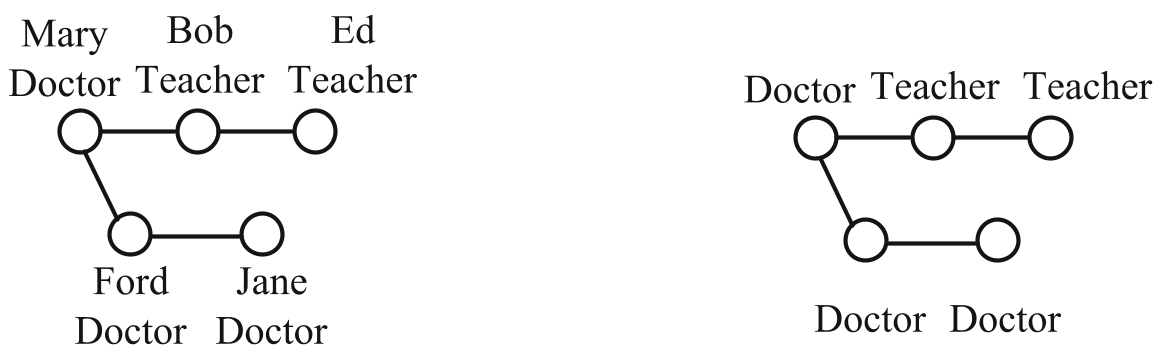 Figure 1: Illustration of how label pairs (Doctor-Teacher) can lead to re-identification in a simple graph.
Experiments & Results
The authors tested their approach on two major real-world datasets: a Co-authorship network and the Arxiv HEP-TH citation graph.
- Utility Preservation: The Degree Distribution of the anonymized graph almost perfectly overlaps with the original, meaning the "social hierarchy" of the network is preserved.
- Clustering & Path Length: Key metrics like the Clustering Coefficient (CC) and Average Path Length (APL) showed only minor fluctuations as increased, proving that the "small-world" nature of the social network remains intact for secondary research.
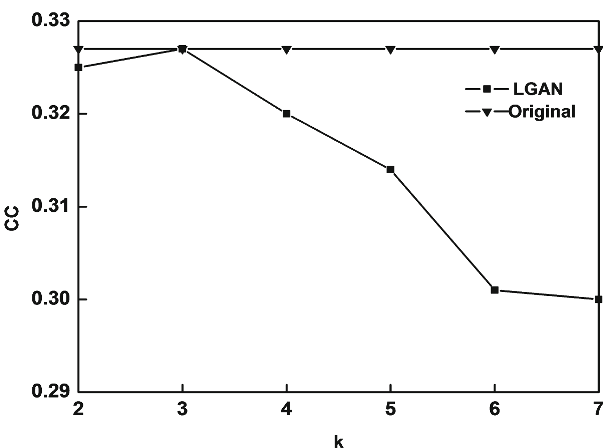 Figure 2: Degree distribution comparison showing high similarity between original and anonymized data.
Critical Analysis & Conclusion
Takeaway
The shift from anonymizing nodes to anonymizing edges (pairs) is a vital evolution in privacy research. LP k2-anonymity successfully prevents identity disclosure without the "scorched earth" approach of removing vertices or adding massive amounts of noise nodes.
Limitations
- Dynamic Graphs: The current model is designed for static snapshots of data. In real-world social networks that evolve daily, maintaining LP k2-anonymity over time without significant re-computation remains a challenge.
- High-Attribute Density: If users have dozens of labels (hobbies, age, location), the generalization process might have to become so broad (e.g., "Human") that the data loses its research value.
Future Outlook
As mobile social networks grow, the fusion of Location-Based Services (LBS) with social graphs will make label pair attacks even more potent. This research provides a foundational framework for future "Personalized Privacy" where users might specify different levels for different types of relationships.