
Preserving Privacy in Social Networks: Why Structure-Awareness is the Key to Utility
Preserving Privacy in Social Networks: A Structure-Aware Approach
The paper introduces a "Structure-Aware" graph anonymization approach for social networks that achieves kd-Anonymity. By partitioning the network into local substructural units and ensuring isomorphism among groups of these units, the method protects against re-identification attacks while preserving critical graph properties like degree distribution and clustering coefficients.
TL;DR
Releasing social network data for research is a double-edged sword: it empowers sociology and data science but risks exposing private relationships. Traditional anonymization often "breaks" the graph's utility. This paper proposes a Structure-Aware kd-Anonymity model that treats community clusters as single units for anonymization, ensuring that for any individual's local network, at least identical structures exist elsewhere, all while keeping edge perturbations below 10%.
The "Isomorphism" Nightmare in Graph Privacy
When we anonymize relational data, we hide attributes. In graphs, the structure is the attribute. If an adversary knows who your friends are, they can find your unique "fingerprint" in a supposedly anonymous graph.
Previous attempts at solving this suffered from two extremes:
- Neighborhood Overlap: Methods like 1-step neighborhood isomorphism often lead to a "domino effect" where changing one node requires changing all neighbors, eventually turning the graph into a dense, useless mass.
- Structural Blindness: Methods that only match node degrees (k-degree anonymity) ignore the rich local subgraphs, making them vulnerable to adversaries who know even a tiny bit more than just a person's friend count.
The Core Insight: Local Structures as Units
The authors observe that social networks aren't random; they have non-trivial community structures. Instead of fighting these patterns, the paper uses them. By defining a Local Structure (LS) as a naturally cohesive subgroup, they can anonymize the "cluster" rather than the "node."
The Methodology Pipeline
The technical approach follows a sophisticated three-stage heuristic to bypass the NP-hard nature of graph transformation:
- Graph Partitioning: Using a multilevel k-way partition, the graph is split into units of size . This minimizes "inter-edges," which are the most expensive to reconstruct during the final phase.
- LS Grouping via Frequent Subgraph Mining (FSM): To minimize the number of edges added or deleted, the system looks for a "Common Subgraph" among the partitions. It uses a Multiplication Factor (MF) to pick the best candidates for grouping.
- Isomorphic Transformation: Within each group of structures, the algorithm matches nodes based on degree and adjusts edges. Unlike previous work, it uses Edge Adding/Deleting—a greedy choice that picks the path of least resistance to achieve isomorphism.
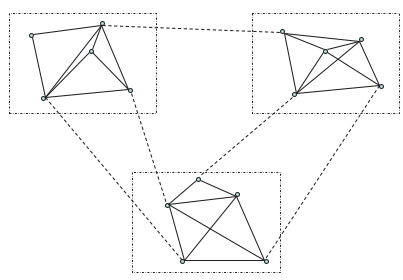 Figure 1: Visualizing how local structures act as naturally inherent units within the social fabric.
Experimental Validation: Efficiency vs. Privacy
The authors tested their approach on the CompGeo (collaboration network) and GBA (Barabási-Albert model) datasets. The results demonstrate a significant win for the structural approach:
- Low Perturbation: Even at a high privacy level (), the percentage of modified edges remained remarkably low.
- Property Preservation: Key metrics like the Clustering Coefficient (CC) and Average Path Length (APL) remained stable. Surprisingly, the combined "Add/Delete" strategy performed better than "Add only" because it prevented the graph from becoming unnaturally dense.
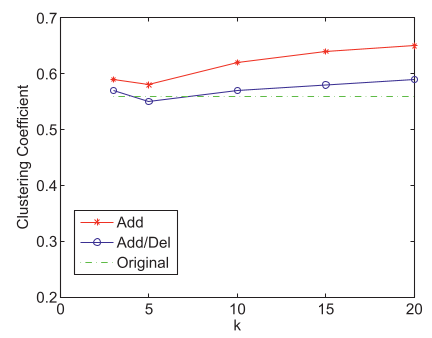 Figure 2: Analysis of Edge Change and Clustering Coefficient across different k-values.
Critical Perspective
While this "Structure-Aware" approach is a massive leap over degree-based anonymity, it does come with trade-offs. The partition size is a sensitive parameter; if is too small, the local structure is too simple and easy to attack; if is too large, the computational cost of finding isomorphisms spikes.
Conclusion: This research proves that privacy doesn't have to mean the destruction of data utility. By respecting the "natural" divisions in social networks, we can create datasets that are both safe for the individual and valuable for the scientist. Future work likely lies in handling dynamic graphs where the structure changes over time, requiring continuous re-anonymization.