
RPPCS: Shielding Social Relationships via the Lens of Compressive Sensing
Preserving the Relationship Privacy of the published social-network data based on Compressive Sensing
The paper introduces Relationship Privacy Preservation based on Compressive Sensing (RPPCS), a novel method for social network anonymization. By treating the sparse relationship matrix as a signal and utilizing Compressive Sensing (CS) random measurements, the authors achieve link randomization that preserves structural properties while outperforming traditional K-anonymity and Neighborhood Randomization (NR) methods.
TL;DR
As social networks like LinkedIn and Facebook grow, "Link Disclosure"—where an attacker infers private relationships despite anonymized identities—has become a major threat. RPPCS (Relationship Privacy Preservation based on Compressive Sensing) offers a breakthrough by using random linear measurements to "blur" network links. Unlike traditional methods, it maintains nearly perfect data utility (graph statistics) while effectively resisting background knowledge attacks.
The Core Conflict: Privacy vs. Utility
The fundamental challenge in social network publishing is the balance between Data Utility (how useful the graph is for researchers) and Privacy Protection.
- K-Anonymity often destroys the graph's "soul" (its unique topological features) because it forces nodes to look identical.
- Edge Randomization often introduces too much noise or requires converting undirected graphs into directed ones, leading to structural distortion.
The authors observed that social relationship matrices are inherently sparse. In the world of signal processing, sparse signals are the "bread and butter" of Compressive Sensing (CS). Why not use the random measurement matrices of CS to perform privacy-preserving link perturbation?
Methodology: How RPPCS Works
RPPCS treats each column of a social relationship matrix as a sparse signal. The process follows five key steps:
- Pre-Processing: Mapping the graph to an Adjacency Matrix .
- Sparse Matrix Generation: Creating a random measurement matrix that doesn't necessarily need to meet the strict RIP condition for perfect recovery, but rather for effective anonymization.
- Linear Measurement: Computing , where is a column of the original matrix.
- Anonymization Process: Instead of a "perfect" reconstruction, the system uses a modified pursuit algorithm to generate an anonymized .
System Architecture
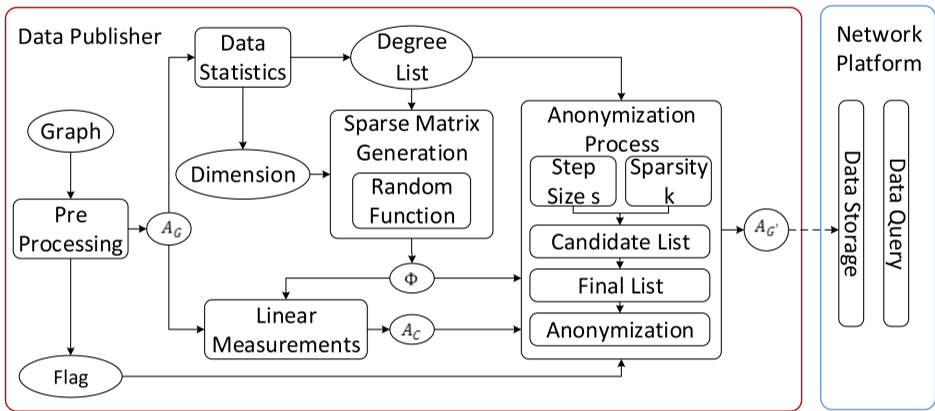 The architecture illustrates the transition from raw network data to the final published anonymized matrix via CS measurements.
The Intuition of the "Step Size" ()
One of the brilliant tweaks in RPPCS is the use of a step size in the recovery algorithm. By selecting multiple columns from the measurement matrix in each iteration, the algorithm reduces computational overhead and naturally introduces the "link blurring" needed for privacy.
Experimental Results: SOTA Comparison
The authors tested RPPCS against the Collaboration Network (undirected) and Gnutella P2P Network (directed).
1. Superior Utility Retention
While K-anonymity caused the Relative Ratio of Average Degree (RRAD) to skyrocket (over 3.0), RPPCS stayed floating around 1.0. This means the macro-scale characteristics of the network—like how many connections a typical user has—remains intact for researchers.
2. Clustering Coefficient (RRCC)
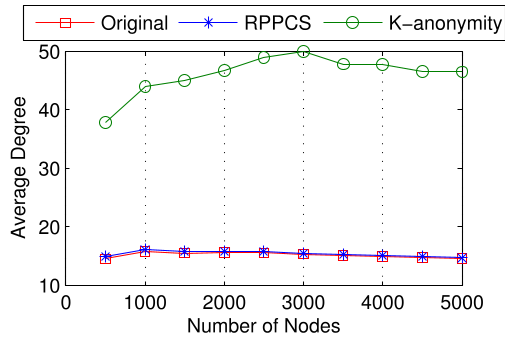 As shown in the charts, the RPPCS curve (dark line) almost perfectly overlaps with the original graph's utility, whereas K-anonymity (lighter line/markers) falls off significantly.
3. Resistance to Background Knowledge
The paper proves that the probability of an attacker correctly guessing the original link structure without knowing the secret measurement matrix is infinitesimally small as the network size increases. Specifically, it guards against:
- Vertex Degree Attacks: Where an attacker knows Alice has exactly 5 friends.
- Link Relationship Attacks: Where an attacker knows the specific connection patterns of a neighborhood.
Critical Insight & Conclusion
The true value of RPPCS lies in its versatility. Most previous research focused on either directed or undirected graphs. By utilizing matrix-based Compressive Sensing, RPPCS provides a unified mathematical framework that doesn't care about edge directionality—it treats everything as sparse data.
Limitations: While the computational overhead is reduced, CS-based recovery still requires matrix multiplications which could be intensive for extremely large-scale graphs (billions of nodes) without further optimization via distributed computing.
Future Outlook: This work opens the door for using other signal-processing techniques (like Wavelet transforms or Graph Neural Networks) in the "measurement" phase of privacy preservation, potentially leading to even more robust "Deep Anonymization" techniques.