
Hide in Plain Sight: Reclaiming SNS Privacy via Steganography
Preserving the User’s Privacy in Social Networking Sites
The paper introduces a privacy-preserving system for Social Networking Sites (SNSs) that employs a combination of AES encryption, Subset Difference (SD) broadcast encryption, and a robust steganographic algorithm. The system enables users to hide sensitive profile data from unauthorized peers and the SNS provider itself, specifically demonstrated and tested on the Facebook platform.
TL;DR
Social Networking Sites (SNSs) like Facebook are "black holes" for personal data—once you post, the platform owns and exploits your information. This paper proposes a clever workaround: Profile Obfuscation. By populating public profiles with fake data and "stashing" the real, encrypted data inside harmless-looking photos via steganography, users can grant access to friends while keeping the SNS provider completely in the dark.
The Core Dilemma: The Provider is the Spy
The fundamental problem with modern social media is that the platform provider is often the primary adversary. Traditional privacy settings only control what other users see, not what the platform analyzes for targeted ads or data harvesting.
Furthermore, early academic attempts to solve this had major flaws:
- Decentralized Networks (e.g., Diaspora): Suffered from the "empty room" problem; they lack the massive user base of Facebook.
- Pure Cryptography: Simply ciphering text (e.g., publishing GPG blocks) often violates SNS Terms of Service, leading to account bans for "suspicious activity."
Methodology: The "Invisible" Profile
The authors suggest a three-layer protection mechanism that operates transparently through a local Proxy and a Data Manager.
1. Data Substitution
Mandatory fields (like gender or birthday) are replaced with plausible fake information. This keeps the SNS "happy" and avoids detection by automated compliance bots.
2. Encryption and Access Control
The real profile data is formatted into an XML file (), encrypted via AES (). To manage who among your friends can see it, the system uses Subset Difference (SD) Broadcast Encryption. This allows the owner to revoke access to specific friends without needing to be online when the friend views the profile.
3. Robust Steganography
This is the technical heart of the paper. Standard steganography (like LSB or F5) fails on Facebook because the platform aggressively compresses images and strips metadata. The authors developed a robust algorithm that:
- Divides images into 8x8 cells.
- Identifies homogeneous cells.
- Uses fixed patterns and Reed-Solomon error-correcting codes to ensure the hidden bits survive the platform's re-encoding.
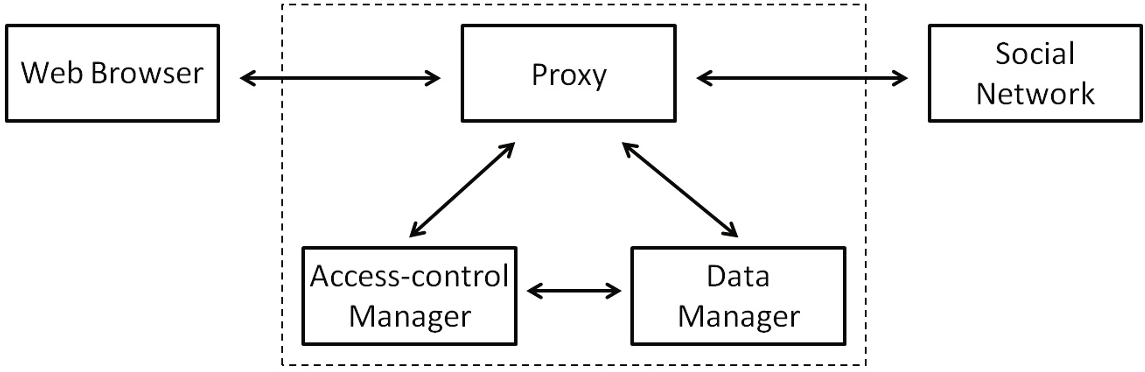 Figure 1: The system architecture showing the Proxy capturing traffic and the Data Manager handling the stego-objects.
Experiments: Performance vs. Privacy
The researchers tested the system on a real Facebook environment. The primary metric was Runtime Latency. If the system takes too long to decrypt and swap profiles, users will abandon it.
| Test Case | Runtime (Seconds) | Description |
|---|---|---|
| Baseline | 4.886s | Standard Facebook profile load |
| Protected Load | 6.903s | Authorized user retrieving hidden data |
| Overhead | ~2.017s | The cost of privacy |
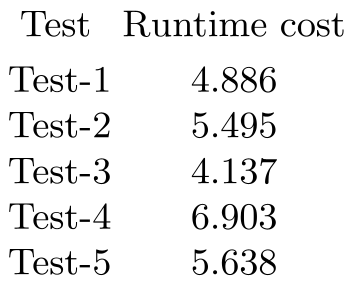 Table 1: Comparison of runtime costs across different scenarios.
The ~2-second delay is a significant "tax" on user experience, but the authors argue it is a reasonable trade-off for users who prioritize data sovereignty.
Critical Insight: The "Whack-a-Mole" Problem
While the technical implementation is sound, the authors admit a significant Limitation: Platform Dependence. Because the system relies on intercepting and modifying HTML traffic via a proxy, it is highly fragile. If Facebook updates its UI or modifies its data structure (which it does frequently), the tool breaks.
Sustainable deployment would require a dedicated open-source community to constantly update the "scrapers" and "injectors"—much like the ongoing battle between ad-blockers and websites.
Conclusion
This paper serves as a proof-of-concept that steganography is not just for spies; it is a legitimate tool for consumer privacy. By treating the SNS as a mere "untrusted host" for encrypted blobs hidden in images, we can maintain the social benefits of centralized platforms while denying them our personal data.