
RPVS: Reimagining Social Network Privacy via Vector Similarity and Edge Space Theory
Preserving weighted social networks privacy using vectors similarity
This paper proposes RPVS (Random Perturbation based on Vectors Similarity), a novel framework for privacy preservation in weighted social networks. By transforming graph structures into vector set models and applying weighted Euclidean distance-based perturbation, the method effectively anonymizes both network topology and edge weights.
TL;DR
Protecting weighted social networks requires more than just hiding names; it requires obscuring the unique "fingerprints" left by connection patterns and interaction strengths. This paper introduces RPVS, a method that converts social sub-graphs into high-dimensional vectors. By perturbing these vectors based on weighted Euclidean distance and edge betweenness, it creates an anonymized network that baffles attackers while remaining highly useful for researchers.
The Motivation: Why Simple Anonymization Fails
In the era of big data, simply removing "Person A" from a graph is insufficient. Attackers with background knowledge—such as knowing how many friends you have or the specific intensity of your interactions—can perform structural re-identification.
Existing techniques often fall into two traps:
- Generalization: Groups nodes into "super-nodes," losing critical structural detail.
- Simple Perturbation: Adds or deletes edges randomly, which often destroys the fundamental properties of the network (like "six degrees of separation").
The author identifies a gap: most prior work treats weights and topology separately. RPVS seeks to protect both simultaneously by treating the graph as a mathematical Edge Space.
Methodology: From Graphs to Vectors
The RPVS workflow is a sophisticated four-stage pipeline:
1. Vector Set Modeling
The network is first partitioned into sub-graphs using node clustering based on common neighbors. These sub-graphs are then mapped to a vector space. If a sub-graph has nodes, it is compared against a complete graph . Each possible edge corresponds to a dimension in the vector; the value in that dimension is the edge's weight (or 0 if the edge doesn't exist).
2. Weighted Euclidean Distance
Not all edges are created equal. The author uses Edge Betweenness (the frequency with which an edge lies on the shortest path between nodes) to assign importance to vector dimensions. The similarity between an original sub-graph and a potential "replacement" is calculated as:
3. Candidate Set Generation & Perturbation
A "Candidate Set" is formed by finding vectors that are "close enough" (within a threshold ) to the original. A replacement is randomly selected from this set. This forces an attacker to guess among many equally probable candidates, significantly increasing the uncertainty of recognition.
 Figure 1: The similarity metric used for node clustering before segmentation.
Experiments: Privacy vs. Utility
The authors tested RPVS against four major baselines (KM, KH, KA, KN) using real-world datasets like PowerGrid and Karate.
Resilience to Attacks
RPVS was subjected to:
- Sub-graph Recognition Attacks (SRA): Adversaries knowing local patterns.
- Weight Recognition Attacks (WRA): Adversaries knowing interaction strengths.
The results showed that RPVS consistently maintained a larger "matching set," meaning the attacker’s probability of success remained lower than the 1/K threshold typically seen in K-anonymity models.
Preserving Network "Spirit"
Crucially, the experiment measured Average Shortest Path Length (ASPL) and Clustering Coefficient (CC). If these change too much, the data becomes useless for social science. As shown in the results, RPVS tracks the original network characteristics much more closely than K-automorphism (KM) as the privacy parameter increases.
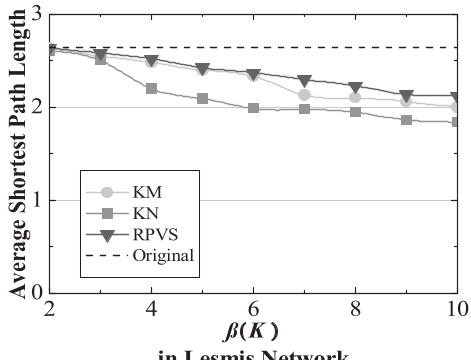 Figure 2: Average Shortest Path Length comparison showing RPVS stability.
Critical Insights & Conclusion
The brilliance of RPVS lies in its linear transformation of a topological problem. By treating a graph as a vector, we can borrow well-understood tools from multi-dimensional data analysis to solve complex privacy issues.
Takeaway for Researchers: The use of edge betweenness as a weight in the similarity metric is a vital "inductive bias." It ensures that the most "structurally important" edges are modified with the most care, which is why the global properties (like ASPL) remain stable even as local privacy is enhanced.
Future Outlook: While robust, the current segmentation is static. Future iterations could benefit from dynamic segmentation or integrating State Space Models (SSMs) to handle time-evolving social networks where connection weights change over time.
Author's Note: This paper demonstrates that privacy doesn't have to mean the destruction of data utility—provided you use the right mathematical lens.