
WPLC: Balancing the Wisdom of the Crowd with the Privacy of the Individual
Preserving worker privacy in crowdsourcing
This paper introduces the Worker-Private Latent Class (WPLC) protocol, a novel quality control method for crowdsourcing that preserves worker privacy. By integrating a (J+1, θ)-threshold additive homomorphic cryptosystem with a decentralized Expectation-Maximization (EM) algorithm, WPLC achieves state-of-the-art accuracy in ground-truth estimation without requiring workers to reveal their raw labels or personal ability parameters to the requester.
TL;DR
Crowdsourcing is a powerful tool for large-scale data labeling, but it currently forces workers to trade their privacy for participation. The Worker-Private Latent Class (WPLC) protocol changes this dynamic. By combining decentralized computation with homomorphic encryption, it allows a requester to estimate ground truth and worker reliability while keeping raw labels and worker "ability" scores completely hidden. It achieves the same accuracy as traditional methods with less than a second of cryptographic overhead.
Background: The Privacy Paradox in Crowdsourcing
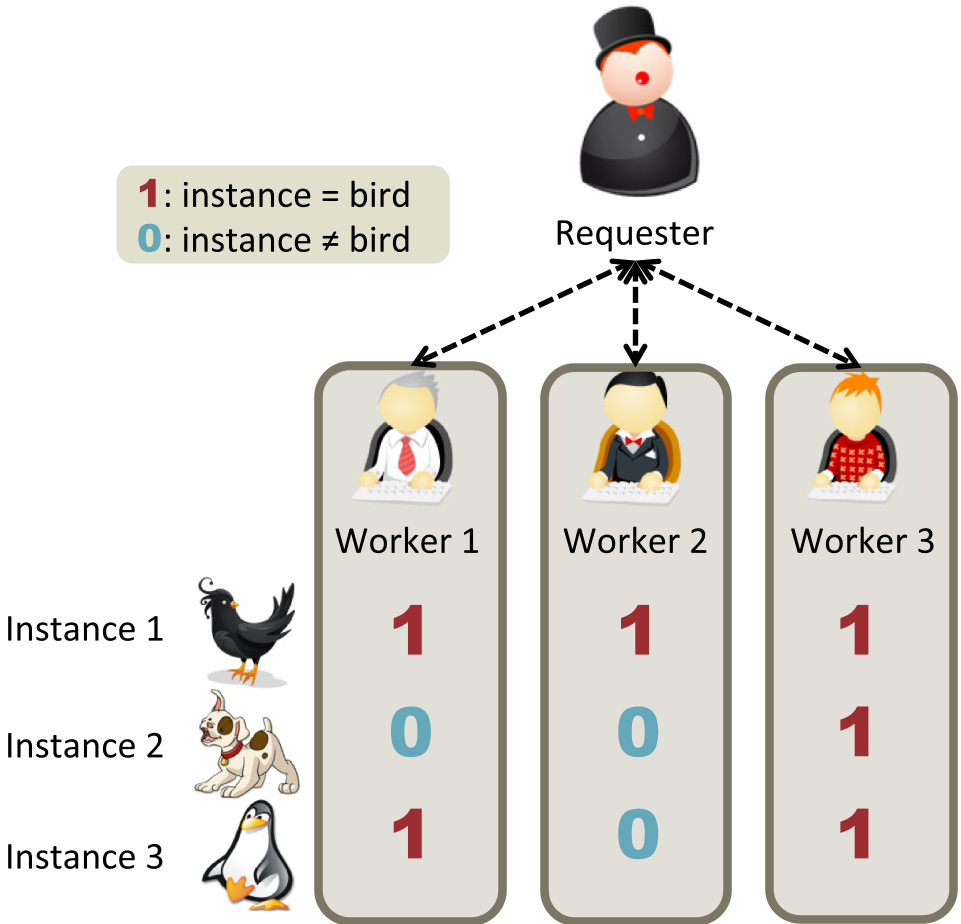
Modern crowdsourcing platforms like Amazon Mechanical Turk rely on redundancy—multiple workers label the same item to overcome individual errors. Sophisticated "Quality Control" methods, like the Latent Class (LC) method, use the EM algorithm to figure out who the "experts" are and weight their votes accordingly.
However, there is a hidden cost: Privacy.
- Location Privacy: Submitting object locations can reveal a worker's trajectory.
- Opinion Privacy: Aggregating survey responses can uniquely identify individuals through high-dimensional data profiles.
- Emotional Safety: Volunteers in unpaid tasks (like Galaxy Zoo) may feel uncomfortable being "evaluated" or "scored" by an algorithm.
The Problem: The Necessity of Raw Labels
Why is this hard? In the standard EM algorithm, the requester must see every label from every worker to update the model parameters. To solve this, the authors asked: Can we compute the global posterior without ever seeing the individual inputs?
Methodology: Decentralization + Secure Sum
The WPLC protocol re-imagines the EM algorithm as a collaborative dance between the requester and the workers.
1. Decentralizing the EM Algorithm
Instead of the requester doing all the heavy lifting:
- The M-Step (Maximization): Shifted to the Worker. Each worker calculates their own "ability" parameters () locally based on the global estimates shared by the requester.
- The E-Step (Expectation): Completed via Secure Sum. The requester needs the sum of specific values from workers to calculate notice expectations, but they do not need the individual components.
2. The Secure Sum Protocol
The core engine is a (J+1, θ)-threshold additive homomorphic cryptosystem.
- Additive Homomorphic: Multiplying two ciphertexts in the encrypted domain equals the encryption of the sum of the plaintexts.
- Threshold Decryption: No single person (not even the requester) can decrypt the data alone. It requires a subset of workers to contribute "decryption shares."
Experiments: Is Privacy "Expensive"?
The authors tested WPLC against the standard LC method and simple Majority Voting (MV).
Accuracy
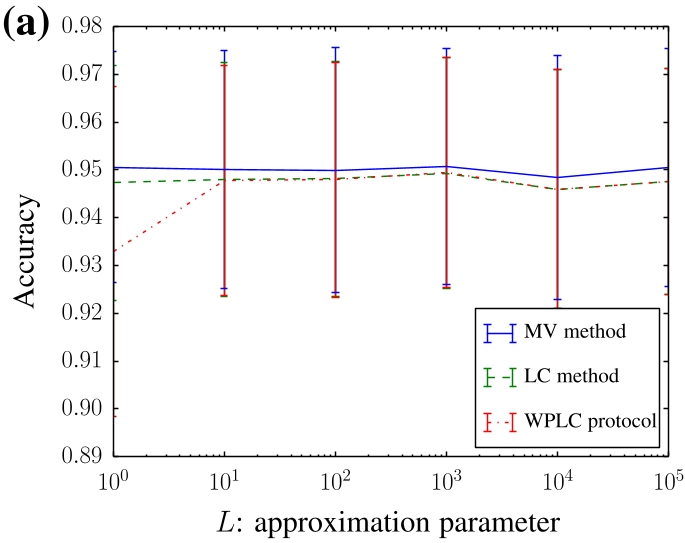
On the "Duchenne Smiles" dataset, WPLC achieved the exact same accuracy (0.761) as the standard LC method, significantly outperforming simple Majority Voting (0.752). The key factor is the approximation parameter —as long as is large enough to minimize rounding errors, the privacy-preserving version is mathematically equivalent to the original.
Efficiency
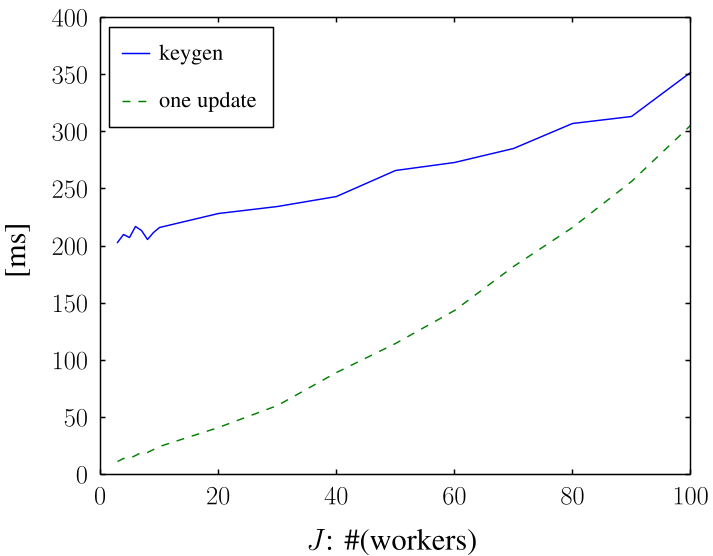
Encryption is often perceived as slow. However, the WPLC protocol scales linearly with the number of workers.
- Key Generation: ~150ms for 20 workers.
- Single iteration: ~40ms for 20 workers. In total, the overhead is less than 0.8 seconds for a typical run.
Critical Insight: The "Honest-but-Curious" Shield
The WPLC protocol is designed for the Semi-Honest Model. It assumes that while a requester might "peek" at the data, they will follow the protocol. The authors prove that even if a requester tries to reverse-engineer the results, there is no "privacy invading function" that can uniquely map the aggregated public outputs back to a specific worker's binary label.
Conclusion & Future Outlook
The WPLC protocol is a landmark in crowdsourcing research because it proves that individual privacy does not have to be sacrificed for collective intelligence.
Limitations: The current model assumes workers do not collude with the requester. In a adversarial scenario where the requester controls multiple "sybil" worker accounts, privacy could be at risk. Future Work: Expanding this to more complex tasks beyond binary/multi-class labels, such as natural language generation or image segmentations, remains an open and exciting challenge.