
The Physics of Status: Why Social Networks Naturally Form Hierarchies
On the prevalence of hierarchies in social networks
The paper introduces two novel deterministic evolutionary models for social networks: the Dominance-Based Evolution Model (DBEM) and the Prestige-Based Evolution Model (PBEM). These models recover the widely observed exponential and power-law node strength distributions as equilibrium states in hierarchical structures.
In the study of complex networks, we often observe patterns like the "Power Law" (where a few individuals have massive influence) but rarely do we understand the mechanical why behind them. This paper, "On the prevalence of hierarchies in social networks," moves beyond simple observation. It treats social evolution as a deterministic dynamical system, proving that our social strategies—whether based on raw dominance or earned prestige—inevitably lead to the mathematical structures we see in society today.
Executive Summary
TL;DR: Researchers have developed two new mathematical models, DBEM (Dominance-Based) and PBEM (Prestige-Based), that derive the "strength" of social ties. They found that simple rules of hierarchy automatically generate the exponential and power-law distributions seen in everything from wolf packs to US airport traffic.
Academic Positioning: This work bridges the gap between biological behavior and network science. It moves away from stochastic "random attachment" models toward deterministic growth models that provide closed-form solutions for network properties like Geodesic distance and Centrality.
Behind the Intuition: Dominance vs. Prestige
The authors argue that social structures aren't just random connections; they are governed by how we perceive those "above" us in a hierarchy:
- Dominance (DBEM): Common in non-human primates. You share resources or attention with those who outrank you simply because they are superior.
- Prestige (PBEM): More common in humans. You grant "status" to leaders because they are already influential or helpful, creating a feedback loop where the rich get richer in terms of social capital.
Methodology: The Core Dynamics
The researchers modeled the change in tie strength () as a function of "strength observation."
1. Dominance-Based Model (DBEM)
In this model, an individual distributes their limited resources equally among all their superiors. If you have 5 bosses, you give each 20% of your effort.

2. Prestige-Based Model (PBEM)
Here, the "attractiveness" of a superior node depends on how much prestige they have already accumulated from others. This creates a reciprocal relationship.
Key Mathematical Insight:
- DBEM results in an Exponential Distribution ().
- PBEM results in a Power-Law Distribution ().
Experiments and Results
The authors didn't just stay in the realm of theory. They tested these models against four distinct real-world datasets:
- Howler Monkey Groups: Found to be primarily Dominance-based.
- Kangaroo Proximity: Prestige-based.
- Wolf Dominance: Ironically, found to follow the Prestige model (reciprocal interactions).
- US Airports: Heavily Prestige-based, where major hubs act as the "leaders."
SOTA Comparison
Unlike the Barabási-Albert model which assumes nodes connect to others based on their degree, these models assume nodes connect based on their position in a hierarchy.
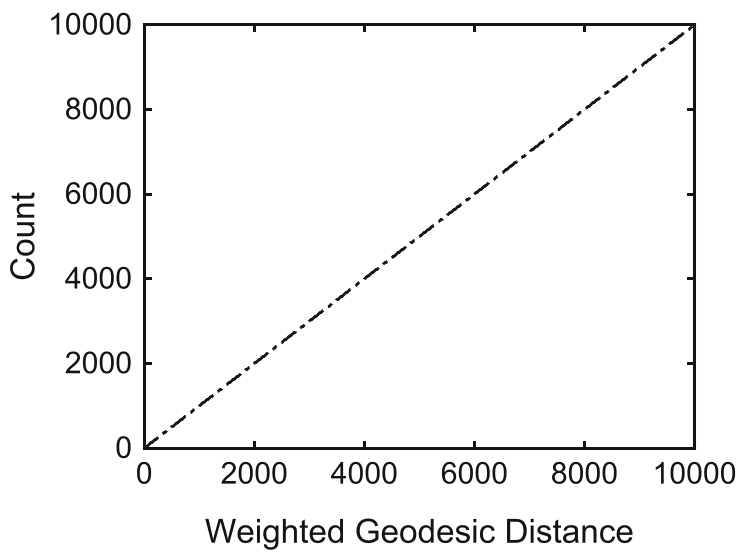 Figure: The DBEM (a) shows a straight line in a semi-log scale, confirming exponential decay, while PBEM (b) shows a straight line in log-log scale, confirming a power-law.
Deep Insights: The Role of Hubs
One of the most profound findings relates to Geodesic Distance (the "shortest path" between individuals):
- In Dominance networks, the shortest path is usually a direct link. There is no centralizing force.
- In Prestige networks, the shortest path always passes through the top leader.
This explains why prestige-based societies are often more efficient at sharing resources but also more dependent on "Super-hubs." It provides a structural reason for the emergence of leadership: hubs reduce the average distance between any two members of the group, making the whole network more robust and communicative.
Conclusion and Limitations
Takeaway: Hierarchies aren't just social constructs; they are mathematically efficient solutions for resource management. The Prestige model, in particular, explains how massive hubs (like O'Hare Airport or a tribal leader) become the "connective tissue" of a system.
Limitations: The current model assumes a fixed hierarchy. In reality, hierarchies are fluid—people rise and fall. Future work could integrate "Rank Dynamics" where the hierarchy itself evolves alongside the tie strengths.