
Co-visiting Patterns: Bridging Human Behavior and Urban Space in LBSNs
Prevalent Co-Visiting Patterns Mining from Location-Based Social Networks
The paper introduces "Co-visiting Patterns," a novel mining task for Location-Based Social Networks (LBSNs) that integrates spatial proximity with social similarity. It proposes the CVMA (Co-visiting Pattern Mining Algorithm) to identify groups of spatial features visited by users with similar behavioral profiles, outperforming traditional distance-only co-location mining.
TL;DR
Geographical proximity is just half the story. This paper introduces Co-visiting Patterns, a framework that mines spatial features by considering both physical distance and the social similarity of their visitors. By leveraging a new behavioral user-similarity metric, the authors provide a way to find urban patterns that are meaningful, interpretable, and socially grounded.
Background & Motivation: Beyond "Close" to "Connected"
Traditional spatial data mining answers the question: What things are usually located near each other? (e.g., cafes are often near bookstores). However, in the era of Location-Based Social Networks (LBSNs) like Yelp or Foursquare, this geographical-only view is insufficient.
The authors argue that two locations are truly "connected" not just because they share a GPS coordinate neighborhood, but because they attract the same kind of people. For instance, two niche galleries might be miles apart but visited by users with identical hobby profiles. Traditional mining fails to capture these "socially proximal" nodes, leading to a sea of redundant results without clear intent.
Methodology: The Fusion of Space and Social Behavior
1. Redefining Similarity: The Social Distance
Unlike prior work that relies on friendship graphs (which are often sparse) or simple user overlaps, this paper proposes a feature-based user similarity. If User A visits many "Gyms" and "Healthy Eateries," and User B does the same, they are considered similar even if they never visit the exact same instance or aren't "friends."
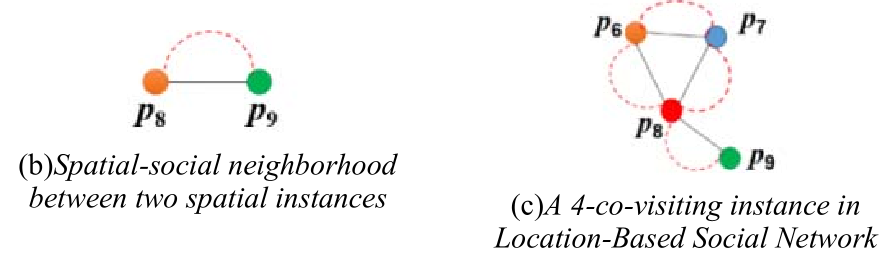
The distance between two spatial instances and is now a multi-modal metric:
- Spatial Distance: Euclidean distance .
- Social Distance: Derived from the similarity of user sets and based on their historical visiting features.
2. The Neighborhood Weight Function
To combine these factors, the paper applies a Gaussian Kernel to both distances and merges them into a Weighted Neighborhood Weight ():
3. The CVMA Algorithm and Pruning
A significant technical hurdle is that the "Prevalent Degree" (measure of frequency) in co-visiting mining does not satisfy the "Downward Closure" property (if a pattern is frequent, all its subsets must be frequent). This makes standard Apriori-like pruning impossible. The authors solve this by introducing Lemma 1: They partition neighborhoods into "Strong" () and "Weak" () sets based on the weight threshold . If a candidate pattern's row instances only consist of weak neighborhoods, it can be pruned immediately, dramatically speeding up the search.
Experimental Validation
Using synthetic data and real-world Yelp data from Washington, the authors demonstrated that their method:
- Reduces Redundancy: The number of co-visiting patterns is notably lower than traditional co-locations because the criteria (spatial + social) are stricter and more focused.
- Scalability: The CVMA algorithm maintains manageable execution times as the visitor count grows, thanks to the weight-based pruning strategy.
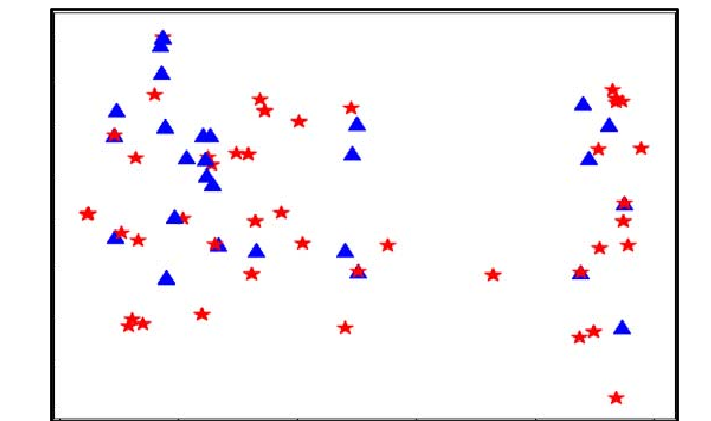 Visualizing the shrinkage of pattern distribution when moving from Co-location (broad) to Co-visiting (targeted).
Critical Insight & Future Outlook
This work represents a shift toward semantic urban computing. By defining "Co-visiting," we can identify functional regions of a city based on how people actually use them rather than how they are drawn on a map.
Limitations: The current model is static. Human behavior is highly temporal (e.g., morning commute patterns vs. weekend leisure). Integrating time-stamps into the "Co-visiting" metric—as the authors suggest for future work—would be the next logical step toward a "Digital Twin" of urban social behavior.
Takeaway for Researchers
If you are working on LBSN data, ignore social features at your peril. Behavior-driven similarity measures provide a much "denser" signal for pattern mining than geographical distances alone.