
Beyond the Mutual Friend Trap: Building Algorithmic Firewalls for Social Organizations
Preventing and Detecting Infiltration on Online Social Networks
The paper introduces a "Safety Community" (SC) model designed to protect organizational members on Online Social Networks (OSNs) from infiltration by Socialbots. By utilizing a novel "relationship-measure" and a greedy optimization algorithm (MSO), the framework effectively filters malicious friend requests and isolates external threats across platforms like Facebook, Slashdot, and Epinions.
TL;DR
Social engineering via "Socialbots" has become a sophisticated threat, boasting up to a 70% success rate by exploiting the trust we place in mutual friends. This paper presents a proactive defense: the Safety Community (SC) model. By calculating a deep "relationship-measure" across multiple hops in a social graph, the authors create an automated perimeter that isolates malicious actors before they can reach high-value organizational targets.
The "Common Friend" Paradox
On platforms like Facebook or LinkedIn, we are conditioned to trust requests that show "10 mutual friends." This vulnerability is the primary vector for organizational infiltration. Attackers target the "weakest link"—employees with the lowest security awareness—and use them as a bridge to reach senior executives.
The core problem is that existing social network security is local. It doesn't look at the structural integrity of the relationship over the entire organizational graph. The authors argue that we need a global measure of familiarity that is difficult for a bot to forge.
Methodology: Quantifying Trust via Intermediate Paths
The secret sauce of this paper is the Relationship-Measure (). Unlike standard metrics that look at direct edges, this measure calculates the probability of connection through intermediate users.
1. The Relationship Formula
The authors define trust as a normalized sum of interactive weights across all possible paths of length .

By setting , the system forces the bot to satisfy a much higher threshold of global connectivity, making simple "mutual friend" spoofing nearly impossible.
2. The SC Model and MSO Problem
The Safety Community is an incrementally built subgraph starting from the organization's core members (). To optimize this, the authors solve the MSO (Maximizing Safety for Organization) problem:

This ensures that every new user added to the protected community has the maximum cumulative trust from the entire organization, not just a single individual.
Experimental Proof: Isolation is Possible
The authors tested the model against simulated Socialbot attacks on three massive datasets: Facebook, Slashdot, and Epinions.
Efficiency and Scale
The proposed Greedy Algorithm allows for rapid construction of the Safety Community. Even with an organization size of 500 and a network of 60,000+ nodes, the algorithm efficiently identifies the safest candidate members.
Performance Results
The comparison between standard attack success and SC-protected organizations is stark. While bots successfully infiltrated unprotected users with high probability (as seen in the "mutual friend" success curves), they failed consistently against the SC model.
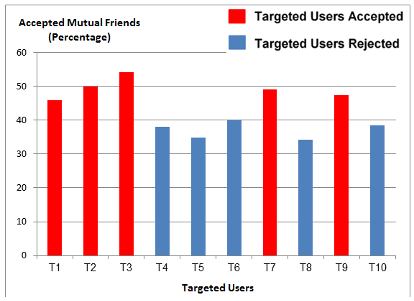 In the figure above, the success rates of infiltration are visualized against various organization sizes and network types.
| Size of Org | Dataset | Safety Threshold | Size of GSC | Infiltration Success? |
|---|---|---|---|---|
| k=100 | 2.98 | 1,000 | No | |
| k=500 | Slashdot | 1.92 | 2,508 | No |
Critical Insight & Conclusion
The takeaway is clear: human intuition is no longer a sufficient defense against social infiltration. The SC model transforms security from a private user decision into an organizational policy powered by graph theory.
Limitations: The model assumes that interaction weights (w) are accurately captures, which may be difficult in privacy-restricted environments. Future work should explore how to apply these safety communities in end-to-end encrypted environments where "interaction frequency" is harder to measure.
By shifting the goal from "detecting bots" to "verifying deep community ties," this approach provides a robust framework for safeguarding sensitive information in the age of social engineering.