
PriRadar: Breakthrough in Privacy-Preserving Spatial Crowdsourcing without Online TTPs
PriRadar: A Privacy-Preserving Framework for Spatial Crowdsourcing
PriRadar is a privacy-preserving framework for spatial crowdsourcing that enables efficient task assignment without relying on an online Trusted Third Party (TTP). It utilizes a grid-based location protection method and a hybrid encryption scheme (CP-ABE and SKE) to secure worker/task locations and task content, achieving state-of-the-art performance in both Server Assignment and Worker Request models.
TL;DR
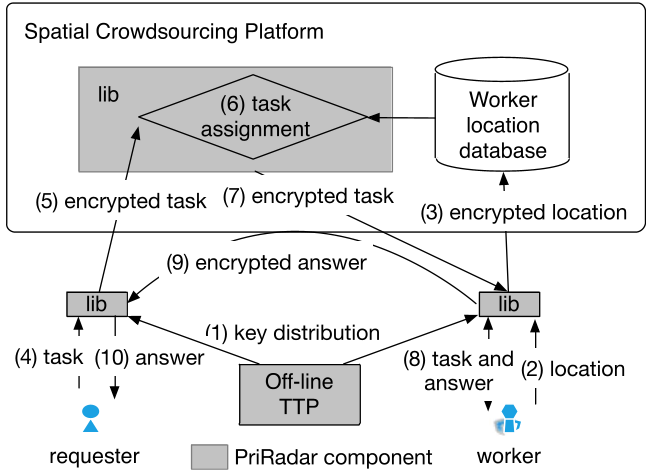
Spatial crowdsourcing (SC) platforms like Uber or TaskRabbit traditionally require users to trade privacy for utility. PriRadar changes this paradigm by introducing a framework that matches workers to tasks on encrypted data. By discretizing the globe into grids and employing a hybrid of Attribute-Based Encryption (ABE) and HMAC-based location codes, it achieves near-optimal task assignment efficiency and accuracy without needing a "middleman" Trusted Third Party (TTP) to be online during the matching process.
Background: The Privacy-Utility Tradeoff
In spatial crowdsourcing, a server needs to know where the worker is and where the task is to ensure the Euclidean distance . Current solutions face a "trilemma":
- Privacy Exposure: Servers know exact coordinates.
- Latencies: Differential privacy methods often require an online TTP, adding round-trip delays.
- Computational Cost: Fully Homomorphic Encryption (FHE) is too slow for real-time matching.
PriRadar breaks this by using Grid-based Location Protection that keeps distance information "just specific enough" for matching but "blind enough" to protect the user.
Methodology: The Core Mechanism
1. Grid-based Location Encoding
Instead of raw coordinates, PriRadar splits the geo-space into an grid of width .
- Workers: Upload a single encrypted code representing their current grid cell.
- Requesters: Upload a "Valid Neighbor" set , which contains the codes of all grid cells within distance of the task.
- Matching: The server simply checks if . This is an lookup operation using hash tables.
2. Secure Data Delivery with CP-ABE
How do you send a sensitive task (e.g., "Take a photo of this medical clinic") only to workers in a specific area without the server seeing the task? PriRadar uses Ciphertext-Policy Attribute-Based Encryption (CP-ABE). The "attributes" here are the longitude and latitude digits. Only a worker possessing the "location keys" for the correct coordinates can decrypt the symmetric session key () used to unlock the task content.
Experimental Performance
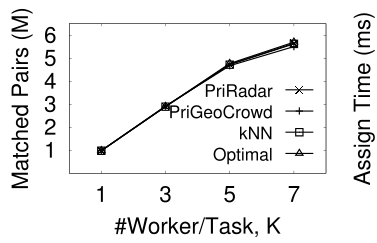
The researchers tested PriRadar against PriGeoCrowd (Differential Privacy baseline) and Optimal Assignment (Max-Flow algorithm).
Efficiency & Quality
PriRadar achieved a massive performance leap. In the Worker Request Model (WRM), it was 132 times faster than the optimal flow-based assignment.
Key Findings:
- High Quality: The number of matched task-worker pairs was nearly identical to the Optimal (non-private) solution.
- Low Error: The assignment error rate remained below 1% in most scenarios, significantly better than the noise-heavy PriGeoCrowd.
- Robustness: The use of Chameleon Hashes (CHash) allowed users to inject "noise" into their location codes, successfully flattening the frequency distribution and thwarting frequency-based inference attacks.
Critical Insights: Why It Works
The brilliance of PriRadar lies in its Inductive Bias toward spatial locality. By moving the complexity of distance calculation to the Requester's side (who generates the neighbor grid set), the Server's role is reduced to a simple set-membership check. This decentralization of computation is what removes the bottleneck of an online TTP.
Limitations
While PriRadar hides exact coordinates, it still leaks "grid-level" location. While this is sufficient for many applications, users in high-density areas might still be vulnerable to pattern-matching attacks if they remain in the same grid for extended periods. The authors suggest periodic key refreshment to mitigate this.
Conclusion
PriRadar represents a significant step forward for the "Privacy by Design" movement in LBS (Location-Based Services). It proves that we can have high-efficiency, high-accuracy task assignment in crowdsourcing without sacrificing the fundamental right to location privacy.