
PriMa: Bridging the Gap Between User Privacy Intent and Social Network Reality
PriMa: a comprehensive approach to privacy protection in social network sites
PriMa (Privacy Manager) is an adaptive privacy protection framework for Social Network Sites (SNS) that automates the generation of access control rules. It utilizes a multicriteria algorithm to balance user preferences with objective risk metrics, achieving fine-grained protection across diverse platforms like Drupal and Facebook.
TL;DR
Social Network Sites (SNS) have become a paradox: they encourage maximum disclosure while providing cumbersome privacy tools that users struggle to manage. PriMa (Privacy Manager) is a comprehensive framework that automates the creation of access rules. By calculating a unique User Access Score—which factors in relationship strength and the objective risk of data leakage—PriMa generates fine-grained policies that adapt as your social circle grows.
Context: This work positions itself as a "Privacy-Enhancing Technology" (PET), moving past the manual "friend list" management of legacy platforms like Facebook toward a semi-automated, mathematically grounded approach.
The Problem: The "Cognitive Burden" of Privacy
The average Facebook user has over 130 friends, but privacy preferences are not binary. You might share your "Home Address" with family, but only "Current City" with colleagues. Manually setting these rules for hundreds of traits (posts, attributes, comments) is a Herculean task.
Current systems suffer from:
- Inference Error: If you trust Bob, a system might suggest you trust Mary (Bob's friend), ignoring that Mary might have a much "leakier" profile than Bob.
- Static Policies: A rule set in 2022 might be dangerously outdated in 2024 as the network graph changes.
Methodology: The Multicriteria Pivot
PriMa’s core innovation is the User Access Score, which moves away from pure trust to a balance of trust and visibility.
1. Semantic Trait Propagation
Instead of asking users to label every post, PriMa uses OWL ontologies and WordNet. If a user marks "Home Address" as sensitive, the system automatically propagates that sensitivity to any traits semantically linked to "Location" (e.g., city, check-ins, or even comments mentioning "my house").
2. The User Access Score Formula
The system calculates the adequacy of a user to see a trait of user using:
- Relationship Score (): Combines the relationship type (Family > Colleague) and a reputation value.
- Risk Score (): This is the "secret sauce." It considers Degree Centrality (how well-connected the users are) and Visibility (how many people can already see the data).
 Above: The Architecture of LightPriMa, showing the pipeline from the Social Graph to the Access Rules Enforcer.
Experiments and Performance
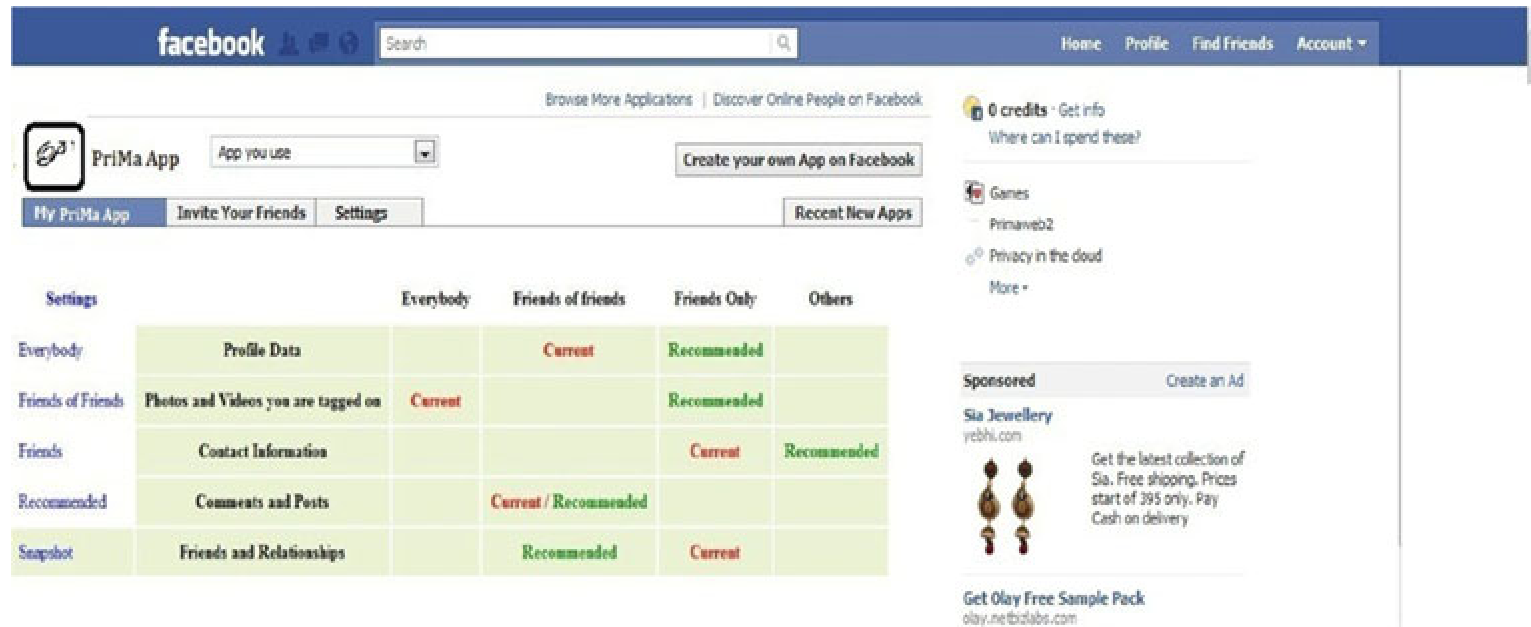
The authors tested PriMa as a Drupal add-on and a Facebook app. The primary concern with automated privacy is latency. If the system takes seconds to calculate a rule every time you post, it’s unusable.
Key Findings:
- Scalability: Rule generation remains under 0.7 ms even with 260 friends.
- Rule Compression: The system is smart enough to group similar users, reducing 70 complex trait partitions into roughly 10 manageable access rules.
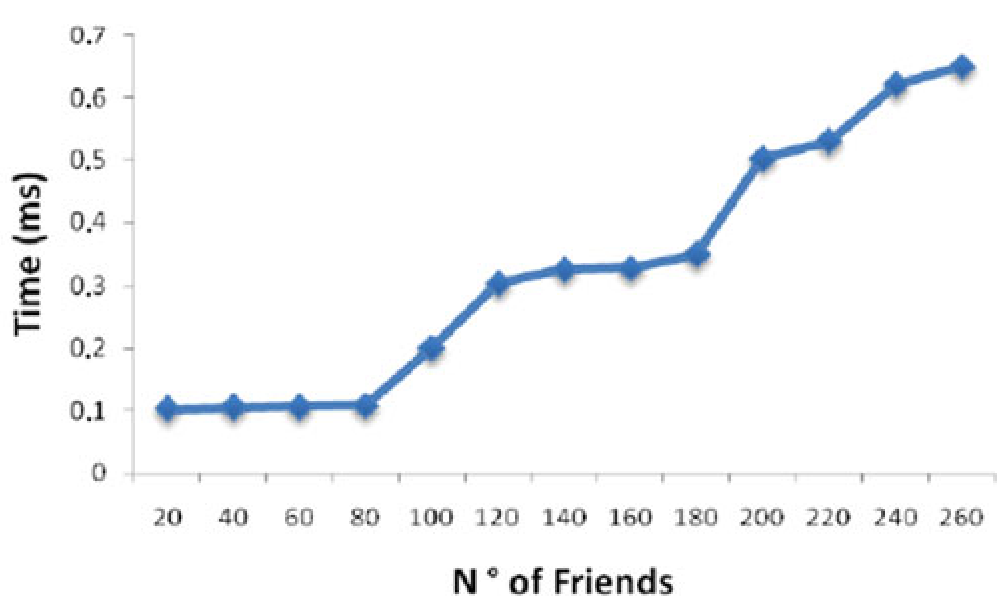 Above: Graphs showing that execution time increases linearly with the number of friends but stays well within acceptable limits for real-time applications.
Critical Insight & Analysis
PriMa's real value lies in the Risk Metric. Most privacy research assumes the "receiver" is the only threat. PriMa recognizes that the structural position of the receiver in the social graph determines the true risk. If you share a secret with a "Super-node" (someone with 5,000 friends), the structural risk of that secret leaking is exponentially higher than sharing it with a "Hidden-node."
Limitations
- Sarcasm & Context: While WordNet helps with semantics, it fails at sarcasm. A sarcastic post about a "great boss" might be exposed to colleagues mistakenly.
- Platform Restrictions: On platforms like Facebook, PriMa cannot "see" the privacy settings of your friends directly due to API limits, requiring "approximation" (informed guessing) based on general user trends.
Conclusion
PriMa represents a shift from Discretionary Access Control (where the user does everything) to Adaptive Access Control. By grounding privacy in social graph metrics rather than just user intuition, it provides a safety net against the "accidental disclosure" that plagues modern social media.
Takeaway for Researchers: The future of privacy isn't more checkboxes; it's smarter algorithms that understand the topology of our digital lives.