
Walmart's PRS: Scaling Every Day Low Price (EDLP) with Bayesian Optimization
15807_Price Investment using Prescriptive Analytics and Optimization in Retail.
The paper introduces the Price Recommendation System (PRS), a large-scale prescriptive analytics framework used by Walmart to automate price investments. It combines Bayesian Structural Time Series (BSTS) for demand forecasting with a two-phase optimization approach (budget allocation and item-level pricing) to maximize demand volume while maintaining revenue targets.
TL;DR
Walmart researchers have developed the Price Recommendation System (PRS), a sophisticated pipeline that moves beyond manual rule-based pricing. By leveraging Bayesian Structural Time Series (BSTS) for demand forecasting and a two-stage optimization for budget/pricing, they achieved a nearly 20% lift in demand volume in live store experiments.
Context: The Investment Logic of Pricing
In the world of retail, lowering a price isn't just a "sale"—it's a price investment. According to Walmart's Every Day Low Price (EDLP) strategy, reducing margins is a deliberate move to drive store traffic and long-term customer loyalty. The challenge lies in "investing" the finite pricing budget into the right products to maximize "lift" (demand volume) without jeopardizing revenue stability.
The Core Challenge: Scalability and Uncertainty
Traditional pricing systems at this scale face three "walls":
- Complexity: Managing millions of UPCs across diverse geographic markets.
- Uncertainty: Knowing not just what the demand will be, but the variance of that demand.
- Physical Constraints: Unlike e-commerce, brick-and-mortar stores cannot change prices hourly due to labor and operational overhead.
Methodology: A Two-Phase Prescriptive Engine
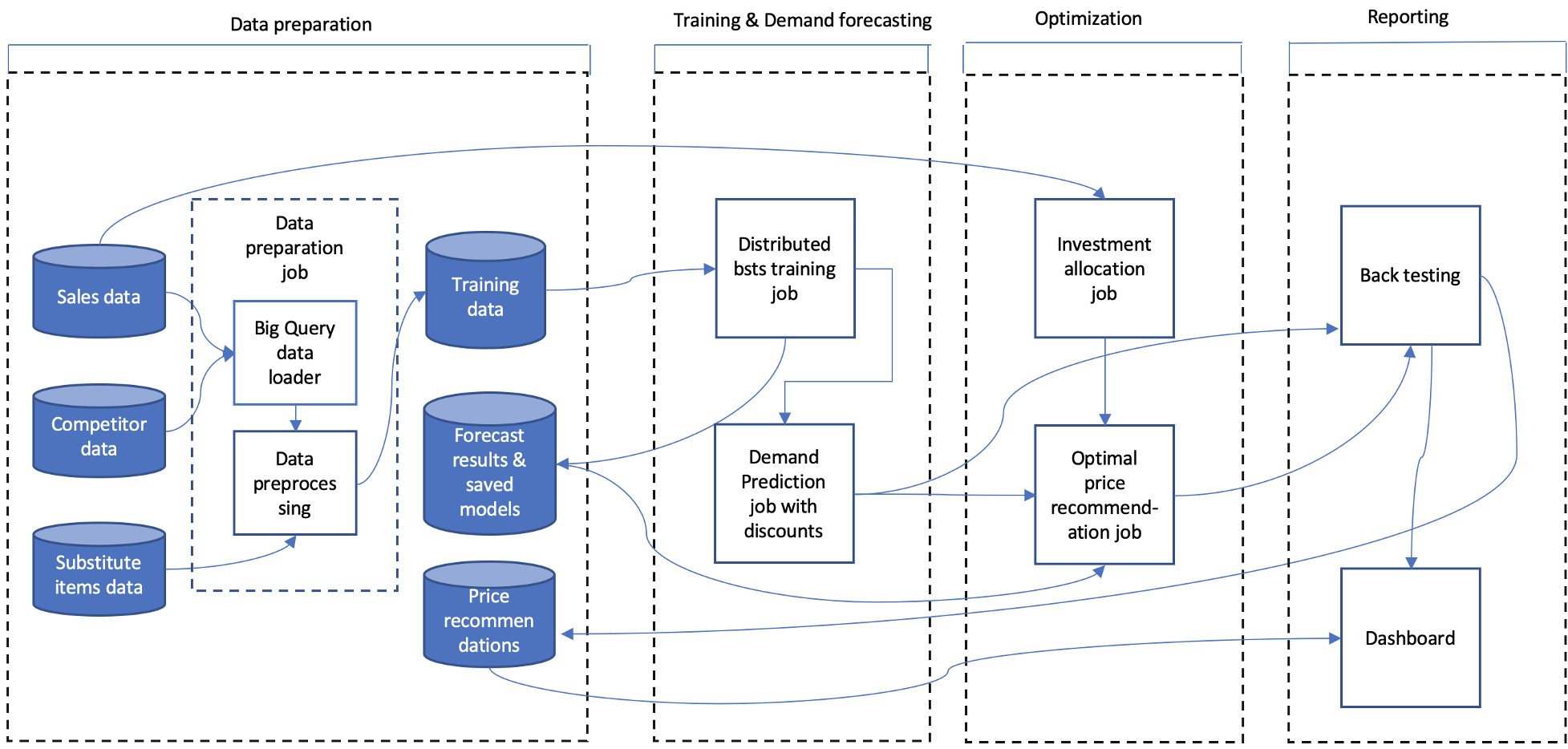
The PRS architecture separates the massive problem into two manageable chunks:
1. Bayesian Demand Forecasting (The Engine)
Instead of a simple linear regression, the authors use Bayesian Structural Time Series (BSTS).
- Why BSTS? It decomposes the signal into local trends, seasonality (weekly, quarterly), and external regressors (competitor prices, holidays).
- Uncertainty Quantification: It outputs a posterior distribution. This allows the optimizer to account for risk—if a price point has high demand uncertainty, the system can choose a "safer" investment.
2. Hierarchical Optimization
- Phase 1 (Budget Allocation): Determines how much of the total "investment budget" should go to "Grocery" vs. "Dairy," etc. It treats product categories like a financial portfolio, minimizing revenue volatility (Risk).
- Phase 2 (Price Point Selection): Within each category, the system picks the exact price for each item to maximize revenue while staying within the allocated budget from Phase 1.
Insights into Price Elasticity
The paper highlights a crucial business reality: Product Substitution. Lowering the price of "Brand A" Mac & Cheese might just steal sales from "Brand B." While many academic papers seek to model this via complex cross-elasticity matrices, Walmart uses structural business rules (e.g., ensuring "Line Pricing" for similar items) as constraints in the optimization to prevent cannibalization naturally.
Experimental Results: Live from the Store
The system was tested in a 500-store "Investment Wave." The results were evaluated using Causal Inference Analysis (comparing treated markets to synthetic controls).
| Metric | Price Market 1 | Price Market 2 |
|---|---|---|
| Actual Unit YoY Lift | +13.09% | +21.82% |
| Lift over Control | +4.15% | +19.25% |
The forecasting accuracy was notably high, with a 3% MAPE in stable periods. Below is a visualization of the causal impact on demand following a price intervention for Mac & Cheese and Condiments.
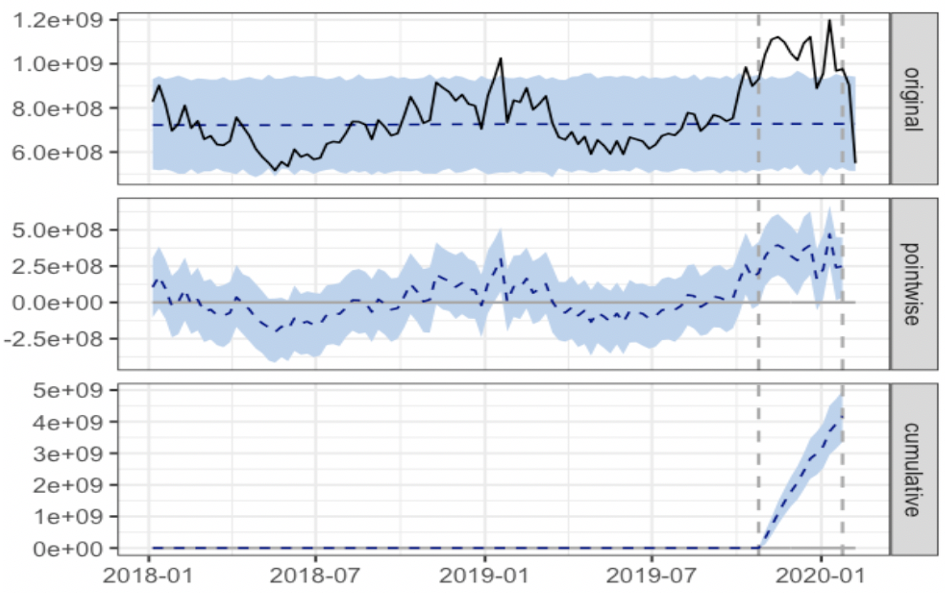 Figure: The blue dashed line represents the counterfactual (what would have happened without the price change).
Critical Analysis & Scaling
A standout feature of this research is the Engineering Scalability. Running MCMC (Markov Chain Monte Carlo) for millions of items is traditionally slow. Walmart solved this by:
- Parallelism: Running category-level models on independent 32-vCPU Virtual Machines on GCP.
- Efficiency: Delivering 57 category recommendations in <1 hour for only $68.
Limitations: The current system relies on business rules to handle substitution. A future iteration could potentially learn these relationships directly from consumer basket data to optimize even more aggressively.
Conclusion
Walmart's PRS demonstrates that Bayesian methods aren't just for academic toy problems; they are robust enough to manage the pricing of the world's largest retailer. By treating price as an "investment," and managing it like a "portfolio," retail is finally bridging the gap between historical intuition and prescriptive AI.