
Deciphering the Price of Code: A Data-Driven Approach to Crowdsourced Software Development
Pricing crowdsourcing-based software development tasks
This paper introduces a predictive pricing framework for crowdsourcing-based software development, specifically targeting complex tasks on the TopCoder platform. It proposes 16 specialized cost drivers and evaluates 12 predictive models (including Machine Learning, Neural Networks, and Regression), demonstrating that the C4.5 algorithm achieves a high prediction quality with Pred(30) > 0.8.
TL;DR
Crowdsourcing software development is no longer just for microtasks like image labeling; platforms like TopCoder handle high-stakes, complex engineering. This paper provides the first systematic pricing framework for such tasks, identifying 16 key cost drivers and proving that machine learning models (specifically C4.5) can predict the "right" prize with over 80% accuracy.
Background: Beyond the Mechanical Turk
While microtask crowdsourcing is well-studied, "macro" crowdsourcing—where developers build entire software components—presents a high-risk financial decision. If a project manager sets the prize too low, no one submits (task starvation); too high, and they waste the budget. Traditional models like COCOMO '81 fail here because the relationship between code size and effort is fundamentally altered by the competitive "winner-takes-all" nature of platforms like TopCoder.
The Core Challenge: Why is Pricing Hard?
The difficulty stems from the Inductive Bias of traditional estimation. In a standard corporate setting, effort equals cost. In crowdsourcing, the prize is a signal to attract the crowd. The authors argue that existing models are obsolete for this paradigm because:
- Size-to-effort decoupling: There is no obvious association between KSLOC and developer effort in the crowdsourced world.
- Multidimensional Drivers: Pricing isn't just about complexity; it's about the quality of the design phase that preceded it.
Methodology: The 16 Price Drivers
The researchers analyzed 5,910 tasks to extract 16 drivers across four dimensions:
- Development Type (DEV): e.g., Java vs. C#, New vs. Update.
- Quality of Input (QLY): How good was the design phase score?
- Input Complexity (CPX): Number of UML sequence diagrams, component dependencies, and requirements pages.
- Previous Decision (PRE): The award granted in the preceding design phase.
Model Architecture and Performance
The authors compared 12 models, ranging from simple Linear Regression (LReg) to Neural Networks (NNet) and Decision Trees (C4.5).
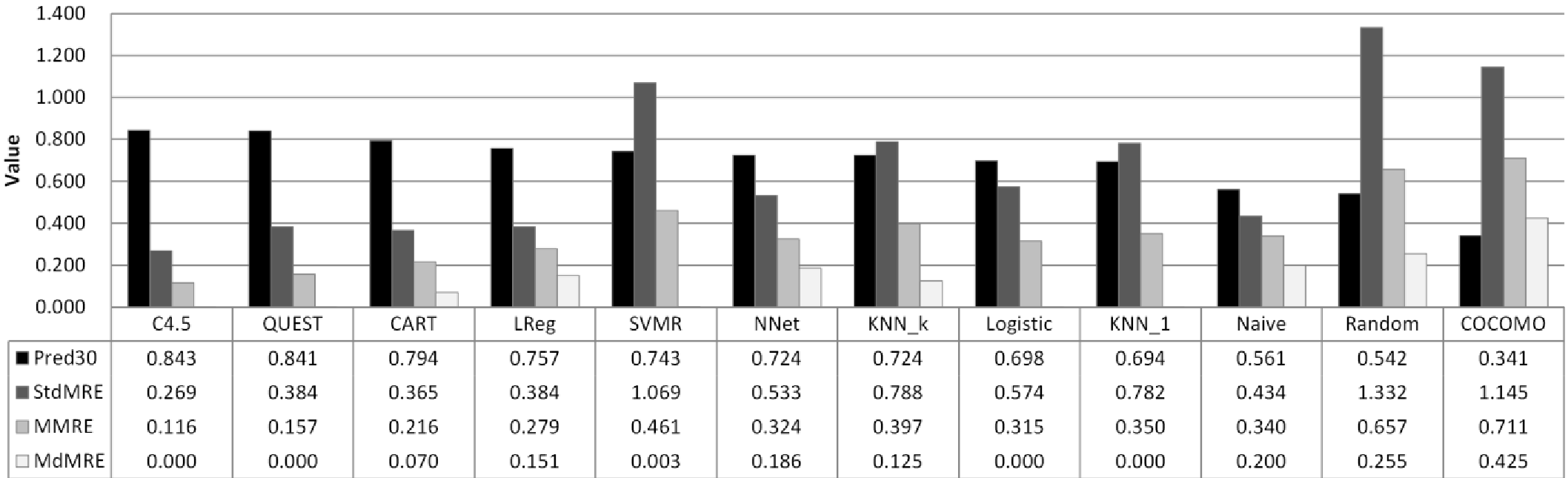 Fig 2: Performance ranking of various models. C4.5 unequivocally leads the pack in Pred(30) accuracy.
Key Insights: What Actually Drives the Price?
Through their regression analysis, the authors uncovered several "rules of thumb" that are highly actionable for project managers:
- The "Legacy" Discount: Updates to existing components are generally $70 cheaper than new developments.
- The Volume Penalty: Every extra 1,000 lines of code (KSLOC) or 4 pages of documentation correlates to a $30 increase in the required prize.
- The Design Anchor: The prize of the design phase (AWRD) is the strongest predictor of the subsequent development phase prize.
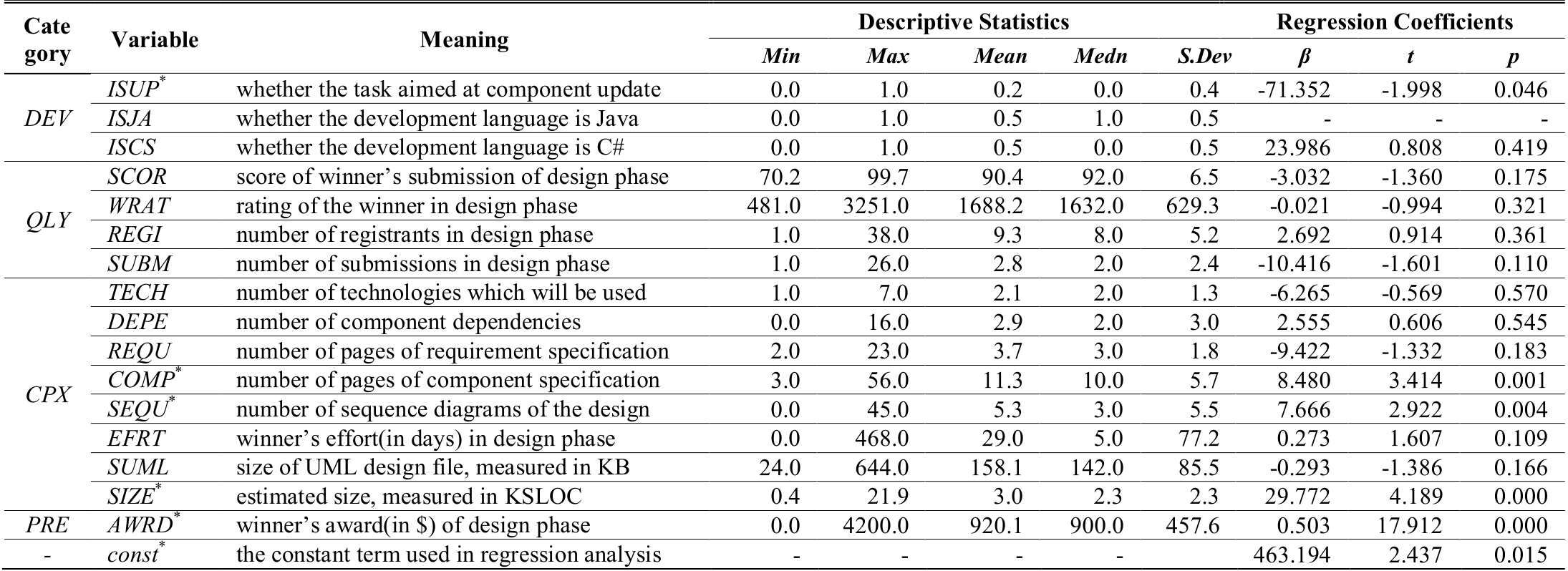 Table 1: 16 price drivers with their statistical significance. Factors marked with () are the true movers of price.*
Critical Analysis & Conclusion
This work represents a vital shift from "gut feeling" pricing to an algorithmic "sanity check." The achievement of Pred(30) > 0.8 means that in 80% of cases, the model's estimate was within 30% of the actual successful prize.
Limitations: The study is heavily focused on TopCoder. Strategic pricing (e.g., intentionally overpaying for an urgent "fire-drill" project) is not yet captured by these structural models.
The Takeaway: For the 430,000+ developers on these platforms, this research provides the transparency needed to evaluate if a task is "fairly priced." For organizations, it offers a roadmap to maximize their ROI in the global developer market.