
Strategizing the Stream: How Online TV Platforms Balance Pricing and Infrastructure Investment
8567_Pricing and Investment for Online TV Content Platforms.
This paper proposes a sequential decision-making framework for profit maximization in online TV content platforms, integrating optimal pricing policies and infrastructure investment levels. By modeling the ecosystem as a two-sided market involving self-interested content producers and audiences, the authors derive a unique equilibrium for content production and a closed-form optimal pricing strategy.
TL;DR
Building a successful online TV platform (like Amazon Instant Video) requires more than just high-speed servers. This paper presents a rigorous mathematical framework showing that a platform's profit is maximized only when its infrastructure investment (the "how much") is perfectly synced with its "pay-per-view" commission fees (the "how to charge"). By anticipating the strategic responses of both viewers and studios, platforms can reach a unique economic equilibrium that guarantees stability and profit.
Background: The Two-Sided Market Challenge
The shift from traditional broadcasting to web-based TV has created a complex "two-sided market." On one side, you have small-to-medium studios seeking a cost-effective distribution channel; on the other, audiences demand variety and high resolution. The platform owner sits in the middle, facing a classic chicken-and-egg problem:
- Investment Risk: Should you buy more servers and bandwidth to improve quality if you don't know how much content will be produced?
- Pricing Friction: If you charge producers too much, they won't join. If you charge too little, you can't cover your massive bandwidth bills.
The "Chain of Influence" Methodology
The authors break down the decision-making process into a sequential flow, recognizing that each player's move affects the next.
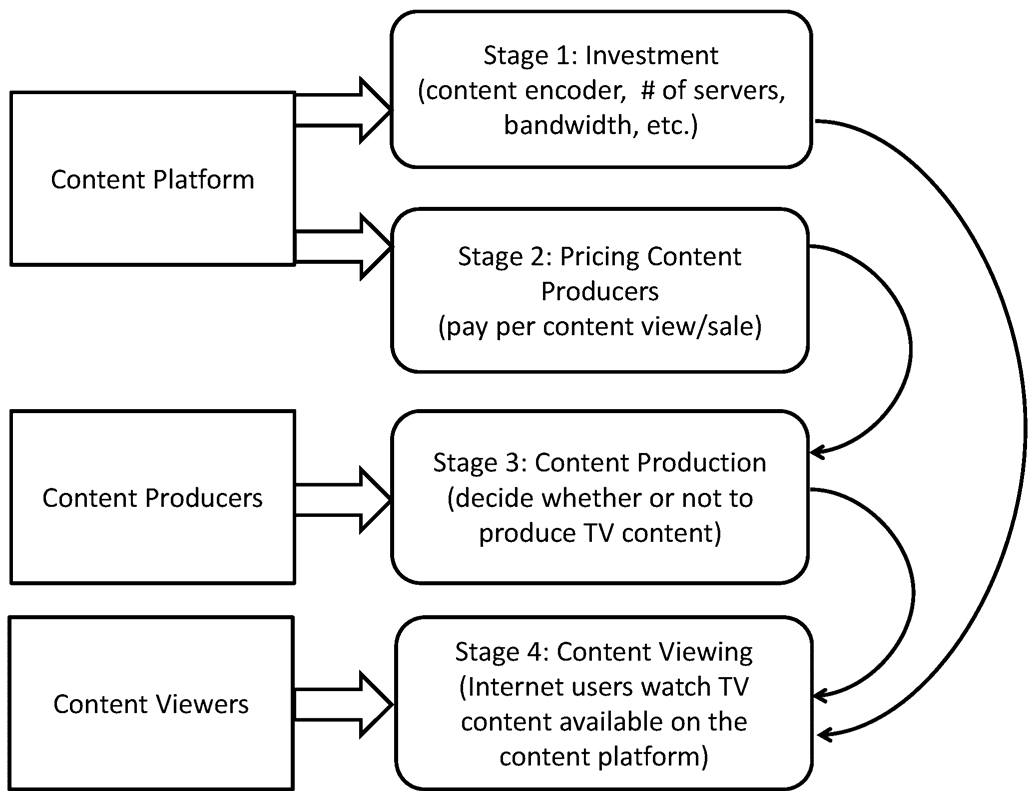
Using Backward Induction, the analysis begins with the viewer and works up to the platform owner:
- Step 1 (The Viewer): Using a quality-adjusted Dixit-Stiglitz utility function, the model determines how a "representative viewer" distributes their limited budget between platform content and "outside" content (traditional TV).
- Step 2 (The Producer): Content producers are modeled as self-interested agents. The paper proves that for any given price set by the platform, there exists a unique Nash Equilibrium. This is a major insight—it means the platform can predict exactly how much content will be made.
- Step 3 & 4 (The Platform): The platform sets its "pay-per-usage" fee and long-term investment level to maximize .
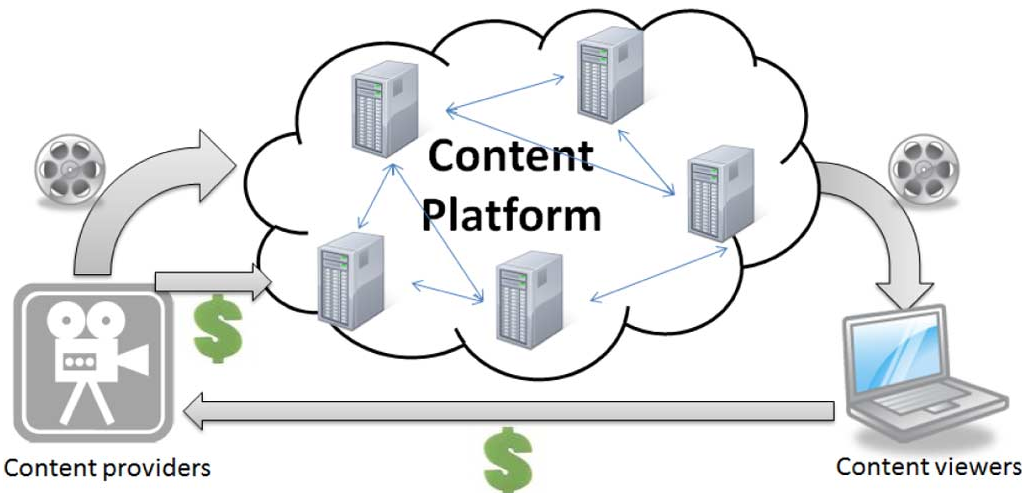
Core Insight: Investment as a Multiplier
The methodology treats investment () as a scaling factor for "Quality of Experience." A content piece has an inherent desirability (), but its actual value to the viewer is .
- High Investment Better Video Codecs/Less Lag Higher Perceived .
- This creates an incentive for producers to join, even if commission fees are high, because the platform’s "selling power" (visibility and quality) ensures more views.
Experimental Findings & SOTA Comparison
The numerical results highlight a fascinating "diminishing return" on infrastructure investment.
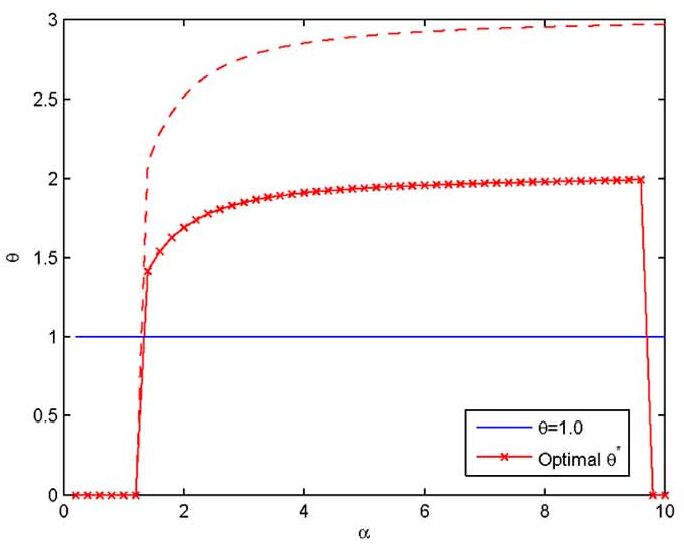
Beyond a certain investment level (around in their simulation), most viewers are already captured. Further spending on servers increases costs without attracting significant new eyes. However, the study shows that when a platform adopts Optimal Pricing (red vs. blue lines above), it can sustain much higher investment levels, providing a superior service that edges out "outside" competitors.
Critical Analysis & Future Outlook
While the paper assumes a uniform price for all content (e.g., the standard $1.99 per episode), it provides a robust foundation for more complex models.
- Limitation: The model assumes "loyal" producers who don't multi-home (post to multiple platforms). In the modern era of exclusive vs. non-exclusive rights, this competition is even more fierce.
- Takeaway: Success in the streaming wars isn't just about buying content; it’s about building a price-investment engine that makes the platform's infrastructure an irresistible force for content creators.
Conclusion
By mathematically linking bandwidth costs to producer incentives, Ren and van der Schaar have provided a blueprint for how platforms like Netflix or Amazon can navigate the volatile economics of digital entertainment.