
Maximizing Viral Impact: The Power of Concave Pricing in Social Networks
Pricing Strategies for Maximizing Viral Advertising in Social Networks
This paper introduces a novel pricing framework for Influence Maximization (IM) in viral advertising, replacing the traditional "fixed-cost" assumption with concave probability functions to model user incentives. The authors propose a Discrete Greedy strategy that achieves a approximation ratio for maximizing information cascades under various diffusion models.
TL;DR
Most viral marketing models assume influencers have a "fixed price tag." This paper shatters that oversimplification by introducing a probabilistic pricing model based on concave valuation functions. By treating the budget as a divisible resource and applying a Discrete Greedy Strategy, the authors provide a mathematically Rigorous and practically superior way to trigger massive "word-of-mouth" cascades.
The Problem: The "Fixed Cost" Fallacy
In the classic Influence Maximization (IM) problem, we try to pick the "best" nodes to start a fire. Most researchers assume if you pay Node A their cost , they will share your content with 100% certainty.
In reality, human behavior is messy. A small voucher might give a 20% chance of sharing, while a large discount might push it to 80%. Specifically, the marginal utility of money decreases—doubling the incentive doesn't double the probability of participation. This "diminishing return" is what the authors address using Concave Probability Functions.
Methodology: From Continuous Budgets to Discrete Wins
The team at Nanjing University formulated the objective as an optimization problem where the goal is to maximize the expected number of active users .
1. The Physics of the Formula
The probability of a user becoming active depends on two factors:
- Direct Incentive: The probability that they accept the price you offered.
- Social Contagion: The probability that they are reached by the cascade started by others.
2. The Algorithmic Insight
The paper proves that finding the absolute optimal pricing is NP-hard by reducing it to a quadratic programming problem. However, the objective function is monotone and submodular.
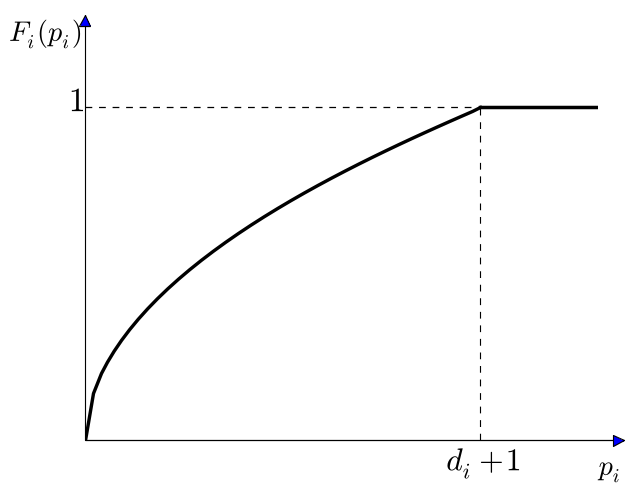 Fig 1: Examples of user valuation functions—from uniform distributions to square-root growth.
To solve this, the authors proposed the DiscreteGreedy algorithm:
- Divide the budget into small pieces.
- In each step, give the next piece of budget to the user who provides the maximal marginal gain in total expected influence.
- The Result: A guaranteed approximation of the optimal discrete solution.
Experimental Battleground
The authors tested their strategy against several baselines across massive datasets, including YouTube (560k nodes) and Weibo (877k nodes).
Key Findings:
- Discriminative Pricing is King: The "Uniform" strategy (paying everyone the same) performed poorly, proving that you must favor influential nodes.
- Concentration vs. Proportionality: Interestingly, "Proportional" pricing (paying based on degree) was often worse than DiscreteGreedy, which suggests that sometimes you should concentrate budget on high-impact "clusters" rather than spreading it thin.
- Convergence: The algorithm stabilizes when the number of budget pieces reaches the number of nodes .
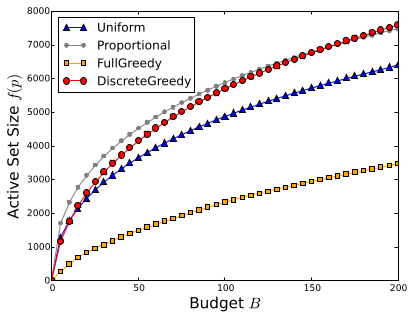 Fig 2: Performance comparison on the CondMat and Youtube datasets showing DiscreteGreedy (black line) consistently dominating.
Critical Analysis & Conclusion
This work moves Influence Maximization from a theoretical abstraction toward a real-world marketing tool. By recognizing that incentives are a spectrum, it allows platforms like Amazon or JD.com to optimize how they distribute vouchers or discounts.
Limitations: The paper assumes that we know the probability distributions for each user beforehand. In practice, estimating these curves (User Profiling) is a massive challenge in itself.
Takeaway: Future viral advertising systems should focus on dynamic granularity—finding the sweet spot where the next dollar spent on an influencer generates the highest marginal "ripple effect" across the social graph.