
Strategic Social Pricing: Maximizing Revenue Under the Clock
Pricing Strategies with Promotion Time Limitation in Online Social Networks
This paper proposes a comprehensive framework for revenue maximization in Online Social Networks (OSNs) that integrates marketing strategies with sequential pricing under limited promotion time. It introduces a Revised Multi-State Diffusion Model (revised-MSDM) to better characterize purchasing behavior and achieves optimized revenue compared to traditional fixed-price or random-pricing methods.
TL;DR
In the world of Online Social Networks (OSNs), selling a product isn't just about who you talk to, but at what price and for how long. This paper introduces a framework that optimizes sequential pricing for products with a "shelf-life" or limited promotion window. By introducing a Revised Multi-State Diffusion Model (revised-MSDM), the authors demonstrate that the timing and order of price changes are just as critical as the network topology itself.
The "Price of Silence" in Traditional Models
Classical viral marketing research typically treats "Influence" as a binary state: you are either infected or you aren't. However, in the real world, a user might be Aware of a product but refuse to Adopt it because the price is too high.
Prior works often ignored this distinction or assumed the seller had the luxury of waiting forever for a diffusion wave to end before changing prices. If you're selling e-tickets for a concert or a seasonal digital item, you don't have that luxury. The core challenge is: Do you set a high price early to grab "big spenders," or a low price to build a massive "influence base"?
Methodology: The Three Pillars of Revenue
The authors split their framework into three distinct components to tackle the complexity of the OSN marketplace.
1. The Revised-MSDM Diffusion Model
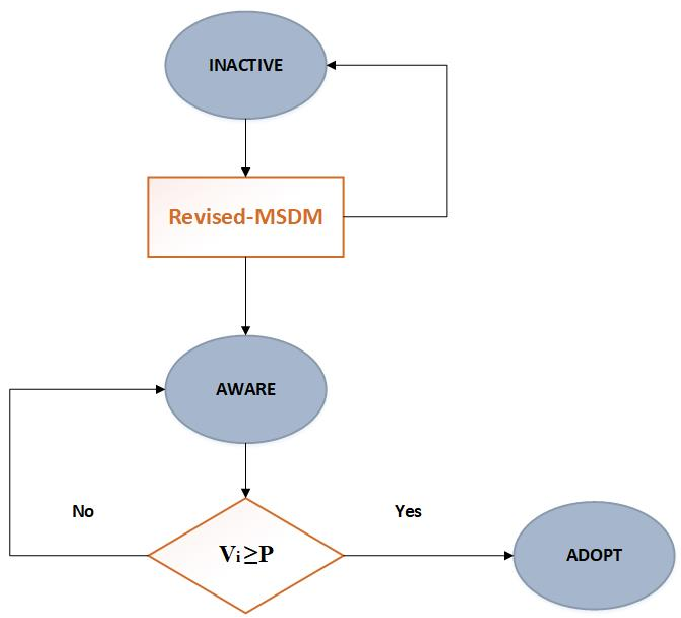
Unlike the standard Independent Cascade (IC) model, the revised-MSDM accounts for three states of existence for a consumer:
- INACTIVE: oblivious to the product.
- AWARE: knows the product exists but is evaluating the price.
- ADOPT: has purchased and is now an active influencer.
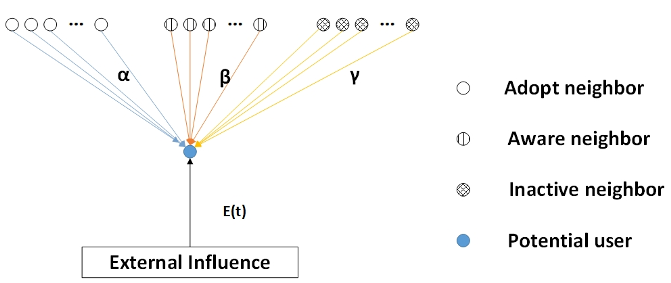
The "Physical Intuition" here is that the influence power follows the hierarchy: (Adopters) (Aware users) (Inactive users).
2. Marketing Strategy (The Seeds)
Using an adapted Degree Discount Algorithm, the seller identifies "seed nodes" to receive free or discounted products. This initiates the cascade by populating the initial "ADOPT" group.
3. Sequential Pricing & Time Allocation
The seller determines a price vector and a time vector . The framework uses Dynamic Programming to solve for the optimal sequence of prices that balances short-term gain with long-term network exposure.
Experimental Insights: Lower is Sometimes Higher
The authors tested their framework using the Facebook dataset, comparing different valuation distributions (Gaussian and Uniform).
Key Findings:
- Price Awareness: Lower prices don't just increase sales; they increase "Awareness," which creates a faster-moving cascade.
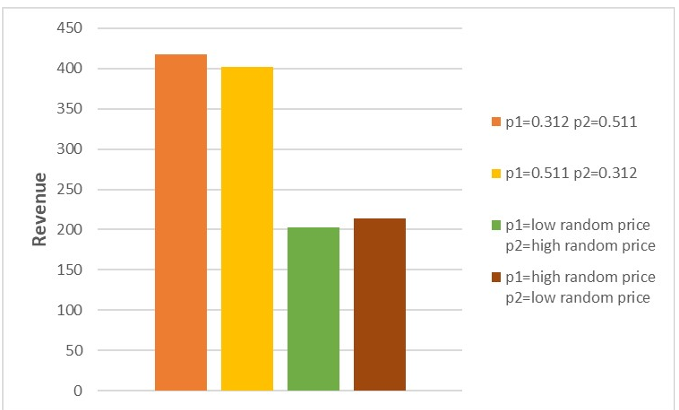
- The Time Factor: Under a total promotion limit (e.g., ), spending more time on the lower price stage (even if it's the first stage) leads to a higher total number of adopters and, counter-intuitively, higher total revenue.
- Sequence Order: While both increasing and decreasing sequences were tested, the duration spent at each price point was the dominant factor in success.
Critical Analysis & Takeaways
The paper successfully bridges the gap between structural influence (who is connected) and economic behavior (valuation vs. price).
Major Takeaway for Sellers: If you have a limited time to promote a digital product via social networks, prioritize exposure through lower prices early on. The "social momentum" gained from a large base of early adopters far outweighs the margin loss, as it accelerates the diffusion process across the graph.
Limitations:
- The model assumes a monopoly. In reality, a competitor's pricing would drastically shift the "AWARE" to "ADOPT" conversion rate.
- Valuation is assumed to be static; however, social trends often make products "leak" value or gain "viral premium" over time.
Conclusion
This work provides a robust mathematical foundation for sellers to navigate the complex trade-offs of social network marketing. By moving beyond simple connectivity and factoring in price-driven transitions, it offers a more realistic roadmap for hitting revenue targets in the modern, fast-paced digital economy.