
Pricing the Woman Card: Computational Insights into Gender Politics
Pricing the woman card: Gender politics between hillary clinton and donald trump
This paper introduces computer vision into political science to quantify the impact of the "woman card" exchange between Hillary Clinton and Donald Trump during the 2016 US Election. Using a CNN-based gender classifier on Twitter profile images, the study analyzes follower transition dynamics to measure shifts in gender-based political support.
TL;DR
During the 2016 US Presidential Election, Donald Trump accused Hillary Clinton of playing the "woman card." While pundits debated its impact, this paper provides a data-driven answer. By applying a Convolutional Neural Network (CNN) to Twitter profile images, researchers found that the exchange significantly bolstered Clinton’s support among women—increasing her female follower growth and decreasing the rate at which women abandoned her campaign—while Trump's gender demographics remained largely unaffected.
The Motivation: From Polls to Pixels
Political science has long discussed the Gender Affinity Effect—the tendency of voters to favor candidates of the same gender. However, traditional polling struggles to capture the "organic" and immediate reactions to specific campaign trail gaffes or slogans.
The authors identified a unique opportunity: high-frequency Twitter follower data. By analyzing who follows and unfollows a candidate immediately after a viral event, we can "price" the political value of rhetoric. The challenge? Twitter doesn't provide gender labels. To solve this, the authors turned to Computer Vision.
Methodology: Mining Gender from Profile Images
The core of the study is a dedicated image classification pipeline designed to infer gender at scale.
- Data Collection: Monitoring millions of IDs from the "US2016" dataset.
- Face Detection: Using OpenCV to isolate faces from profile pictures, filtering for high-quality images (>18kb).
- The CNN Model: A relatively lightweight but effective architecture consisting of 2 convolutional layers, 2 max-pool layers, and a fully connected layer.
- Weak Supervision: To avoid the bottleneck of manual labeling, the model was trained on 42,554 images labeled via gendered first names (e.g., "Luke" vs. "Emily"), achieving a robust 90.2% accuracy on a manually labeled validation set.
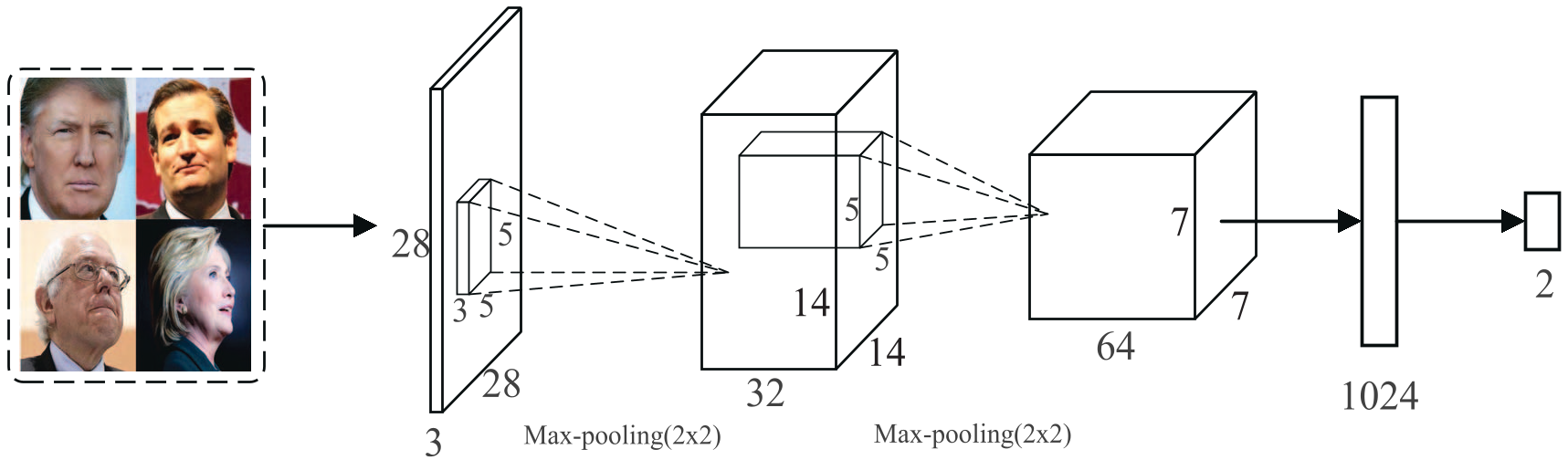 Figure 1: The CNN model architecture used for gender classification.
Experiments & Results: Did the "Woman Card" Work?
The study compared two windows: one week before the "woman card" speech (April 26, 2016) and one week after.
1. The Clinton Effect: Statistical Gains
For Hillary Clinton, the impact was clear and statistically significant. The percentage of women among her new followers rose by 1.6%, and more importantly, the percentage of women leaving her (unfollowers) dropped by 3.77%. This suggests the rhetoric acted as a powerful "retention" and "recruitment" tool for her base.
2. The Trump Effect: Stalemate
In contrast, Donald Trump’s gender composition was virtually unchanged. While he saw a minor 0.67% increase in female followers, the score test (p-value 0.1582) showed this was not statistically significant.
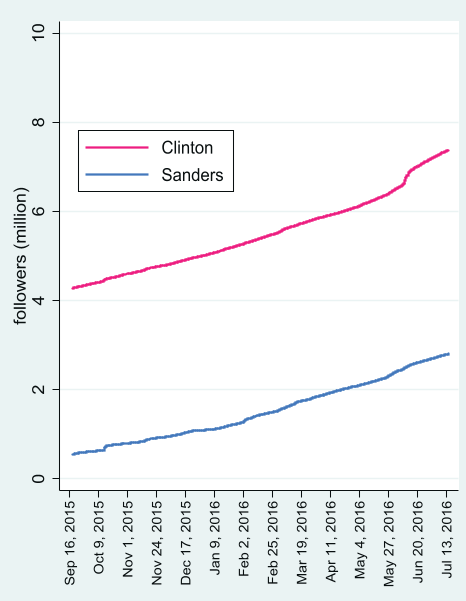 Figure 2: Overall Twitter follower growth for both candidates leading up to the general election.
3. Statistical Significance
The researchers used a Score Test (Z-statistic) to ensure the findings weren't just noise.
- Clinton New Followers: p = 0.0093 (Significant)
- Trump New Followers: p = 0.1582 (Not Significant)
Critical Insight: The Value of "Voting with Feet"
The most innovative aspect of this paper is the focus on unfollowers. While many studies look at follower growth, "voting with feet" (leaving a candidate) is a much stronger signal of dissatisfaction. The fact that the "woman card" speech significantly reduced female attrition for Clinton provides empirical evidence that her counter-punch ("Deal me in!") resonated deeply with her target demographic.
Limitations & Future Work
While successful, the study relies purely on profile images. A potential bias exists if certain genders are more or less likely to use a face as their profile picture. The authors acknowledge this and suggest that future work should integrate Natural Language Processing (NLP) to analyze usernames and tweet content alongside visual data for an even more robust demographic profile.
Conclusion
This research represents a successful bridge between Social Science and AI. It proves that gender politics isn't just a matter of opinion—it's measurable. In the "gender war" of 2016, the data shows that Hillary Clinton effectively turned Donald Trump's criticism into a mobilization victory.