
PRIGUARD: Beyond Access Control—Using Semantic Reasoning to Stop Social Media Privacy Leaks
PriGuard: A Semantic Approach to Detect Privacy Violations in Online Social Networks
This paper introduces PRIGUARD, a semantic-based framework that utilizes Description Logic (DL) and multi-agent commitments to detect complex privacy violations in Online Social Networks (OSNs). By leveraging an ontological reasoning engine and a depth-limited detection algorithm, it identifies both direct and indirect (inference-based) privacy breaches that traditional access control mechanisms fail to capture.
TL;DR
Access control lists (ACLs) are no longer enough to protect your privacy on social media. Privacy breaches today aren't just about "wrong settings"; they happen when your friends tag you, when photos contain geotags, or when your location is inferred by combining multiple posts. PRIGUARD is a sophisticated semantic framework that uses Description Logic and Agent-Based Modeling to detect these "indirect" violations that traditional systems miss.
The "Inference" Crisis in Modern Privacy
In a standard banking system, a friend cannot reveal your transaction history because the system is a closed silo. In an Online Social Network (OSN), the system is the interaction. Privacy violations are often exogenous (caused by others) and indirect (caused by inference).
The authors categorize violations into four types:
- Endogenous-Direct: You misconfigure your own settings.
- Exogenous-Direct: A friend tags you in a public photo against your wishes.
- Endogenous-Indirect: You post a "private" photo, but a hidden geotag reveals your location.
- Exogenous-Indirect: A friend posts their location while you're in their photo, revealing your location.
Traditional tools only solve Type 1. PRIGUARD aims to solve all four.
Methodology: Agents, Ontologies, and Commitments
PRIGUARD treats every user as a Software Agent. Instead of static "Allow/Deny" rules, it uses a Commitment-based model.
1. The Semantic Layer
The OSN is modeled using Description Logic (DL). This allows the system to move beyond simple labels and understand the meaning of connections (e.g., "Friend of a Friend" or "Colleague").
2. Norms and Datalog Rules
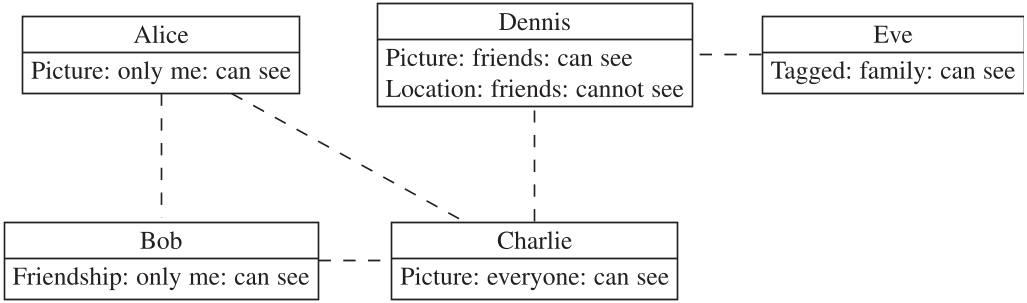
The system defines "Norms" using Datalog rules. For example, a norm might state: If a post contains a geotagged medium, it is a 'LocationPost'. If Alice is tagged in a photo by Bob, and Bob shares his location, Alice's location is also revealed.
3. The Commitment Engine
A commitment is a formal agreement represented as: In PRIGUARD, the OSN (debtor) promises the User (creditor) that if certain conditions are met (antecedent), a specific privacy outcome (consequent) will be guaranteed.
The Detection Algorithm: Depth-Limited Search
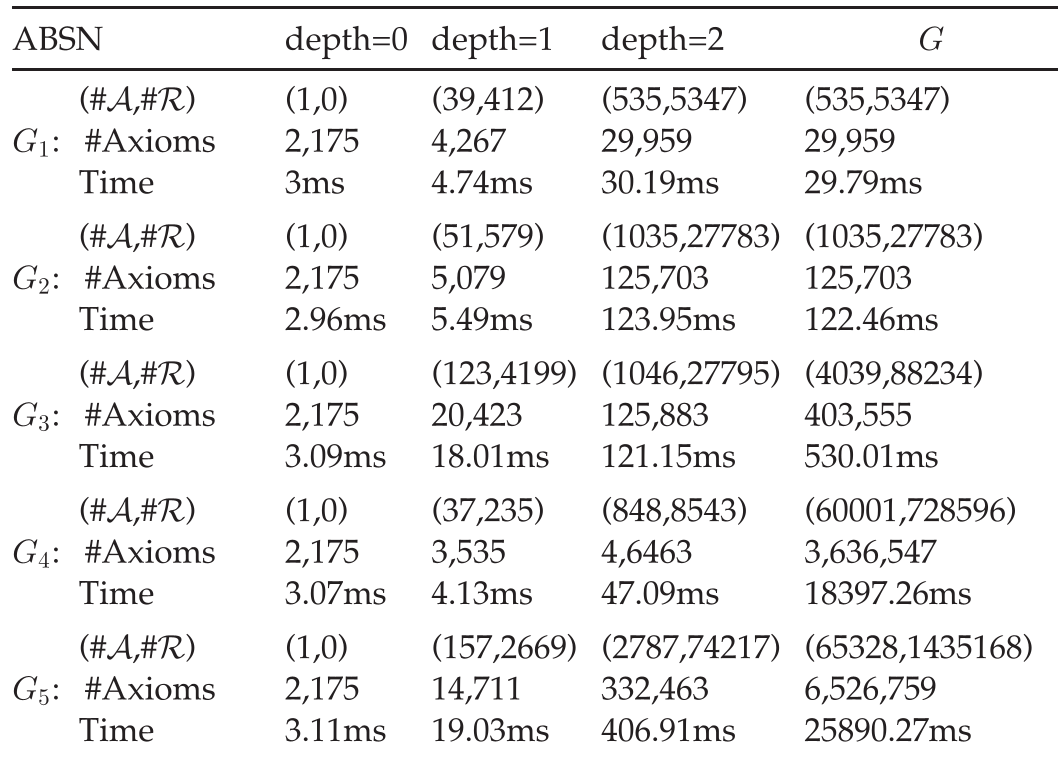
Checking for violations across a billion-user network is computationally impossible. PRIGUARD uses a Depth-Limited Detection Algorithm. It starts with a "Base View" (the user’s own data) and iteratively "broadens" the view to include friends (Depth 1), then friends-of-friends (Depth 2).
It transforms privacy requirements into SPARQL queries that run against the knowledge base to find "Violation Statements."
(Note: The architecture combines domain ontology, norms, and a reasoner to output privacy alerts).
Experimental Results
The authors tested PRIGUARD against real-world datasets from Facebook and Google+.
- Effectiveness: Unlike Facebook or other academic models (Hu et al., Carminati et al.), PRIGUARD was the only system capable of detecting Type IV (Exogenous-Indirect) violations where location is leaked via a friend's metadata.
- Performance: While reasoning is heavy, checking for violations at Depth 1 (the most critical layer) takes mere milliseconds. Even on large graphs with 65,000+ users, the time growth remains polynomial, suggesting it can be optimized for production environments.
Critical Insight & Future Outlook
The genius of PRIGUARD is its shift from Data Protection to Semantic Protection. It acknowledges that data itself isn't always private, but the conclusions drawn from it are.
Limitations: The system currently relies on "Defined Norms." If a new way to leak data emerges (e.g., AI-based face recognition identifying a user in the background of a blurry video), the human modeler must write a new rule for it.
Future Work: The authors suggest a "Proactive Agent" model where the system doesn't just detect violations but prevents them by suggesting users untag themselves or strip geotags before they even click "Post."
Conclusion
PRIGUARD proves that a logic-based approach to privacy is not only scientifically sound but practically necessary. As our digital shadows grow longer and more interconnected, we need agents that understand the context of our lives, not just the checkboxes of our settings.