
q0: Rethinking Pretraining as Population Exploration in the Data-Constrained Era
q0: Primitives for Hyper-Epoch Pretraining
The paper introduces Hyper-Epoch Pretraining (q0), a framework designed for the data-constrained regime where compute budget exceeds the supply of high-quality text. By shifting the objective from refining a single model to training and aggregating a diverse population of models, q0 achieves a lower validation loss than a single refined model. It matches a strong 256-epoch ensemble baseline with only ~56 epochs, demonstrating a 4.6x reduction in training time or up to 12.9x data efficiency under specific settings.
TL;DR
As we approach the limits of high-quality human-generated text, the industry is shifting from a "data-rich" to a "data-constrained" regime. Hyper-epoch Pretraining (q0) argues that instead of squeezing a single model for hundreds of epochs until it saturates, we should spend that compute to cultivate a population of diverse models and aggregate them. This method achieves up to 12.9x data efficiency and matches strong baselines in 4.6x less time.
The Data Wall: Why More Epochs Aren't Enough
For years, the recipe for SOTA performance was simple: Scale compute and data proportionally. However, we are running out of internet. When data is fixed and compute continues to grow, we default to "multi-epoch" training. The problem? Saturation. After 4-8 passes, a single model's validation loss flattens; it has "memorized" the corpus and no longer gains new capabilities.
The authors of q0 provide an elegant solution based on Solomonoff induction: Prediction should be viewed as an average over all computable explanations of data. If we can't get more data, we should generate more (and better) "explanations" (models) within our fixed compute budget.
The q0 Strategy: Three Primitives for Efficiency
The "Hyper-epoch" framework is built on three pillars that address the failures of naive ensembling.
1. Snapshot Ensembling via Cyclic Schedules
Training 100 models from scratch is impossible. q0 uses a cyclic Learning Rate (LR) schedule to "collect" snapshots along a few parallel trajectories.
- The Twist: They anti-correlate Weight Decay (WD) with LR.
- The Intuition: High LR/Low WD allows for broad exploration of the loss landscape, while Low LR/High WD forces the model to settle into a low-norm, high-quality basin just before a snapshot is taken.
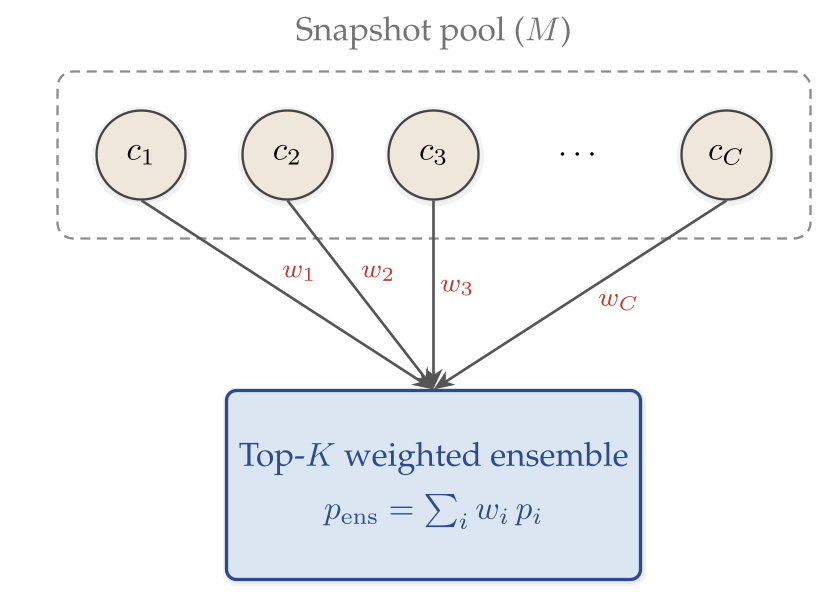 Figure: (a) Cyclic LR, (b) Chain Distillation, (c) Weighted Inference.
2. Chain Distillation: Compounding Quality
Usually, snapshots are just "points on a path." To make them better, q0 introduces Chain Distillation. Snapshot is trained not just on the data labels, but using Snapshot as a frozen teacher.
- This introduces "dark knowledge"—the inter-class similarities the previous snapshot already learned.
- It ensures that the population's individual quality actually improves over time, rather than just being a collection of mediocre variants.
3. The Learned Prior (Non-uniform Weighting)
Most ensembles use uniform averaging (1/K). q0 uses a Learned Generalization Prior—a small softmax-weighted layer optimized on a tiny held-out "fitness set."
- This prior identifies complementary models. It might give high weight to a model that has slightly higher loss but "knows" things the other models missed.
Experimental Results: Breaking the Efficiency Barrier
The results are striking. Tested on a 1.8B parameter model with FineWeb tokens:
- Speedup: q0 reaches the same loss as a massive 256-epoch baseline in just 56 epochs.
- Accuracy: On downstream benchmarks like PIQA and SciQ, q0 consistently outperforms independent run baselines.
- Allocation Scale: The authors discovered a "staircase" of optimality. Small budgets favor one trajectory with many cycles; large budgets favor more parallel trajectories.
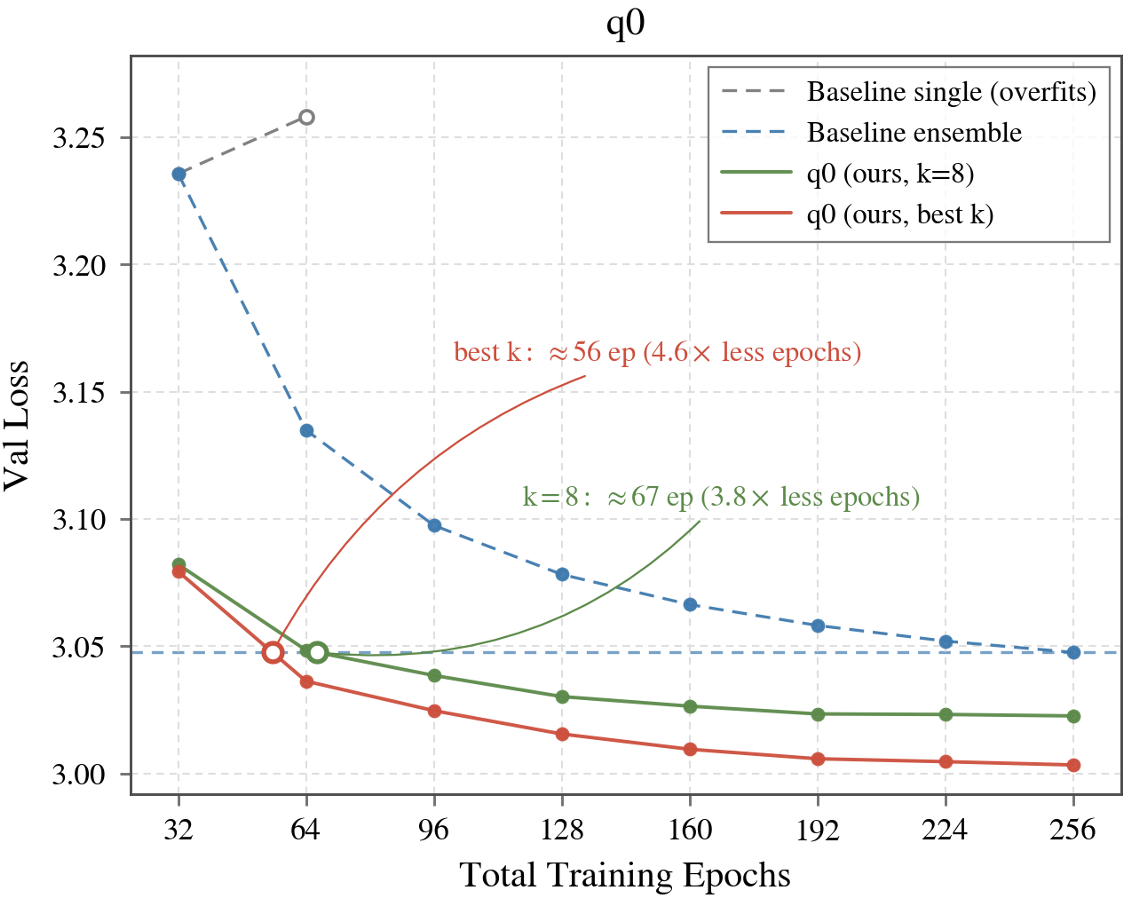 Figure: q0 vs. Baseline. The gap is most significant in the small-to-medium epoch regime.
Critical Analysis & Conclusion
The Good: q0 provides a rare, prescriptive recipe for the data-constrained regime. It moves away from the "brute force" single-model training and provides a mathematically grounded way to use extra compute.
The Limitations: The elephant in the room is Inference Overhead. An ensemble of 8 models requires 8x more compute during inference. While the authors suggest these can be distilled back into a single model (student), that step is not the focus of this paper.
Takeaway: q0 is a definitive signal that the "Scaling Laws" of the past are evolving. When data is the bottleneck, diversity is the solution. By using cyclic schedules and chain distillation, we can build ensembles that are far greater than the sum of their parts.