
Mining Common Sense: Using Web Text to Fix Computer Vision Blind Spots
Deriving a Priori Co-occurrence Probability Estimates for Object Recognition from Social Networks and Text Processing
This paper investigates the derivation of object/background co-occurrence probabilities from non-visual sources to aid object recognition. It introduces a method to extract these a priori semantic estimates from the Flickr social network and large-scale web text via the Exalead search engine, achieving a significant correlation between text-derived and image-derived statistics.
TL;DR
Can a computer "know" that a zebra shouldn't be on an ice floe, even if it looks like a polar bear? This paper demonstrates that we don't need millions of labeled photos to learn these rules. By mining co-occurrence statistics from general web text and social networks like Flickr, researchers can derive a priori probabilities that significantly prune errors in object recognition systems, bridging the gap between linguistic knowledge and visual perception.
The Motivation: Why Vision Systems Need "Contextual Logic"
Traditional image recognition relies heavily on visual signatures—pixels, edges, and textures. However, visual data is often ambiguous. A blurry lion might look like a rattlesnake to a Support Vector Machine (SVM).
Humans solve this using context. We know lions are found in savannas, not underwater. While researchers have attempted to code this context from annotated image datasets, these datasets (like COREL or CLIC) are tiny compared to the written word. The authors argue that if we can prove that word co-occurrence in text mirrors object co-occurrence in the physical world, we can unlock a virtually infinite source of "common sense" to guide AI vision.
Methodology: Mining the Web and Social Networks
The researchers compared two primary sources of data:
- Flickr (Social Context): Utilizing tags and descriptions provided by users for millions of photos.
- Exalead (Textual Context): A search engine used to query 8 billion web pages. They specifically used the
NEARoperator to find words appearing within 16 words of each other, assuming this proximity implies a semantic relationship.
The Mathematical Link
To compare these sources, the authors focused on the conditional probability . Since the total population of "the web" is hard to define, they utilized a function for rank correlation: This allowed them to see if the ranking of likely backgrounds for a "zebra" in text matched the ranking found in tagged images.
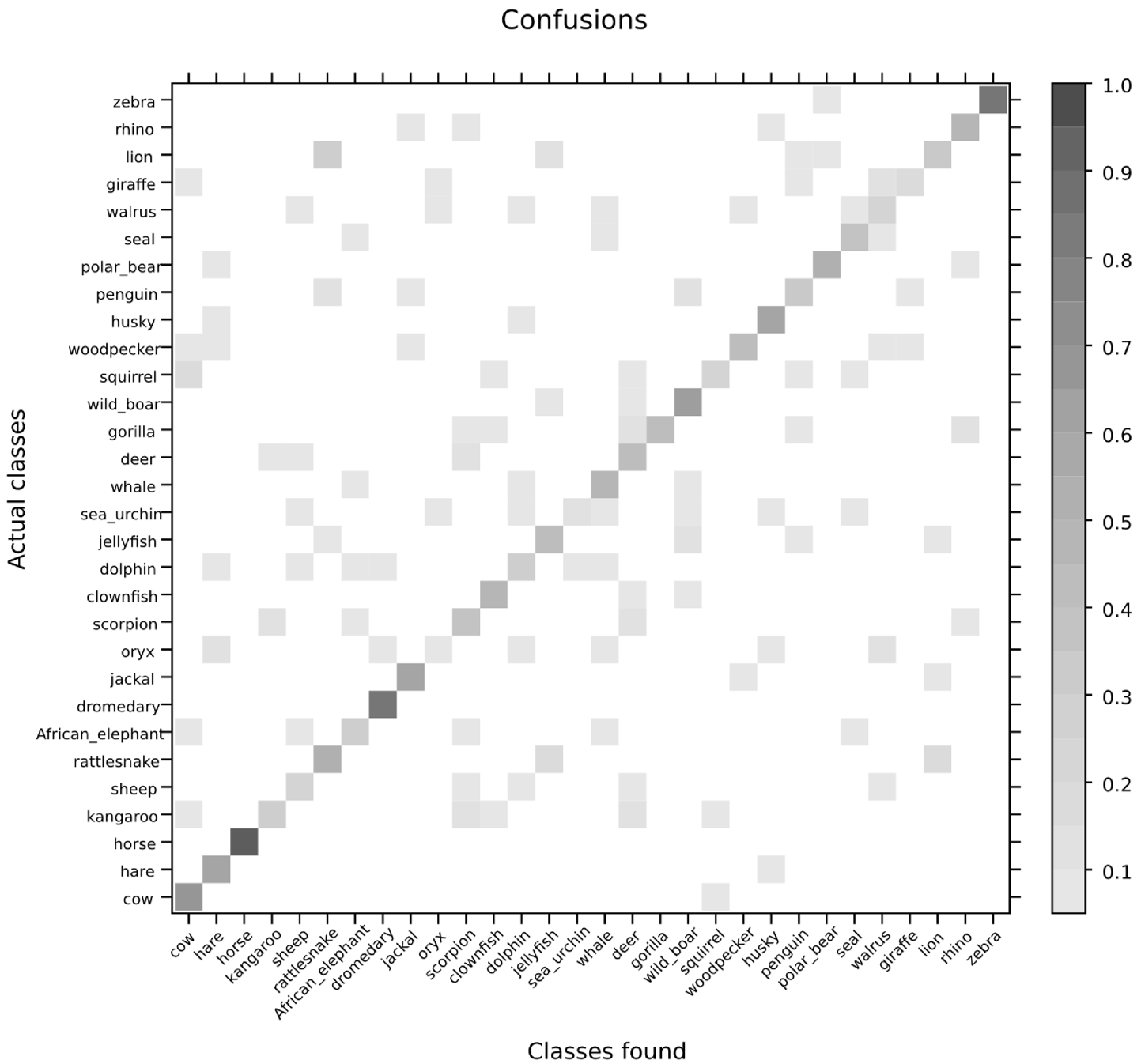 Fig 1: The confusion matrix of a standard animal identification system. Notice how "Zebra" is frequently confused with "Polar Bear"—a mistake contextual priors could easily fix.
Experimental Results: Text vs. Image Tags
The results showed a clear, statistically significant correlation between the two sources.
- Correlation: Rankings derived from Exalead's
NEARoperator and Flickr's tags were highly similar, especially for natural environments. - Error Reduction: In a controlled experiment, the authors used a hand-made background association table as a filter. They found that out of 101 common misclassifications (like a lion being identified as a penguin), 58% (59/101) could be rejected simply because the recognized animal didn't fit the identified background.
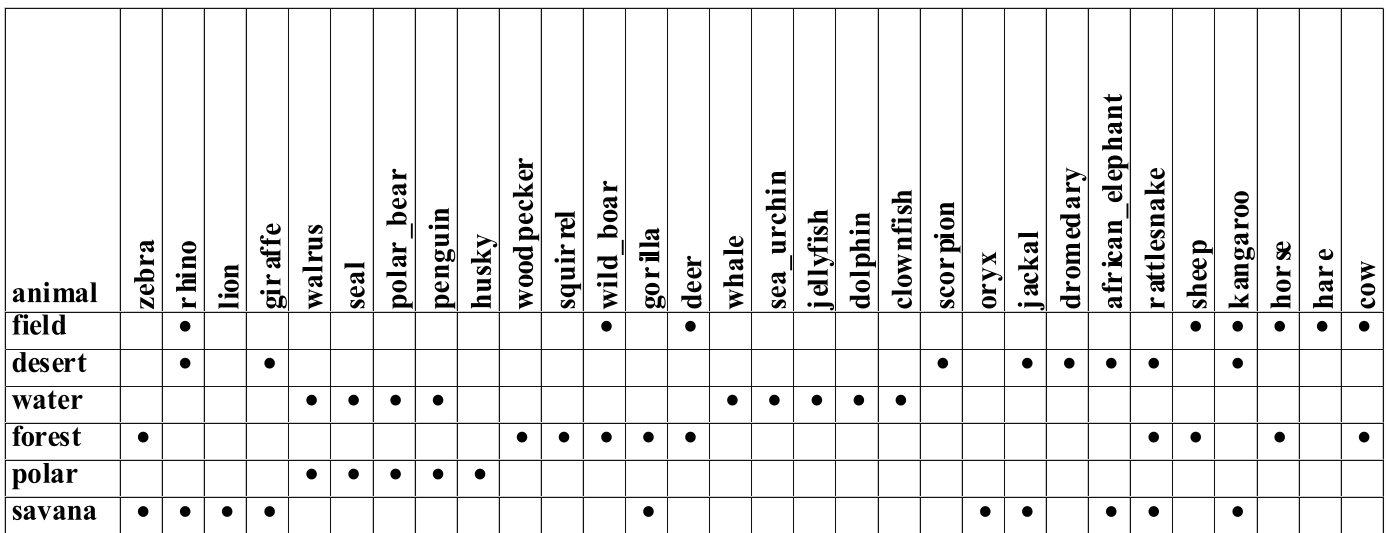 Table 1: The intuitive associations between animals and backgrounds used to filter out visual misidentifications.
Critical Insights & Future Outlook
The "Academic Breakthrough" here isn't just a slightly better accuracy score; it's the validation of text as a proxy for the physical world.
Strengths
- Scalability: Text is much cheaper to process than images.
- Coverage: While a dataset might not have photos of "a platypus in a river," the web certainly has text describing it.
Limitations
- Linguistic Bias: Some objects co-occur in text because of metaphors or news stories, not physical proximity (e.g., "the lion's share of the budget").
- The "Reporting Bias": People don't often write "The fork is on the table" because it's too obvious, whereas they might write about "A shark in a cage."
Conclusion
This work is a precursor to modern Multi-modal AI. It proves that a priori knowledge derived from language is a powerful tool for visual disambiguation. By treating object recognition not just as a pattern matching task, but as a logical inference task grounded in world knowledge, we can create AI that is not only "eyes-on" but also "brains-on."