
PAISP: Revolutionizing Proximity-Based Social Discovery with Priority-Aware Privacy
Priority-Aware Interests Similarity Protocol (PAISP) for Proximity Based Mobile Social Network
This paper introduces the Priority-Aware Interests Similarity Protocol (PAISP), a decentralized privacy-preserving matchmaking framework for proximity-based mobile social networks (PMSNs). By leveraging the additive homomorphic properties of the Paillier cryptosystem, PAISP allows users to compute profile similarity across three escalating privacy levels, achieving state-of-the-art results in balancing information disclosure with matching accuracy.
TL;DR
Socializing in the digital age often requires a trade-off: share your personal profile with strangers to find "matches," or stay private and stay lonely. PAISP (Priority-Aware Interests Similarity Protocol) shatters this dichotomy. It uses advanced homomorphic encryption to allow nearby users to find their "best match" based on shared interests and priorities without ever revealing the specific interests that don't match.
The "Music vs. Football" Dilemma: Why Prior Work Fails
Imagine Alice and Bob both like Football (Priority: 10/10) and Music (Priority: 1/10). Meanwhile, Alice and Edward both like Music (1/10). Traditional protocols might see Alice-Bob and Alice-Edward as equal matches because they both share one interest.
Current state-of-the-art (SOTA) work often calculates priority differences blindly. If Alice and Bob both rank an interest as "10," the difference is 0. If Alice and Edward both rank a different interest as "1," the difference is also 0. To the algorithm, these matches are identical. PAISP's core insight is that a match on a high-priority interest is fundamentally more valuable than a match on a low-priority one, and it provides a mechanism to distinguish them without sacrificing privacy.
Methodology: The Three Levels of Secrecy
PAISP leverages the Paillier Cryptosystem, an additive homomorphic encryption scheme. This allows a responder to perform mathematical operations on your data while it is still encrypted.
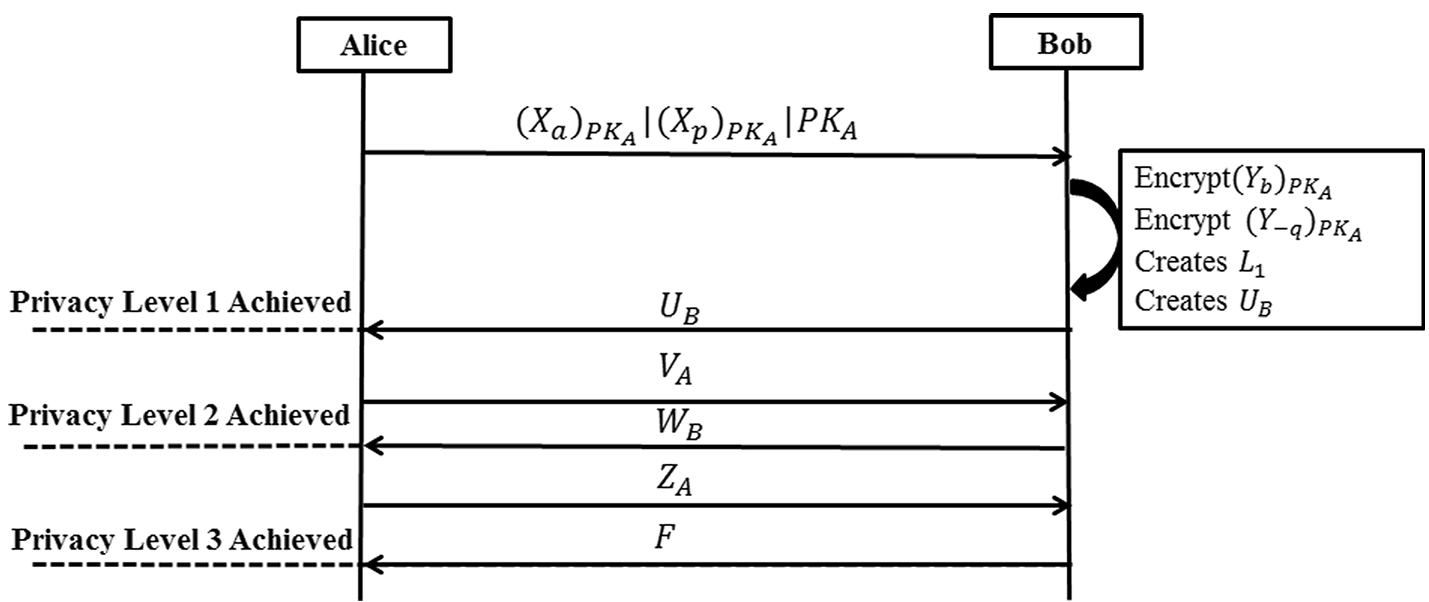
The protocol operates in three distinct phases:
- Level 1 (The Handshake): Determines the number of common interests. Bob shuffles the indices so Alice knows how many matches there are, but not which ones.
- Level 2 (The Refinement): Computes the difference in priorities for those matches. Alice learns that "one match has a priority difference of 0," but she still doesn't know which interest it refers to.
- Level 3 (The Discovery): Reveals Alice's own high-priority values for the perfect matches. This allows Alice to conclude, "Bob and I both love Football with maximum passion," without Bob ever learning Alice's other interests.
Performance: Efficiency Meets Security
One of the primary roadblocks for homomorphic encryption on mobile devices is the computational cost. PAISP optimizes this by ensuring that the complexity remains linear with the number of interests.
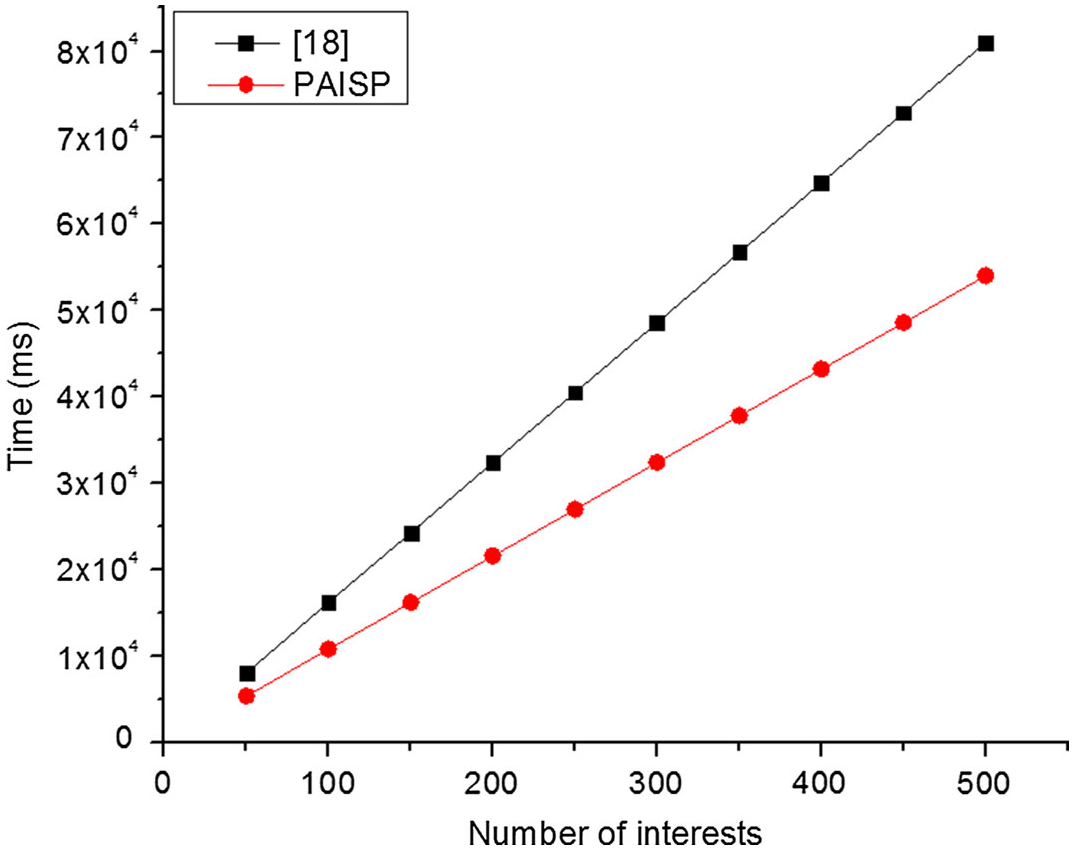
As shown in the experimental results, while competing protocols (like Zhang et al.) see costs skyrocket as priority levels become more granular, PAISP stays flat. For a user with 100 interests—more than enough for a comprehensive social profile—the entire process takes only seconds on a standard quad-core mobile processor.
Critical Analysis & Conclusion
PAISP is a significant leap forward because it moves away from the "all-or-nothing" approach to privacy. By allowing users to stop the protocol at any level (e.g., if the number of matches is too low), it provides User-Centric Privacy Control.
Limitations: While the protocol is resilient against "honest-but-curious" actors, it still faces challenges from malicious users who might "profile-stuff" (setting all interests to 1). The authors propose detection mechanisms for this, but the communication overhead of constant key generation for every session remains a factor to watch in extremely high-density environments.
Future Outlook: The logic behind PAISP—prioritizing matches within a secure intersection—goes beyond social networking. It could be applied to secure hiring platforms (matching skillsets) or privacy-preserving supply chain logistics.