
PBRA: Maximizing ROI in Targeted Social Advertising through Priority Ranking
A Priority-Based Ranking Approach for Maximizing the Earned Benefit in an Incentivized Social Network
The paper proposes the Priority-Based Ranking Algorithm (PBRA) for a targeted variant of the Social Influence Maximization (SIM) problem. It focuses on maximizing "earned benefit" from specific target nodes under a fixed budget where each node has a unique selection cost.
Executive Summary
TL;DR: This paper tackles the "Incentivized Targeted Social Influence" problem. By developing a Priority-Based Ranking Algorithm (PBRA), the authors provide a method to select the most cost-effective "seed" users who can maximize the conversion (benefit) of specific target customers within a strict budget.
Background: Within the academic coordinate system, this work moves beyond traditional Influence Maximization (IM)—which treats all nodes as equal—to a more pragmatic Earned Benefit Maximization framework, accounting for both heterogeneous costs and targeted outcomes.
Problem & Motivation: The Reality of Incentivized Networks
Most classic Social Influence Maximization (SIM) models suffer from two idealistic assumptions:
- Uniform Cost: They assume every influencer costs the same to recruit.
- Uniform Value: They assume influencing a random user is as valuable as influencing a high-intent target user.
In reality, influencers have different "incentive demands" (costs), and brands care about "target nodes" (potential buyers). The challenge is finding the optimal seed set that stays under budget while maximizing the expected sum of benefits from influenced target nodes.
Methodology: The PBRA Framework
The core insight of the paper is the localized effect of influence. Influence rarely spreads effectively beyond 2 or 3 hops. Based on this, the authors define "Effective Nodes" and rank them using a proprietary Priority Function.
1. The Priority Function
The algorithm evaluates nodes based on a multi-objective formula:
- Low Indegree (): Nodes that aren't easily influenced by others are better candidates for being "seeds."
- Effective Outdegree (): Prefers nodes with direct connections to target users.
- Cost-Benefit Ratio (): Prioritizes nodes that offer the highest expected benefit relative to their incentive cost.
2. Algorithm Architecture
The workflow follows three distinct phases:
- Effective Node Marking: Identifying all nodes within hops of the target set.
- Priority Ranking: Calculating the score for each candidate.
- Spread-Aware Selection: Picking seeds while ensuring that once a node is picked, its neighbors are deprioritized to prevent "influence overlap."
 Figure 1: The mathematical definition of the Priority Function used for ranking.
Experiments & Results
The authors tested PBRA on two distinct graphs: Facebook (dense social interaction) and HEP Collaboration (sparse academic co-authorship).
SOTA Comparison
Compared to baseline heuristics (Random, Max Degree, Max Clustering) and specialized algorithms (MIA, PMIA), PBRA showed significant gains:
- Facebook Dataset: Achieved up to 14.5% more benefit in trivalency settings.
- HEP Collaboration Dataset: Achieved a massive 118% improvement over PMIA in specific settings.
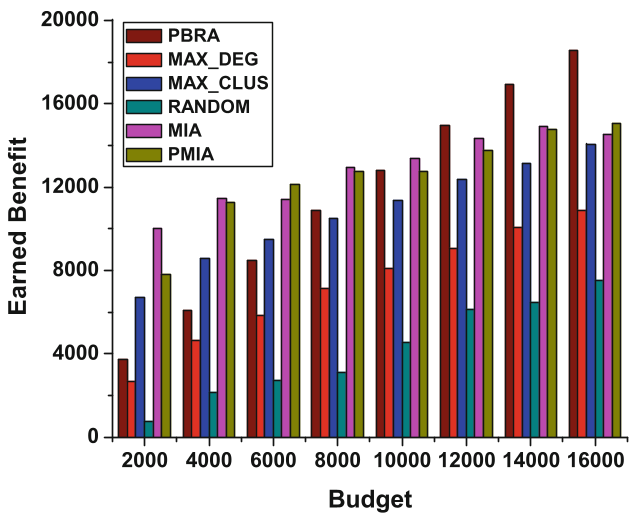 Figure 2: Budget vs. Earned Benefit on the Facebook Dataset, showing PBRA's consistent lead.
Critical Analysis & Conclusion
Takeaway
The PBRA provides a computationally efficient () approach to a complex combinatorial problem. Its strength lies in its Heuristic Intuition—it prioritizes localized influence and independence (low indegree), which are often overlooked in global centrality measures.
Limitations & Future Work
- Static Nature: The model assumes the social graph is static. Future iterations should address Time-Varying Networks where links appear and disappear.
- Hop Limitation: While is practical, the algorithm's performance in "small-world" networks with very high clustering might require more sophisticated overlap management.
Overall, this work is a vital step toward making Social Influence Maximization algorithms applicable to real-world E-commerce and digital marketing budgets.