
PRG-SFR: Revolutionizing Reliable Multi-Path Communication in Mobile Social Networks via Priority Relation Graphs
On exploiting priority relation graph for reliable multi-path communication in mobile social networks
This paper introduces the Priority Relation Graph-Based Social Feature Routing (PRG-SFR) algorithm for Mobile Social Networks (MSNs). It leverages a new topology called the Priority Relation Graph (PRG), structured as an (n, k)-hypercube, to establish reliable, node-disjoint multi-path communication based on the similarity of social features between users.
TL;DR
Mobile Social Networks (MSNs) often struggle with message reliability due to the intermittent nature of human movement. This paper proposes PRG-SFR, a routing algorithm that treats social similarities as a structured graph (Priority Relation Graph). By allowing connections between users who share "most" but not necessarily "all" key features, it creates a robust multi-path highway that increases fault tolerance and slashes transmission latency compared to standard hypercube methods.
The "History Requirement" Bottleneck
Modern MSN routing usually falls into two traps:
- History Dependence: Methods that require months of contact logs to predict future encounters, making them useless for new or dynamic networks.
- Rigid Feature Matching: Methods like the standard Hypercube-based routing (HSFR) restrict data movement to users who differ by only ONE social feature at a time.
The authors argue that human behavior is more flexible. If you are a "Computer Science Teacher," you are likely to encounter a "Math Student" almost as frequently as a "Math Teacher." This "priority relationship" is the key to unlocking better routing efficiency.
Methodology: The (n, k)-Hypercube Advantage
The core innovation is the Priority Relation Graph (PRG). While a standard hypercube only connects nodes with a Hamming distance of 1, the PRG connects nodes if their feature distance is .
1. Structural Insight
By defining the network as an -hypercube, the authors mathematically prove two critical advantages:
- Reduced Diameter: The "distance" across the network shrinks from to .
- Higher Degree: Each node has more potential "neighbors" to forward data to, creating a massive increase in redundant paths.
2. The PRG-SFR Algorithm
The algorithm works by segmenting the difference between a source and a destination into chunks of size . Instead of flipping one feature at a time, the data "jumps" through the PRG by resolving feature differences in a single hop.
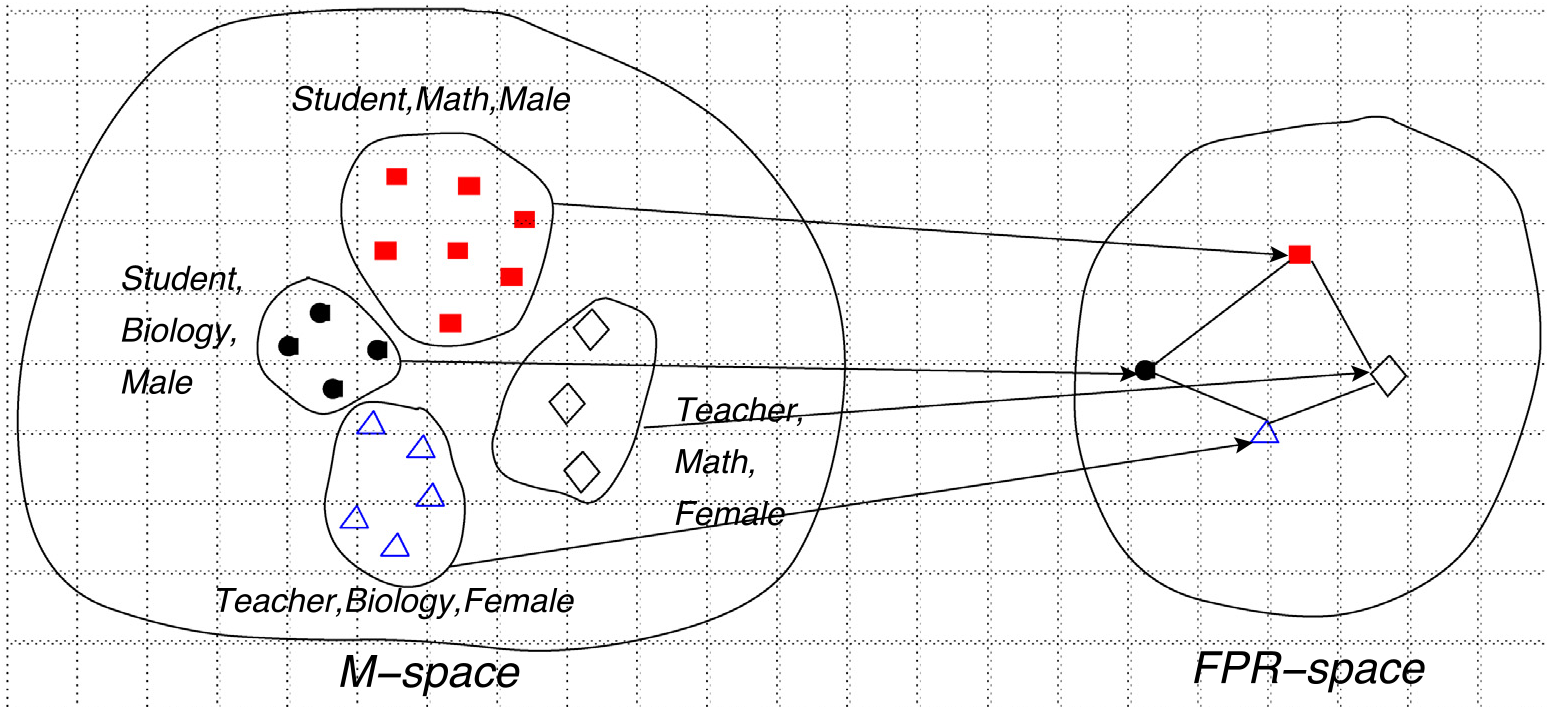 Figure: The mapping from physical social groups to the Priority Relation Graph space.
Battle-Tested: Theoretical & Numerical Results
The researchers compared PRG-SFR against the HSFR baseline across four dimensions:
- Fault Tolerance: PRG-SFR identifies significantly more node-disjoint paths ( vs ), meaning the network remains functional even if a large percentage of nodes fail or move away.
- Forwarding Efficiency: Because each step resolves more feature "gaps," the average number of hops (Forwarding Number) is consistently lower.
- Latency & Delivery: Numerical simulations in Matlab showed that as the "similarity threshold" increases, the delivery rate climbs while transmission time drops exponentially.
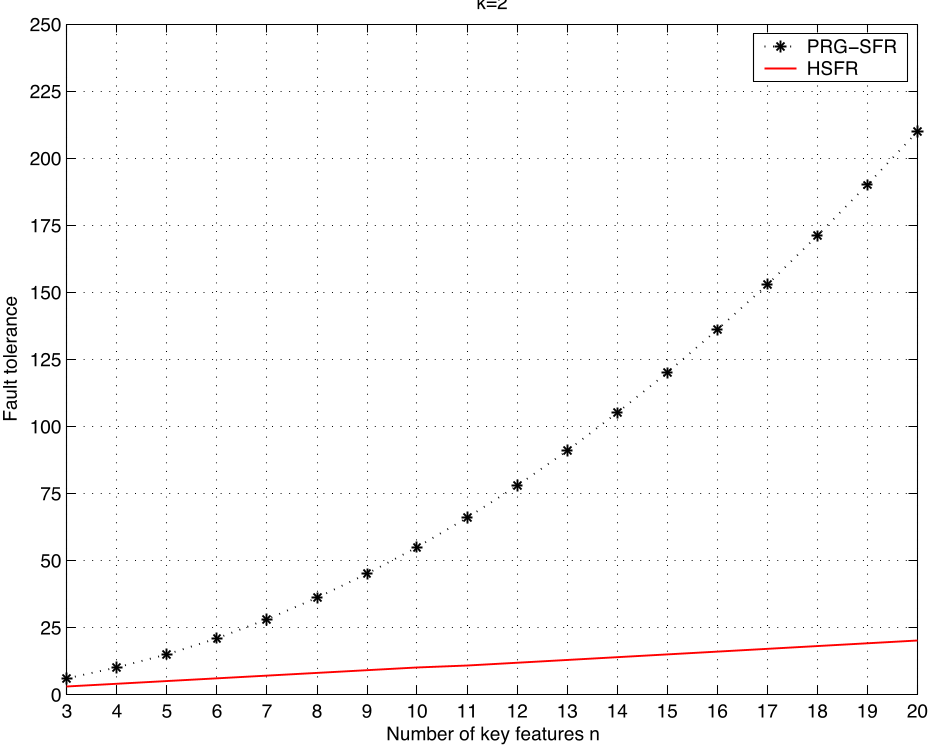 Figure: PRG-SFR shows a much steeper growth in fault tolerance compared to the linear growth of traditional HSFR.
Critical Insight: Beyond Simple Routing
The value of this paper lies in its system-level abstraction. By turning social features into a formal topological structure (the PRG), the authors provide a framework that isn't just about routing—it's about network resilience.
However, there is a catch: the paper assumes that all "key features" are independent. In real-world social circles, "Profession" and "Identity" are often highly correlated (e.g., a "Professor" is rarely a "Student"). Future iterations would need to account for these feature correlations to refine the PRG's edges.
Conclusion & Future Outlook
PRG-SFR proves that "social similarity" is a powerful routing metric when mathematically structured. The authors suggest that this graph-based approach can be extended to Anonymity Transmission (using disjoint paths to hide data trails) and Malicious Node Detection (using the PRG's regular structure to identify outliers). For builders of decentralized apps or delay-tolerant networks, the (n, k)-hypercube offers a blueprint for reliability in an unpredictable mobile world.